
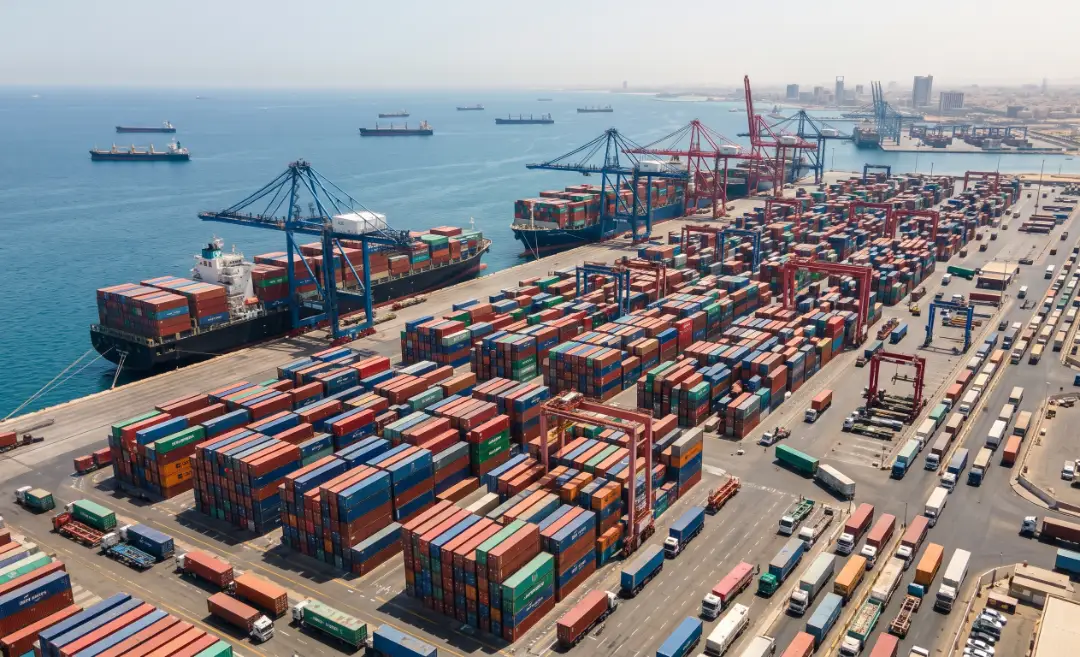
The gradual normalization of Red Sea shipping routes is producing an unintended consequence: congestion at the very ports that were supposed to benefit from the return of direct services. Jeddah Islamic Port, Saudi Arabia's primary Red Sea gateway, has become the focal point of this paradox, absorbing a disproportionate share of the new direct services launched by carriers seeking to capitalize on shorter transit times through the Suez Canal . The concentration of cargo at Jeddah is not a function of weak infrastructure investment—DP World has poured resources into its South Container Terminal—but rather a reflection of how quickly volume can outpace even upgraded capacity when multiple services converge on the same gateway simultaneously.
DP World's South Container Terminal at Jeddah handled more than 221,200 TEUs in July 2026, the highest monthly throughput recorded since the operator began managing the facility in 1999 . The July figure surpassed volumes recorded before the Red Sea shipping disruptions began in late 2023, marking a symbolic recovery milestone. First-half volumes surged nearly 79% year-on-year, with growth recorded across imports, exports, and transshipment, and 390 vessel calls during the six-month period . Export volumes alone reached a monthly record of 79,720 TEUs in July, underscoring the scale of the recovery in Saudi Arabia's western trade corridor.
The operational reality behind these headline numbers is less reassuring. Freight forwarder Expeditors reported in its September market update that Jeddah was experiencing congestion, with landside transportation delays of 10 to 12 days after container discharge . This means cargo sits idle for nearly two weeks before it even begins its inland journey—a delay that erodes much of the transit time advantage gained by routing through Suez rather than around the Cape of Good Hope. For shippers moving time-sensitive goods, the net benefit of the shorter sea voyage is being partially consumed by port-side bottlenecks.
The congestion has been exacerbated by the specific structure of the new services entering the market. Evergreen's OGRD service, which restores direct Far East–Red Sea connections, deploys vessels of 7,024 to 9,466 TEUs on a rotation calling at Jeddah, Sokhna, and Aqaba, with the first sailing departing Qingdao on 14 November . Emirates Shipping Line has launched a fortnightly Central/South China–Red Sea service using three vessels of 2,500 to 4,900 TEUs, calling at the identical trio of ports from Shanghai, Ningbo, and Nansha, with its inaugural sailing on 13 November . The overlapping port choices mean that rather than spreading cargo across a broader range of Red Sea gateways, these services are funneling additional volume into the same terminals.
The concentration effect is not limited to Jeddah. Ports that receive fewer direct calls risk losing traffic and terminal utilization as shipping lines consolidate their networks around selected hubs . This divergence creates a two-tier system within the Red Sea port landscape: a handful of gateways absorbing the bulk of new direct services and the congestion that accompanies them, while others face underutilization. For Saudi Arabia, which has invested heavily in Jeddah's capacity, the challenge is managing the surge without allowing delays to undermine the port's competitiveness against alternatives like King Abdullah Port or the UAE's Khor Fakkan.
DP World has responded to the volume growth with equipment investments. The terminal has added three quay cranes, bringing its fleet to 17, along with 17 automated electric rubber-tyred gantry cranes and 35 electric terminal tractors . Further expansion is underway to increase annual capacity to 5 million TEUs. These investments signal confidence in Jeddah's long-term role as a Red Sea hub, but they also highlight the lag between demand arrival and capacity activation. Equipment ordered and infrastructure built today will not alleviate delays in the current quarter.
Looking ahead, the congestion risk at Jeddah is likely to intensify before it eases. Flexport's November market update forecast that arriving vessel capacity at European ports would reach 131% of normal levels in Week 47, with roughly 40% arriving via Suez—a threshold the forwarder treats as a congestion risk . While that forecast focuses on European gateways, the underlying dynamic applies equally to Jeddah: the return of Suez routings is compressing arrival windows, and ports at both ends of the corridor are absorbing clustered vessel calls that would previously have been spread out by the longer Cape route. For shippers planning December and January inventory, the practical implication is clear: the Red Sea route is shorter on water but may not be faster end-to-end until port-side operations stabilize.