
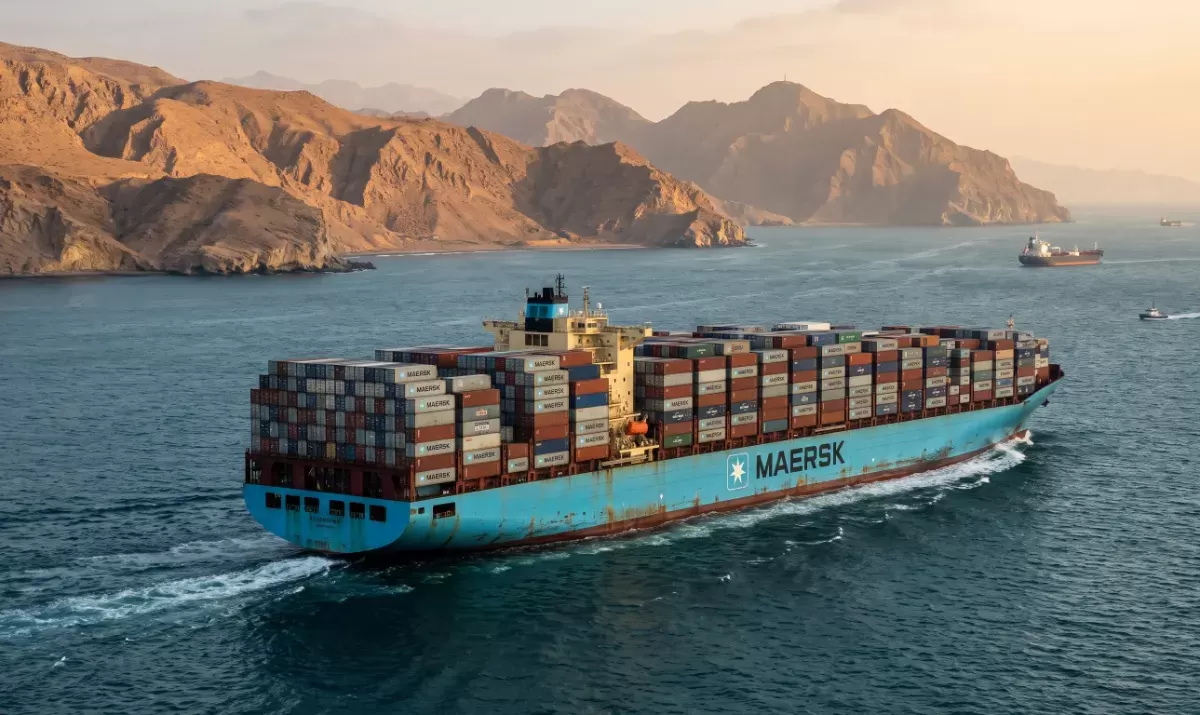
Maersk has introduced a two-tier emergency pricing structure for cargo moving through the Persian Gulf and the Strait of Hormuz, reflecting the escalating security and operational risks that have disrupted commercial shipping in the region throughout 2026. The Emergency Freight Rate applies to cargo loaded from or destined for Iraq, Kuwait, Saudi Arabia (specifically Dammam and Jubail), Bahrain, Qatar, the United Arab Emirates, and Oman, with Salalah excluded from the scope . The rate is structured by container type: USD 1,800 for a 20-foot dry container, USD 3,000 for a 40-foot dry container, and USD 3,800 for reefers, special cargo, and dangerous goods containers .
On top of the emergency freight rate, Maersk has imposed an additional USD 1,000 per container surcharge on any vessel transiting the Strait of Hormuz . This separate fee is explicitly intended to cover the elevated insurance premiums and crew risk compensation associated with sending vessels through the contested waterway. For a shipment subject to both charges, the total additional cost could reach as high as USD 4,800 per container, a figure that materially alters the landed cost calculus for importers and exporters across the Gulf region .
The carrier has been transparent about the rationale behind these charges. Maersk stated that the emergency freight rate is necessary to cover the additional costs incurred from using alternative routings and temporary storage, as well as the charter of additional transport assets and the eventual movement of cargo from temporary storage locations to final destinations once safe passage can be arranged . The USD 1,000 Hormuz transit fee, by contrast, is specifically tied to the risk premium of operating in the strait itself—insurance costs that have risen sharply as attacks on commercial vessels have persisted .
The surcharges are not merely a pricing mechanism; they are accompanied by significant operational restructuring. Maersk has redirected cargo booked for Kuwait, Iraq, Qatar, Bahrain, and the UAE away from the traditional Jeddah transshipment hub. Instead, these shipments now transit via Salalah in Oman and Khor Fakkan in the UAE, then move by landbridge to Sharjah before connecting to Maersk's intra-Gulf feeder network . Cargo destined for Jeddah where the consignee is based outside Saudi Arabia is no longer discharged at Jeddah, but routed to the consignee's country via Khor Fakkan .
This rerouting carries its own costs and complications, which the emergency surcharge is designed to offset. The landbridge from Salalah and Khor Fakkan to Sharjah involves additional road transport, customs procedures, and handling at multiple touchpoints. Maersk has acknowledged that these alternative arrangements may lead to longer transit times and additional logistics costs beyond the published surcharges, including inland carriage, handling charges, customs clearance, and storage . The carrier has advised customers to verify capacity availability and confirm customs and border procedures before committing to alternative routings.
The booking restrictions that accompany these measures further constrain shipper options. Maersk has maintained suspensions on dry cargo bookings to and from the UAE, with limited exceptions for Khor Fakkan and Jebel Ali, and has suspended dry cargo bookings to and from Iraq and the Saudi ports of Dammam and Jubail . Reefers, dangerous goods, and out-of-gauge cargo face even stricter restrictions. For essential commodities such as foodstuffs, pharmaceuticals, and other perishables, Maersk has indicated it will give special attention, but the overall capacity available for Gulf-bound cargo has contracted significantly.
From a market perspective, Maersk's surcharges represent the institutionalization of risk pricing for Hormuz transits. What began as temporary emergency measures in mid-2026 has become a sustained pricing structure as the security situation has failed to stabilize. Other carriers have followed suit, with Ocean Network Express having earlier implemented its own Emergency Surcharge for Gulf cargo . The cumulative effect is a substantial increase in the cost of moving goods into and out of the Gulf, with those costs ultimately passed through to consumers in importing nations.
The timing of these measures—remaining in force as of November 2026—suggests that Maersk does not anticipate a near-term normalization of Strait of Hormuz transits. The carrier has stated that the emergency rates may be adjusted as the situation evolves, but the operational infrastructure it has built around Salalah, Khor Fakkan, and the landbridge to Sharjah indicates a longer-term commitment to alternative routing . For shippers dependent on Gulf markets, the new pricing reality requires a fundamental recalibration of logistics budgets and supply chain planning, with the Strait of Hormuz risk premium now embedded as a structural cost rather than a temporary disruption.