
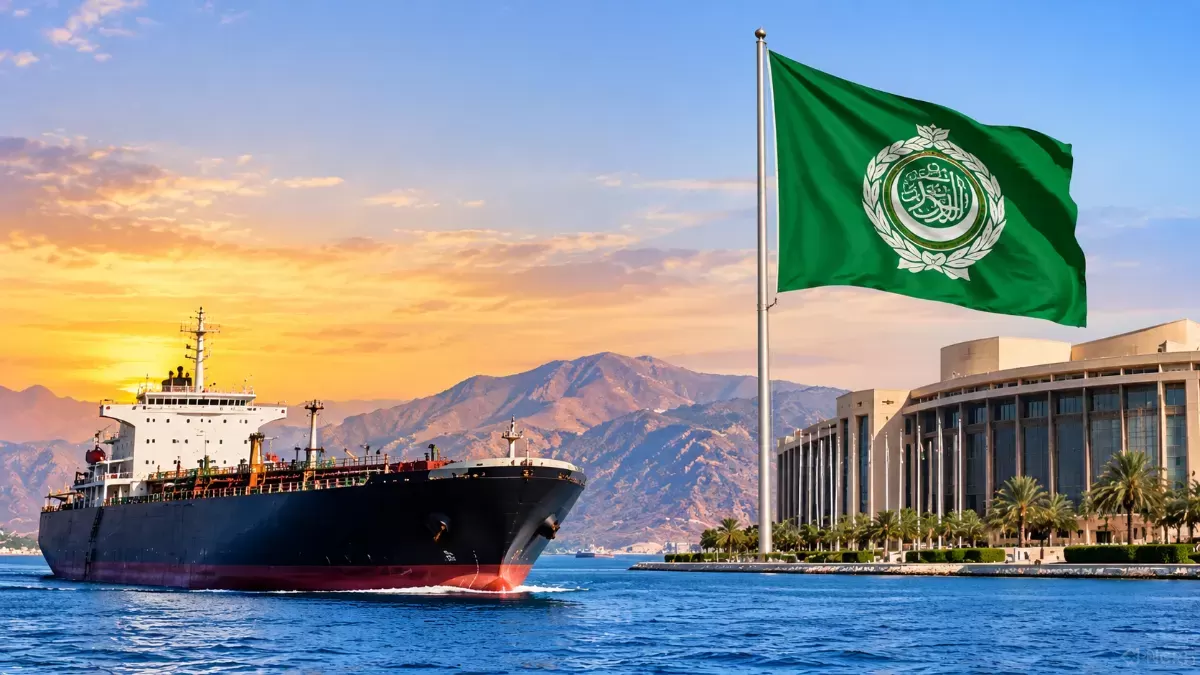
Arab League Secretary-General Nabil Fahmy has issued a strong condemnation of the attack on an ADNOC Logistics & Services vessel as it transited the Strait of Hormuz, framing the incident within a broader pattern of escalating threats to maritime security in the Gulf region . The statement, released by the Arab League on Wednesday, expressed "deep concern about ongoing threats to freedom of navigation in the region's waterways" and underscored the importance of safeguarding maritime corridors that serve both regional and international interests . The condemnation comes as commercial shipping in the Strait of Hormuz faces sustained security risks, with multiple vessels targeted in recent weeks.
The Arab League's statement did not limit itself to the ADNOC vessel incident. Fahmy also condemned Iranian attacks on Kuwait and Bahrain, characterizing them as "a flagrant violation of both countries' sovereignty and territorial integrity" and "an unacceptable assault on their security and stability" . The Secretary-General emphasized that the security, sovereignty, and territorial integrity of Kuwait and Bahrain are "an integral part of Arab national security," and that any attack on either country poses a direct threat to the security and stability of the entire region . This linkage elevates the maritime security issue from a narrow shipping concern to a matter of collective Arab security.
Fahmy's language was notably firm in describing the trajectory of recent attacks. He stated that "the growing frequency and scope of Iranian attacks on Arab countries indicated a continuing pattern of escalation that risked widening the confrontation" . He warned that these attacks "could have serious political and security repercussions beyond the targeted countries, affecting regional and international security and undermining the foundations of security and stability" . The explicit reference to "Iranian attacks" marks a direct attribution that goes further than ADNOC L&S's own carefully worded statement on the vessel incident, which avoided naming any party.
The Arab League's call to action was directed at the international community, specifically the United Nations Security Council. Fahmy "urged the UN Security Council to fulfil its responsibilities and act urgently to ensure the full implementation of its resolutions, particularly Resolution 2817 (2026)" . Resolution 2817 appears to be the operative international legal framework addressing the current security situation in the Gulf. The Arab League's invocation of this resolution signals that it views the Security Council as the appropriate venue for enforcement, rather than bilateral or regional mechanisms alone.
The statement also emphasized Arab solidarity with the United Arab Emirates, the flag state of the targeted ADNOC vessel. Fahmy "reaffirmed his full solidarity with both countries and stressed the importance of safeguarding maritime security and protecting regional and international interests, including those of the UAE" . This explicit mention of UAE interests reflects the Arab League's position that attacks on commercial shipping transcend the immediate victim and implicate the collective economic and security interests of Arab states. For ADNOC L&S, the Arab League's endorsement provides diplomatic backing as the company continues search and rescue operations for its missing crew member.
From a logistics and trade perspective, the Arab League's intervention underscores the gravity with which regional bodies view disruptions to Strait of Hormuz shipping. The strait is the world's most important oil chokepoint, with daily flows of crude, refined products, and LNG that underpin energy security for Asia, Europe, and the Americas. The Arab League's framing of maritime security as inseparable from regional stability effectively links the commercial interests of ship operators to the geopolitical posture of Arab states, potentially raising the political cost of continued attacks.
The timing of the statement is significant, coming as the search for the missing ADNOC L&S crew member continues and as insurers and ship operators reassess risk premiums for Hormuz transits. The Arab League's condemnation adds multilateral weight to the diplomatic pressure on actors responsible for the attacks, though it remains to be seen whether the Security Council will respond with the urgency Fahmy demanded. For shipping companies operating in the region, the statement offers rhetorical support but does not alter the immediate operational reality: the Strait of Hormuz remains a high-risk transit corridor, and the threat of further attacks has not been neutralized.