
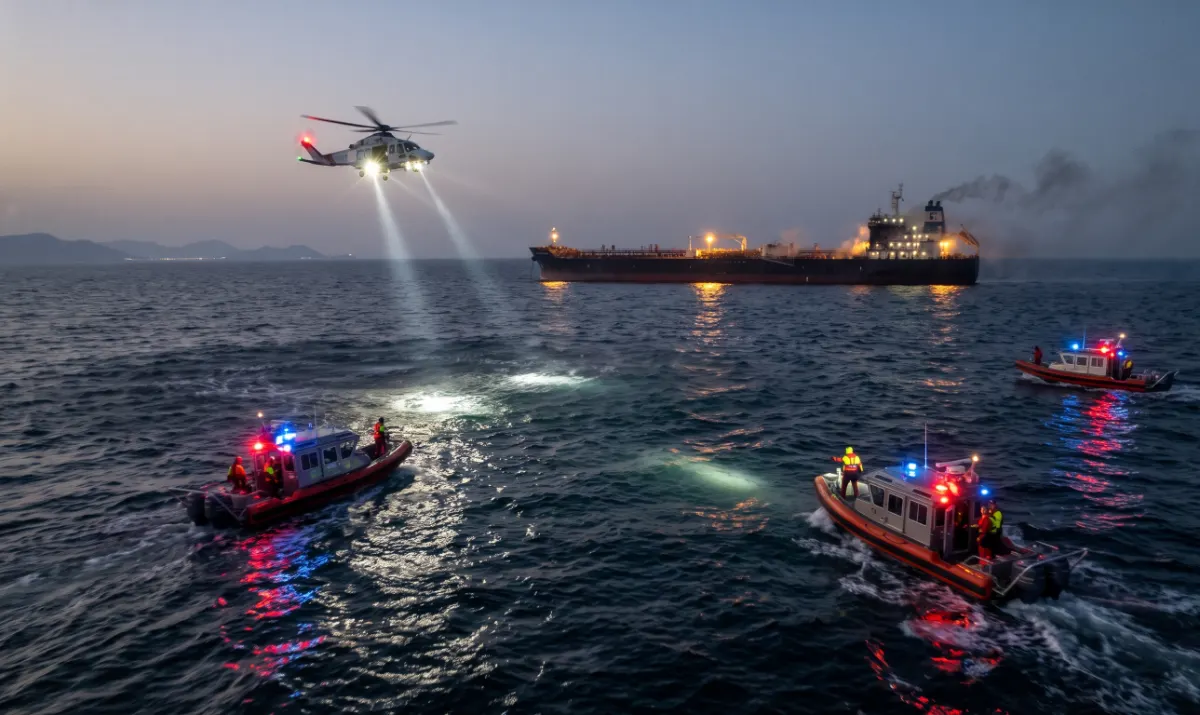
ADNOC Logistics & Services (ADNOC L&S), the maritime logistics arm of Abu Dhabi National Oil Company, has confirmed that one of its vessels came under attack while transiting the Strait of Hormuz on the evening of 17 November 2026 . The company disclosed that eleven crew members sustained injuries and one crew member remains unaccounted for, with search and rescue operations continuing in coordination with relevant authorities . All other crew members were safely evacuated from the vessel, and those requiring medical attention are receiving care . The company did not disclose the name or type of the vessel in its official statement.
The attack represents an escalation in the already volatile security environment of the Strait of Hormuz, a chokepoint through which approximately one-fifth of global oil and gas supplies transit in peacetime . UK Maritime Trade Operations (UKMTO) has documented a sustained campaign of projectile attacks on commercial shipping in the strait throughout October and November 2026, targeting tankers, container ships, and LPG carriers . The pattern suggests a systematic threat rather than isolated incidents, with multiple vessels struck by "unknown projectiles" while conducting both inbound and outbound transits.
ADNOC L&S issued a carefully worded statement that avoided attributing responsibility for the attack while emphasizing broader principles. "Our immediate priority is supporting the search and rescue effort, our crew and those affected," the company said . It further "reiterates the importance of protecting seafarers and safeguarding freedom of navigation and maritime security" . The statement also urged the public to rely solely on official sources and avoid circulating rumors or unverified information, reflecting the heightened sensitivity surrounding maritime security incidents in the region.
The timing of the attack is significant. It follows a series of reported threats and attacks on commercial vessels in and near the Strait of Hormuz over recent weeks, with Iran frequently blamed by ship operators for mines and projectile strikes . A memorandum of understanding signed between Washington and Tehran on 18 June had raised hopes for de-escalation, but implementation has stalled amid disagreements about freedom of navigation in the strait . The continued attacks suggest that diplomatic efforts have yet to translate into tangible security improvements for commercial shipping.
For ADNOC L&S specifically, this is not the first security incident. The company reported damage to one of its vessels in an attack in UAE territorial waters just the previous week . The recurrence underscores the vulnerability of energy-sector logistics operators in the region, even those backed by substantial state resources and operating under the UAE flag. For a company that provides shipping, integrated logistics, and marine services to the energy industry with over 100 global clients, each incident carries reputational as well as operational implications .
The humanitarian dimension of the attack has drawn attention to the risks faced by seafarers. The missing crew member and eleven injured personnel are the immediate human cost of the security failure. ADNOC L&S's emphasis on protecting seafarers reflects a broader concern within the maritime industry that crew safety is being compromised by geopolitical tensions beyond their control. Industry associations and flag states have repeatedly called for enhanced protection measures, but the operational reality in the strait remains dangerous for commercial mariners.
From a logistics and trade perspective, the sustained attacks in the Strait of Hormuz pose risks to global energy supply chains. The strait remains a critical artery for crude oil, refined products, and liquefied natural gas from Gulf producers. While no complete blockade has been imposed, the threat environment has forced vessel operators to reassess routing, insurance costs, and crew risk premiums. These additional costs ultimately feed through to freight rates and, by extension, to consumers in importing nations across Asia, Europe, and the Americas.
The international response to the ADNOC L&S attack will be closely watched. The company's measured statement, avoiding direct accusations, may reflect diplomatic sensitivities, but it also places the onus on regional and global powers to address the security vacuum. Whether this incident catalyses stronger multilateral action on maritime security in the Gulf, or becomes another data point in an deteriorating trend, will depend on whether the pattern of attacks is disrupted in the coming weeks. For now, vessels transiting the strait remain advised to exercise extreme caution.