
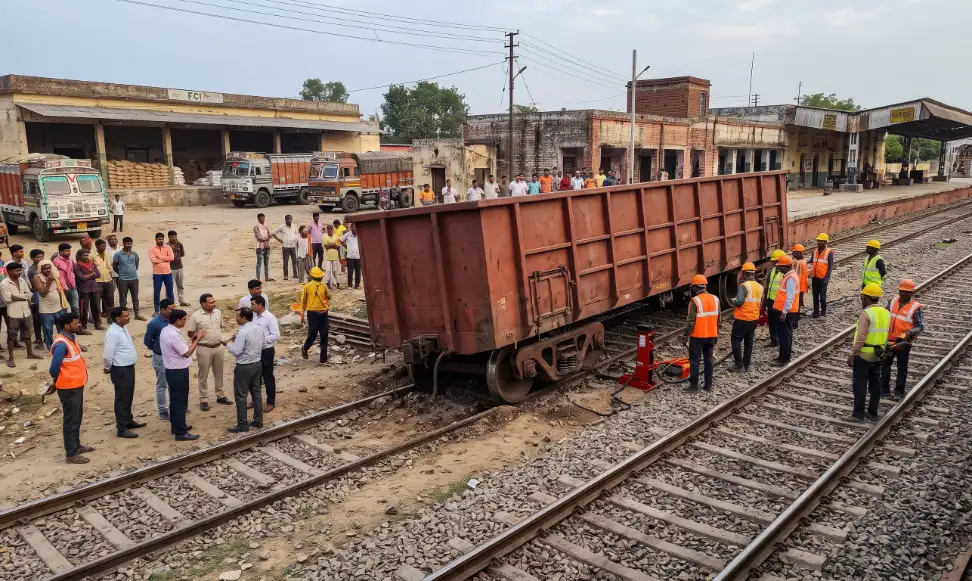
An empty goods wagon derailed during shunting operations at Hathras Kila railway station on Wednesday, disrupting Food Corporation of India (FCI) cargo handling and triggering friction between the two government agencies . The incident occurred as the wagon was being moved backward during shunting, a routine procedure for rearranging locomotives and coaches within station yards . No injuries were reported, but the derailment blocked the route and brought loading and unloading operations to a complete halt .
The operational disruption quickly escalated into an inter-departmental dispute. FCI officials confronted railway authorities over the stalled operations, pointing out that workers were sitting idle and freight vehicles were accruing additional detention costs while the track remained blocked . The FCI manager emphasized that the closure of the route was causing financial losses on multiple fronts, and the confrontation continued for an extended period before tempers subsided .
Railway response was swift once the derailment was reported. Technical teams from Aligarh and Tundla were dispatched to the site, and a lift machine was deployed to raise the derailed wagon and place its wheels back on the track . The rerailing operation took approximately one to two hours, according to railway officials, though the broader investigation into the cause continued into the evening . Amit Malviya, Public Relations Officer for the Prayagraj headquarters, stated that the situation had been rectified and that action would be taken against anyone found responsible .
Local sources pointed to deferred track maintenance as a likely cause of the incident. The railway track between Hathras Kila station and Hathras Junction has been undergoing replacement work for approximately one month, but the pace of progress has been slow . Workers and local residents suggested that had the track renewal been completed with greater urgency, the derailment might have been avoided . Railway authorities, however, maintained that a formal investigation would determine the actual cause, with findings pending .
The incident also brought long-simmering grievances about station infrastructure to the surface. Contractors and laborers protested for nearly an hour over the absence of basic amenities including drinking water and toilet facilities at the station premises . The protest, which authorities struggled to pacify, highlighted the broader neglect of Hathras Kila station despite its role as a key freight handling point for FCI grain shipments .
From an operational standpoint, the derailment exposed the vulnerability of freight handling at a station that serves as a primary conduit for foodgrain movement in the region. Hathras Kila is used mainly for goods trains bringing and unloading supplies, with only one passenger service to Delhi operating from the station . The blockage of the sole operational route meant that FCI grain stocks remained exposed in the open, with unloading work suspended for an extended period .
The FCI depot in-charge, Neeraj Sharma, had previously written to railway officials multiple times about the poor condition of facilities at the station, but no effective improvements were made . The derailment and the subsequent standoff underscored the coordination gaps between FCI, which depends on railway infrastructure for grain distribution, and the railway administration responsible for maintaining that infrastructure.
For the broader logistics sector, the Hathras incident is a reminder that India's rail freight network, despite its scale and strategic importance for bulk commodities like foodgrain, remains susceptible to localized infrastructure failures. Aging track assets and delayed maintenance can cascade into operational disruptions that affect not only railway schedules but also the supply chains of dependent agencies like FCI. The investigation's findings will determine whether this was an isolated incident or indicative of systemic maintenance shortcomings in the North Central Railway zone.