
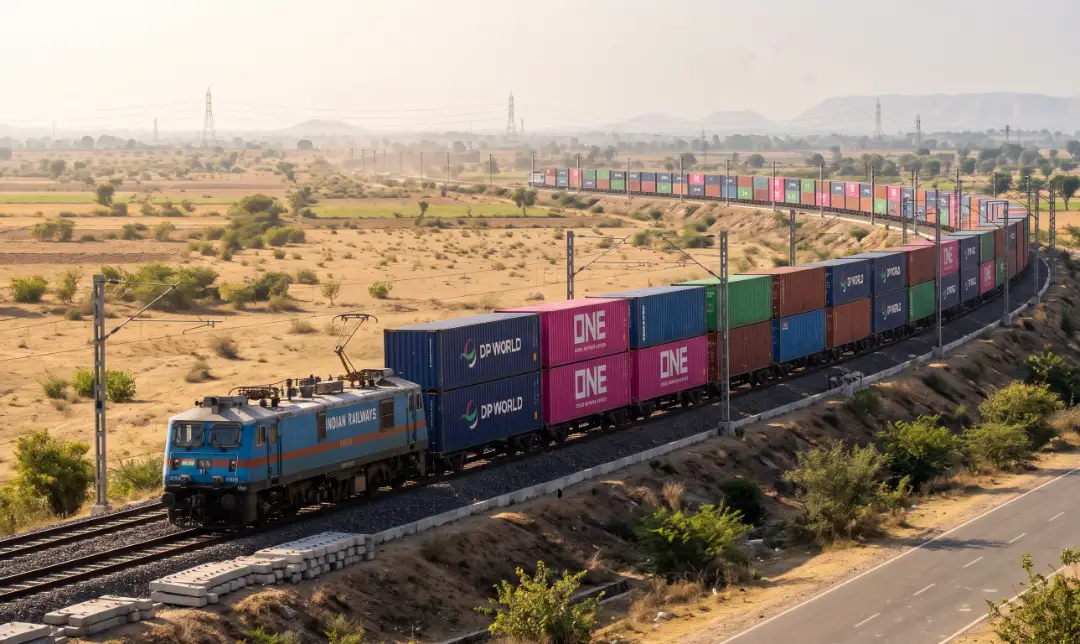
DP World has introduced a dedicated export rail freight service for Ocean Network Express (ONE), linking the National Capital Region (NCR) of India directly to Mundra Port in Gujarat. The service, announced earlier this week, represents a significant step in strengthening multimodal logistics connectivity between northern India's manufacturing clusters and the country's premier western gateway port . The partnership brings together DP World's inland logistics infrastructure and ONE's global shipping network, creating a more integrated corridor for export cargo originating in the NCR region.
The operational specifications of the service are notable for their emphasis on reliability and predictability. The twice-weekly service operates on the Dedicated Freight Corridor (DFC), with each rake carrying up to 180 twenty-foot equivalent units (TEUs) . Scheduled departures are aligned with vessel schedules at Mundra Port, allowing exporters to plan shipments with greater confidence and reducing the uncertainty that has historically plagued inland-to-port cargo movements. This alignment between rail and ocean schedules is a critical enabler of supply chain efficiency for time-sensitive export commodities.
The service is facilitated through three of DP World's inland container depots: Panipat, Pali, and Modinagar . These facilities serve as consolidation points where exporters can deposit cargo, complete documentation, and load containers onto the dedicated rakes. By routing through these ICDs, the service allows multiple commodities to be consolidated within a single train, accommodating the diverse export mix of the NCR region. This consolidation capability is particularly valuable for small and medium-sized exporters who may not generate sufficient volume to fill an entire rake independently.
The strategic rationale for the service is rooted in the NCR's role as a major manufacturing and export hub. Hemant Kumar Ruia, DP World's Country Manager for the Subcontinent, noted that the region is a key source of automotive and auto components, industrial goods, FMCG products, and textiles . These sectors require seamless access to global markets, and the dedicated rail service addresses a critical bottleneck: the movement of export cargo from inland production centres to coastal ports. By offering dedicated capacity rather than shared freight, the service reduces the risk of delays caused by competing cargo priorities.
From ONE's perspective, the partnership provides dedicated rail connectivity that complements its ocean shipping operations. Masahiro Sakikubo, Managing Director of ONE India, emphasized that dedicated capacity, scheduled departures, and vessel schedule alignment would enhance supply chain reliability and support seamless cargo movement between inland markets and international trade routes . For a global carrier like ONE, having a reliable inland feeder network is increasingly important as shippers demand end-to-end visibility and predictability, not just port-to-port transit.
The launch is part of DP World's broader strategy to build integrated logistics solutions in India. By combining its inland terminals and rail network with port operations at Mundra, warehousing capabilities, and freight forwarding services, the company aims to position itself as a one-stop logistics partner for Indian exporters . This integrated approach contrasts with the fragmented model that has traditionally characterized Indian logistics, where exporters often deal with separate entities for inland transport, port handling, and ocean carriage. The ability to offer a single point of accountability across these stages is a competitive differentiator.
For exporters in the NCR, the practical benefits extend beyond scheduling reliability. The dedicated rail service reduces dependence on road transport for the long haul to Mundra, a distance of over 1,000 kilometres. Road transport is subject to variable transit times, fuel cost fluctuations, and capacity constraints during peak seasons. Rail, by contrast, offers a more consistent transit time and lower per-unit costs for high-volume movements. The DFC infrastructure further enhances rail's advantage by providing a dedicated freight corridor free from passenger train conflicts, enabling faster and more reliable transit.
Looking ahead, the success of this service will be measured by utilization rates and exporter adoption. The twice-weekly frequency and 180 TEU capacity per run represent a meaningful commitment of resources, and DP World and ONE will need to demonstrate that the service delivers on its promise of reliability and efficiency. If successful, the model could be replicated on other inland-to-port corridors, further embedding rail as a critical link in India's export supply chain. The launch also signals growing confidence in the DFC's operational readiness and its potential to reshape the economics of containerized freight movement across the country.