
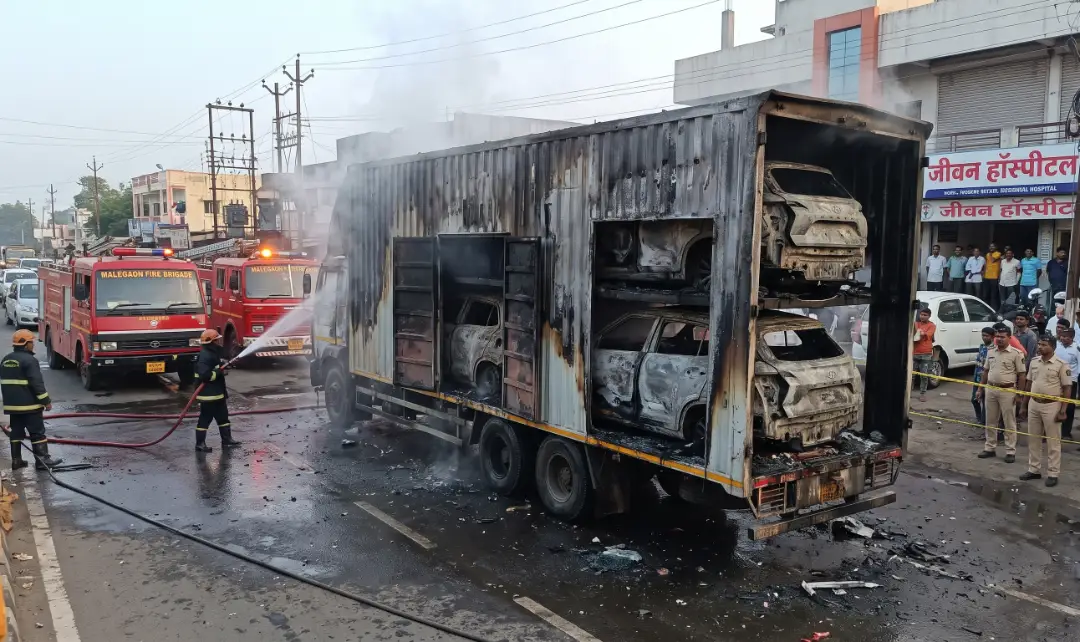
A major fire incident involving a vehicle transport container has highlighted persistent safety risks in India's road cargo sector, with preliminary losses estimated at ₹1.5 crore. The incident occurred in the early hours of Wednesday morning in Malegaon city, Nashik district, when a container truck operated by Sandeep Logistic Company caught fire while transporting seven new Hyundai Creta cars. The vehicle was positioned in front of Jeevan Hospital near Manmad Chowfuli when the blaze erupted, creating panic in the surrounding area .
The container, registered as HR-46 F-7692, was an enclosed carrier, which complicated firefighting efforts as flames spread rapidly within the confined space. According to reports, three of the seven Hyundai Creta cars were completely gutted, while the remaining four sustained partial damage. The total value of the lost and damaged cargo was pegged at approximately ₹1.5 crore, a significant loss for the logistics operator and the vehicle consignee .
The response from local emergency services was swift and instrumental in limiting the damage. Constables stationed at the Malegaon Police Control Room spotted the fire and immediately alerted the main fire station. Two fire engines along with firefighting personnel were dispatched to the scene without delay. The firefighting operation was carried out under the guidance of Chief Fire Officer Sanjay Pawar, with firefighters Mohan Bairagi, Yahya Khan, Kiran Suryawanshi, and Sunil Bagul playing key roles in bringing the blaze under control .
Firefighters assessed the severity of the situation upon arrival and began spraying water from multiple sides of the container using hose pipes and hose reels. Despite the fire rapidly intensifying within the enclosed cargo area, the team worked with caution and persistence. After nearly one to one-and-a-half hours of continuous operations, the blaze was completely extinguished. Their efforts successfully saved goods worth nearly ₹50 lakh, preventing the loss from being substantially higher .
The cause of the fire remains undetermined. Because the container was fully enclosed, investigators have faced difficulty in ascertaining the origin of the blaze. No casualties were reported among the driver, crew, or bystanders. The incident has been noted by local police and fire authorities, though no formal investigation findings have been released. The vehicle carrier was en route at the time of the incident, though the specific origin and destination of the shipment were not disclosed in initial reports .
This incident underscores a recurring vulnerability in India's road freight ecosystem: the transportation of high-value finished goods, particularly automobiles, by road carries inherent fire risks that can result in catastrophic losses. Enclosed containers, while offering protection from weather and theft, can also trap heat and accelerate fire spread once ignition occurs. The absence of automatic fire suppression systems in most commercial cargo containers remains a gap that industry observers have periodically flagged.
For Hyundai and its dealership network, the loss represents a disruption in vehicle availability during a period when automakers are pushing to maximize deliveries. The seven Creta units were presumably destined for dealership stock, and their destruction will require replacement allocation. For Sandeep Logistic Company, the incident raises questions about cargo insurance coverage and liability, particularly given the preliminary loss estimate of ₹1.5 crore against goods saved worth ₹50 lakh.
From a broader policy perspective, the incident adds to the case for enhanced safety standards in road cargo transport, including mandatory fire detection and suppression systems for vehicles carrying high-value or combustible cargo. While India's road freight sector moves the majority of the country's goods by volume, regulatory oversight of vehicle safety and cargo handling practices remains uneven. Incidents such as this one in Malegaon serve as reminders that the costs of inadequate safety infrastructure extend beyond the immediate losses to include insurance premiums, supply chain disruptions, and reputational damage for all parties involved.