
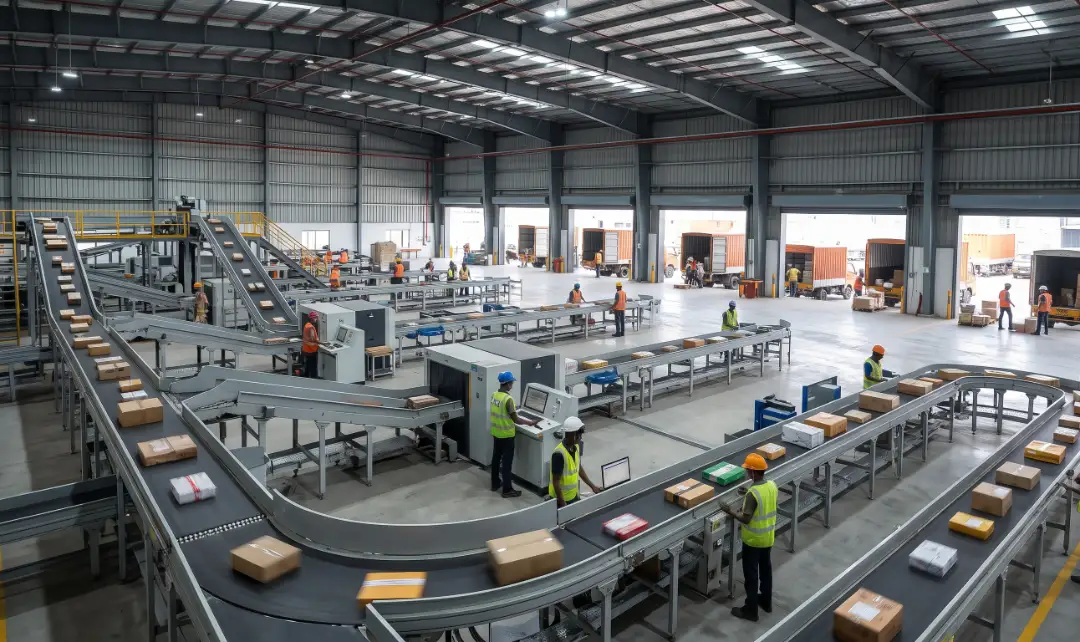
TCI Express Ltd, one of India's leading express logistics providers, on Thursday detailed a ₹500-crore capital expenditure programme that will be deployed over the next five years to deepen its nationwide delivery network . The announcement coincided with the operational launch of three new company-owned sorting centres located in Ahmedabad, Lucknow, and Kolkata, a move that expands the company's tally of such facilities from 25 to 28 . The new centres collectively span approximately 4 lakh square feet, materially enhancing TCI Express's shipment processing throughput and its geographic reach across western, northern, and eastern India .
The strategic rationale behind the investment is rooted in the accelerating performance of TCI Express's high-growth business lines. Managing Director Chander Agarwal noted that domestic air express and e-commerce express have emerged as the principal growth engines for the firm in FY2027 . During the September quarter, domestic air express recorded a 29.4% year-on-year expansion, while e-commerce express surged 51.6%. Surface express, the company's traditional mainstay, grew a more modest but steady 9.4% . The new capital is explicitly earmarked for reinforcing these verticals rather than spreading resources thinly across the entire portfolio.
Automation forms a central pillar of the expansion strategy. The Ahmedabad and Kolkata sorting centres will be equipped with fully automated sorting systems, distinguishing them from the Lucknow facility. Upon completion, TCI Express will operate four fully automated sorting hubs across its network . The company has framed this technological upgrade as essential for improving operational efficiency, reducing human error, and ensuring service reliability as parcel volumes continue to climb. The automation push also aligns with broader industry trends in India, where labour costs and scale requirements are driving logistics firms toward mechanised handling.
The ₹500-crore commitment is not TCI Express's first major outlay. The company disclosed that it has already invested an equivalent sum over the past seven years to build its current network . The new tranche is therefore positioned as a second phase of growth, one that Agarwal described as focused on "building a more agile and scalable network" rather than simply adding geographic coverage . This distinction matters for investors and shippers alike: the emphasis is shifting from footprint expansion to density and efficiency within existing corridors.
From a competitive standpoint, the expansion strengthens TCI Express's position against both traditional road freight incumbents and newer entrants backed by e-commerce majors. The dedicated focus on air express and e-commerce fulfilment reflects where margin growth is concentrated in India's logistics sector. While surface transport remains the volume backbone, the higher realisations and service premiums associated with time-definite air cargo and D2C fulfilment are where TCI Express sees its most defensible moat.
The employment implications of the new sorting centres were also highlighted in the company's announcement. TCI Express indicated that the facilities are expected to generate significant local job opportunities across the three states . In a sector where warehouse and sorting hub operations remain labour-intensive despite automation, the multiplier effects on ancillary services—transport contractors, maintenance crews, and last-mile delivery partners—extend beyond direct payroll.
Looking ahead, the success of this expansion will hinge on execution speed and utilisation rates. The Indian express logistics market is becoming increasingly crowded, with organised players and e-commerce captive networks competing for the same parcels. TCI Express's bet is that automated capacity, strategically located near consumption and manufacturing clusters, will translate into shorter turnaround times and higher customer retention. The next two to three quarters will reveal whether the demand momentum in air and e-commerce express justifies the pace of this capex cycle.