
India has imposed an effective duty of 162.5% on bulk Scotch imports, escalating a customs classification dispute that has already left more than 80 shipping containers stranded at Indian ports . The development, reported by Reuters and Zawya on 18 November 2026, represents the first major dispute linked to the India-UK Comprehensive Economic and Trade Agreement, which was implemented in July 2026 and was celebrated as a landmark win for Scotch whisky exporters.
The dispute centres on how bulk Scotch concentrates should be classified under India's customs tariff. The CETA halved tariffs on Scotch to 75%, and businesses and the British government hailed the agreement as a significant benefit for companies like Pernod Ricard and Diageo, which import Scotch in bulk and blend it to make products for India's $65 billion liquor market . However, Indian investigators have argued that companies are using incorrect customs classifications, contending that bulk Scotch concentrates—deemed raw material for blended whiskies—should fall under a newly created customs line for "compound alcoholic preparations" that attracts a 150% tariff . A consumption tax takes the total effective duty to 162.5%, according to a government document reviewed by Reuters and eight sources, including industry executives and customs agents .
The practical consequence for importers is that they face a duty rate higher than the 150% that applied before the CETA was implemented. Industry sources noted that Scotch prices in the Indian market had already been reduced when the trade pact kicked in, and now importers are facing higher duties again . Pernod, Diageo, and other Indian companies believe that Scotch imports, both bulk and bottled, should be taxed only at 75% as per the trade agreement . The British government has said it is working with New Delhi on the issue, and India has said the dispute will be resolved soon .
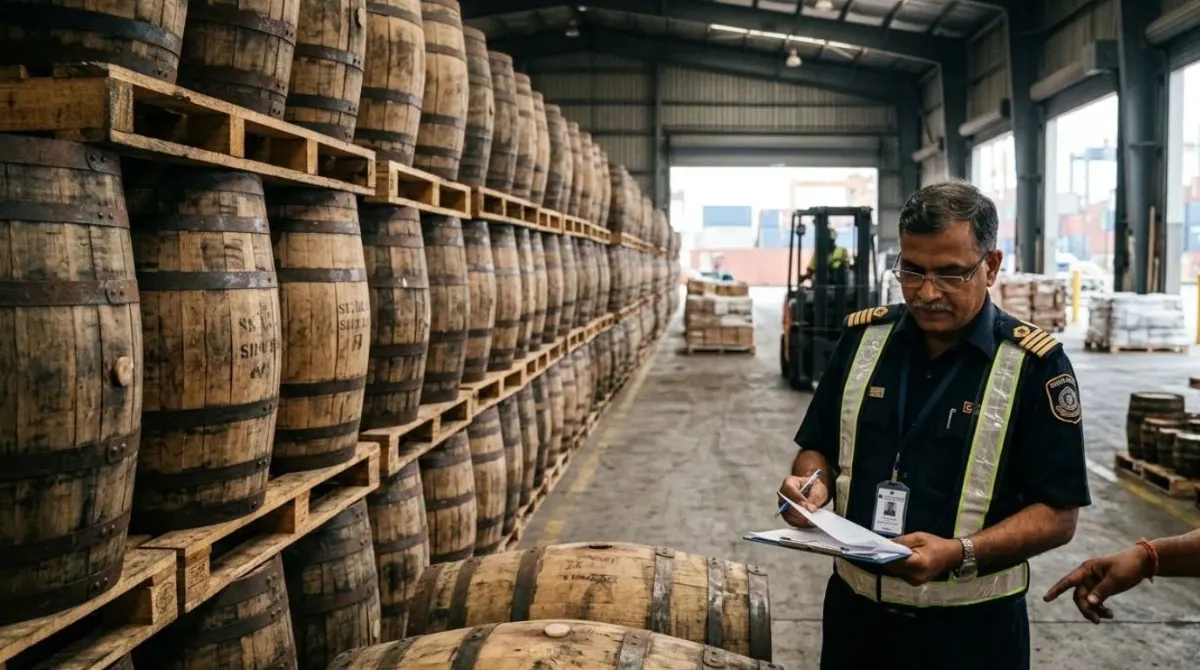
The operational impact on logistics is significant. More than 80 shipping containers of bulk Scotch belonging to Pernod, Diageo, and Bacardi have been stuck at ports . Under a provisional release mechanism pending investigation, importers must pay duty at 75% of the goods' value upfront, with the remainder covered by bank guarantees . Pernod and Diageo have moved to arrange bank guarantees and other funding to get their blocked containers released so that business can continue, while Bacardi is still deciding its next steps . Smaller companies may face greater stress in arranging guarantees, as they may require collateral and the guarantees must be reported as contingent liabilities .
The broader context is that about 80% of Scotch whisky imports from Britain by volume arrive in bulk, and India is the biggest market for Scotch by volume . Most bulk Scotch goes into making Indian-Made Foreign Liquor by mixing a small quantity of Scotch with other spirits, producing mass-market offerings that are far cheaper than wholly imported whiskies like Chivas Regal or Johnnie Walker . A disruption to bulk Scotch supply therefore affects the mass-market segment of India's liquor industry, not just the premium imported brands.
For India's import logistics sector, the dispute illustrates the implementation risks that accompany trade agreements. The CETA's tariff concessions were designed to reduce duties and facilitate trade, but the classification dispute has created a situation where importers face higher effective duties than before the agreement, and cargo is held at ports while the issue is resolved. This is the kind of operational friction that can erode the benefits of a trade deal and create uncertainty for importers, freight forwarders, and customs brokers who handle the affected cargo.
Looking ahead, the key question is how quickly the classification dispute can be resolved and whether the government will clarify the applicable tariff line for bulk Scotch concentrates. The Reuters report noted that a confidential memo from Indian investigators said any misclassification under the India-UK pact needs to stop as it has "substantial revenue implications" for New Delhi . For importers, the immediate priority is to secure the release of their containers through provisional release mechanisms while the dispute is resolved. For the broader trade relationship, the outcome will indicate whether the CETA's implementation can deliver the predictability and market access that its negotiators intended.