
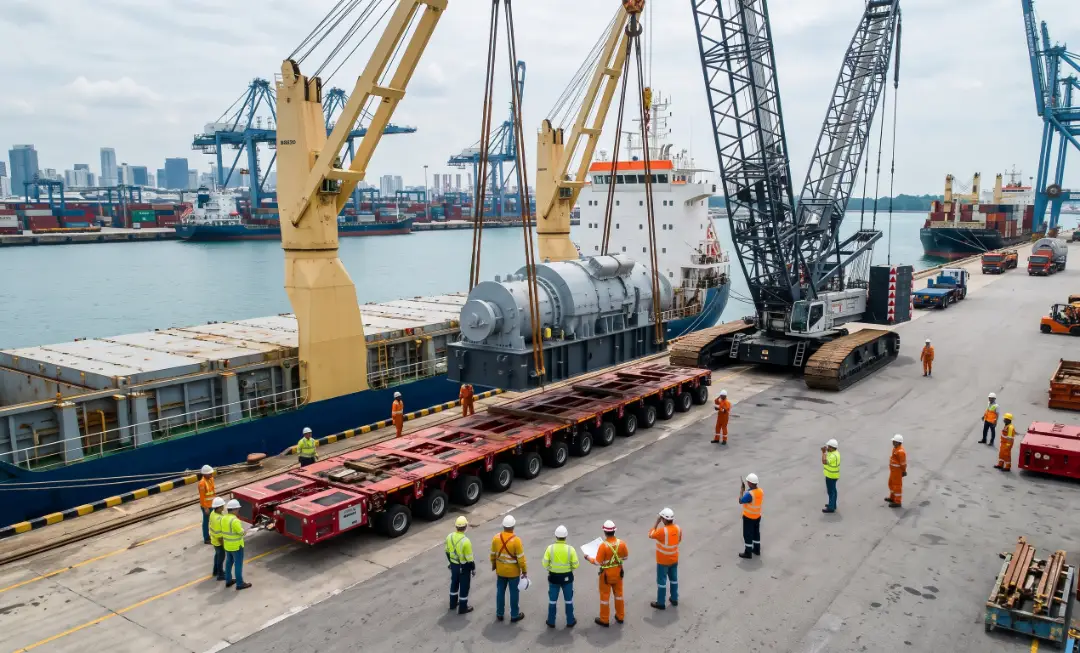
The global project logistics sector is undergoing a strategic reorientation, with industry leaders gathered at Breakbulk Asia in Singapore framing the change as a shift from freight movement to integrated engineering-led delivery. Singapore's Minister of State for Trade and Industry Gan Siow Huang told the conference that Asia's industrial transformation—including nearly 150% growth in ASEAN manufacturing FDI to US$44 billion in 2024 and projected data centre power demand of up to 10.7 gigawatts by 2035—is creating demand for logistics providers who can do more than move cargo from one place to another. "Major industrial projects often involve oversized equipment, specialised handling requirements and tight delivery schedules," she said, adding that providers must coordinate across transport modes, suppliers, and countries to ensure critical equipment arrives safely and on time.
The economics of this shift are visible in market structure. Transportation and freight services still account for the largest share of project logistics revenue at 60.6%, but project management and coordination is growing faster at approximately 6.8% CAGR, projected to reach US$19.8 billion by 2035. The distinction matters: the value is migrating toward the engineering, permitting, route survey, lift planning, and interface coordination that determine whether an oversized module can actually reach a construction site. Maersk's framing, cited in market analysis, characterises project logistics as integrated management of material flow, order management, and shipment execution across multiple origins and transport modes.
Asset ownership is becoming a competitive differentiator, but with significant capital barriers. A 1,000-tonne crawler crane can cost US$50–100 million, and wind installation vessels exceed US$200 million. Multipurpose vessel newbuilding prices reached US$52.75 million for 30,000 DWT units in late 2024, with delivery slots contested by other shipping segments. This capital intensity has driven consolidation and vertical integration: CEVA Logistics completed its acquisition of Fagioli Group in March 2026, combining Fagioli's fleet of thousands of owned and leased heavy-lift assets and engineering expertise with CEVA's global logistics network. CEVA's global project logistics vice president Stéphane Armand told the Journal of Commerce that "owning assets gives confidence to clients," but stressed that "the IP of Fagioli is related to people and experience"—operating heavy-lift equipment requires specialist knowledge built over time.
The human capital dimension is emerging as a binding constraint. Armand warned that attracting a new generation into project logistics is "becoming critical," adding that while artificial intelligence will influence the sector, "capacity to move a heavy-lift will be driven by humans. Every case is unique". This tension between technological optimisation and irreplaceable operational judgement runs through the sector's strategic planning. AI-enabled route-optimisation platforms are reportedly trimming end-to-end costs by 10–15%, but the physical execution of complex lifts and abnormal loads remains dependent on trained engineers, riggers, and site supervisors.
Geopolitical disruption is reshaping route planning and project sequencing. The Red Sea diversions around the Cape of Good Hope have extended transit times and altered freight and insurance economics for Asia-Europe movements, but for breakbulk and heavy-lift cargo the consequences are more acute: a reroute can affect lifting windows, port slots, and construction sequencing because oversized cargo cannot be easily transferred to another service. Tariff escalation and sanctions compliance add further layers of complexity, with project cargo planners now required to assess origin choices, duties, and multi-jurisdiction sanctions exposure across contractors, subcontractors, equipment suppliers, and transport providers throughout a project's multi-year lifecycle.
Asia's project pipeline is the demand engine behind these changes. Breakbulk Asia's organisers reported over 400 shippers and cargo owners attending, representing companies including Siemens Energy, GE Vernova, Vestas, Larsen & Toubro, Fluor, BHP, Shell, Mitsubishi Heavy Industries, and Hitachi Energy. Fluor's project logistics manager described the event as bringing together cargo owners, EPC contractors, carriers, and logistics experts as Asia becomes "a key hub for energy transition, sustainable fuels, semiconductors and large-scale industrial investment". The conference programme reflected this: sessions on AI infrastructure's impact on cargo flows, megaproject delivery in Southeast Asia, India, and Australia, and fleet readiness to meet Asia's project pipeline all addressed the same underlying question of whether logistics capacity can keep pace with investment commitments.
The competitive landscape remains fragmented but consolidating. No single provider exceeds 8% market share, yet the engineering-led segment is dominated by a handful of global players: Kuehne+Nagel holds an estimated 15–20% share of the outsized and heavy-lift engineering segment, DHL Industrial Projects 12–18%, DB Schenker 10–14%, with GEODIS and DSV each at 8–12% and CEVA at 6–10%. Regional specialists collectively account for 20–30%, reflecting the value of local route compliance, authority relationships, and corridor knowledge in markets where global operators have limited ground presence. For cargo owners, the practical implication is that selecting a project logistics partner increasingly means evaluating engineering capability, asset access, and regional execution depth rather than freight rates alone.
The direction of travel is clear, but the execution challenge is substantial. Asia's energy transition, data centre buildout, and industrial infrastructure programmes will generate sustained demand for heavy-lift and project cargo services through the next decade. Whether the sector can mobilise sufficient specialised assets, trained personnel, and coordinated multi-modal capacity to deliver those projects on schedule remains an open question. As one industry executive put it, the sector faces a future where "we will not be short of work, but we will be short of time".