
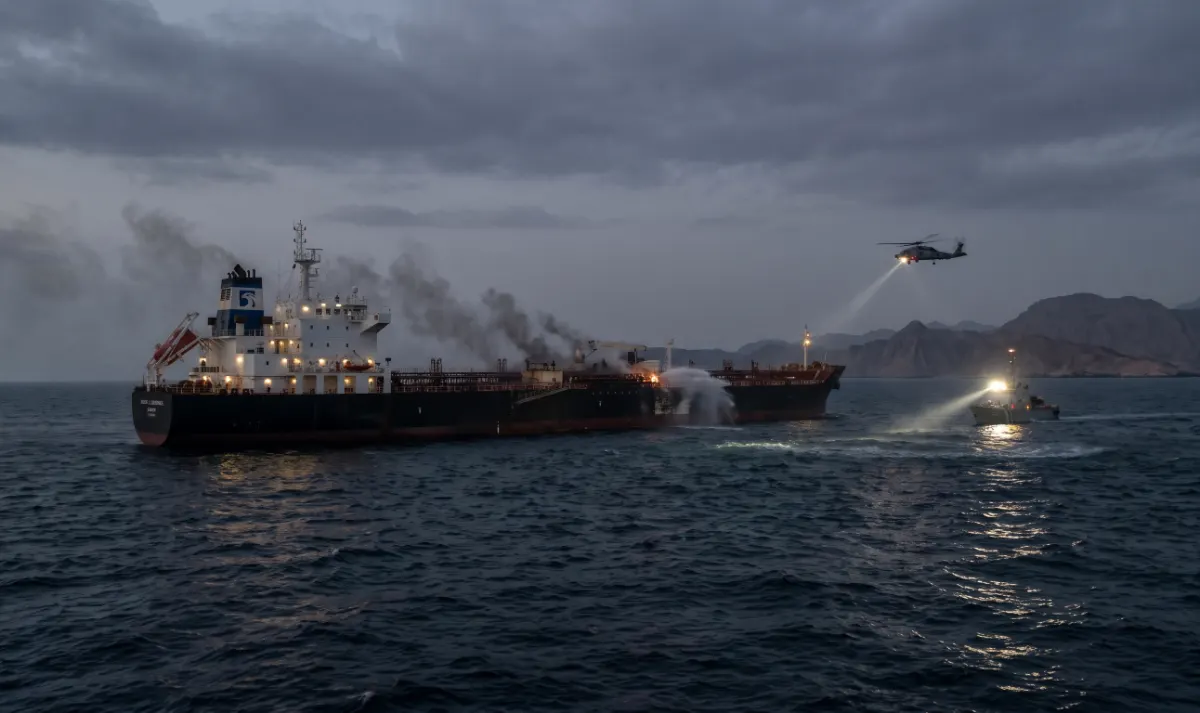
The attack on an ADNOC Logistics & Services vessel in the Strait of Hormuz on the evening of 17 November 2026 has drawn renewed attention to the fragility of global supply chains that depend on a handful of maritime chokepoints. ADNOC L&S confirmed that one crew member remains unaccounted for, eleven sustained injuries, and all other crew were safely evacuated, with search and rescue operations ongoing in coordination with relevant authorities . The company did not identify the vessel or the nature of the attack, but the incident is part of a pattern that has intensified since hostilities with Iran resumed earlier in 2026.
The Strait of Hormuz, situated between Iran and Oman, connects the Persian Gulf to the Gulf of Oman and the wider Indian Ocean. Before the current conflict, approximately one-fifth of globally traded oil and liquefied natural gas passed through the waterway . Its effective closure has forced shipping companies to either suspend transits or divert to alternative routes, with Kpler data showing crude flows through the strait averaging 10.5 million barrels per day since early October 2026, down from a pre-war average of 13.5 million barrels per day .
The ADNOC L&S incident is not an outlier. The International Maritime Organization recorded 134 confirmed maritime incidents in the Strait of Hormuz and Middle Eastern waters as of 11 November 2026, with 25 seafarers killed . October 2026 saw 35 incidents, the highest monthly total since the conflict began, and UK Maritime Trade Operations has logged repeated reports of tankers and container ships struck by “unknown projectiles” in the strait . Iran’s Islamic Revolutionary Guard Corps has claimed responsibility for some strikes, asserting that vessels using unauthorized routes struck naval mines, while also denying progress in peace negotiations with the United States .
The economic consequences extend well beyond the immediate region. Disruptions at Hormuz and the parallel Bab al-Mandab chokepoint at the southern end of the Red Sea have driven up energy, transport, and insurance costs, feeding inflationary pressures across global markets . The IMF now assumes Hormuz will reopen in March 2027, with conditions normalizing by October 2027—a longer disruption than previously anticipated—and oil prices are expected to average around US$96 per barrel in 2026, with refined product prices 70% to 95% above pre-war levels . The attacks have also thinned global airfreight capacity as non-regional carriers become increasingly reluctant to overfly the region.
For the logistics sector, the persistence of attacks despite diplomatic efforts—including a US-Iran memorandum of understanding signed in June 2026 whose implementation stalled over disagreements on freedom of navigation—signals that the security environment in the strait remains unresolved. War-risk insurance premiums for Hormuz transits have risen sharply, and the diversion of vessels to longer routes has added transit days and fuel costs to supply chains already under pressure from other geopolitical disruptions. The fact that a state-owned operator of ADNOC’s scale has now suffered a direct hit underscores that the threat is not confined to independent commercial operators or vessels perceived to be aligned with particular geopolitical actors.
The broader lesson for global supply chain management is the concentration risk inherent in reliance on maritime chokepoints. The Strait of Hormuz, the Bab al-Mandab, the Suez Canal, and the Panama Canal collectively handle a disproportionate share of global trade, and disruptions at any one of them ripple through energy markets, container shipping schedules, and airfreight capacity. The current crisis in the Middle East has demonstrated that even a partial, sustained disruption—rather than a full closure—is sufficient to impose significant and lasting costs on global commerce.
ADNOC L&S stated that its immediate priority is supporting the search and rescue effort and those affected, and urged the public to rely only on official sources . Further updates on the missing crew member and the investigation into the attack are expected as operations continue. For shipping operators and cargo owners alike, the incident serves as a reminder that the security of maritime chokepoints is not an abstract geopolitical concern but a direct operational and financial variable in global logistics planning.