
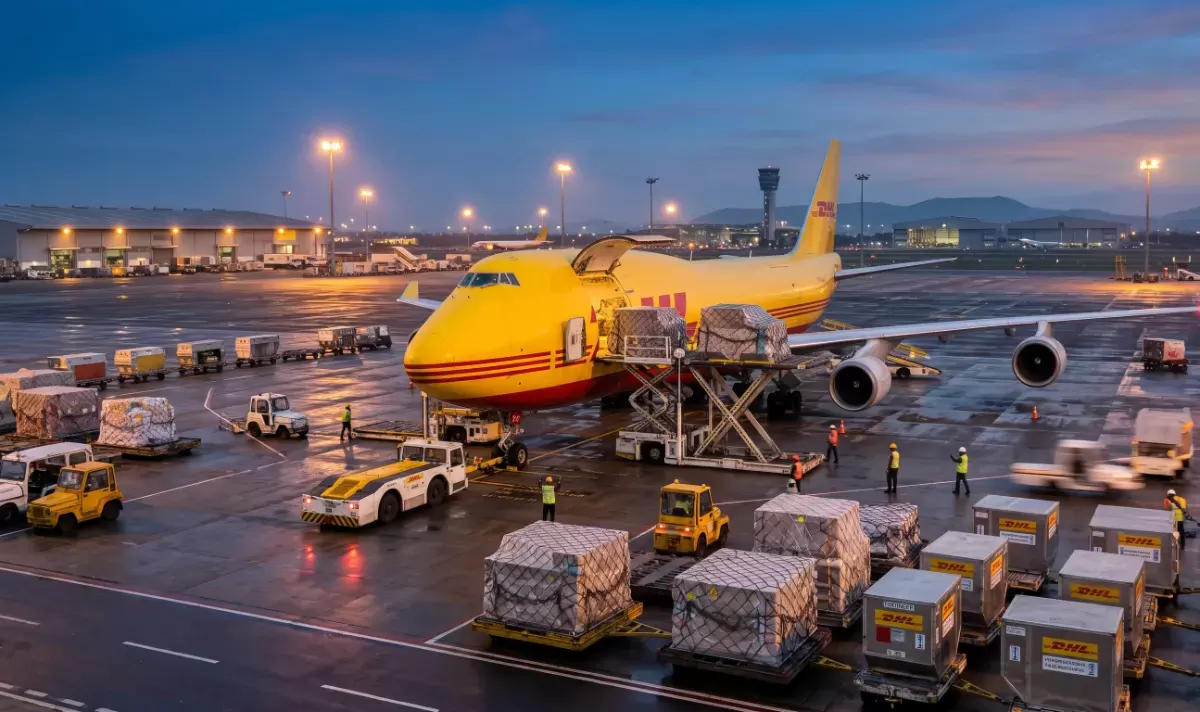
DHL Global Forwarding announced on 16 November 2026 the launch of a dedicated freighter service linking Hong Kong (HKG), Navi Mumbai (NMI), and Liège (LGG), its first dedicated freighter operation serving India. The service operates twice weekly with a Boeing 747 freighter, with DHL Aviation acting as the airline supplier. The route officially began in October 2026, according to industry publication Cargo Facts, though DHL's formal announcement came in mid-November.
The network design serves two distinct trade lanes simultaneously. The Hong Kong–Navi Mumbai leg provides shippers in Hong Kong and mainland China with direct dedicated capacity into the Mumbai region, while the Navi Mumbai–Liège segment opens additional capacity from India to Europe through DHL's European hub at Liège. From Liège, cargo can connect onward across DHL Global Forwarding's broader European network. This structure allows DHL to serve both the China-India manufacturing corridor and the India-Europe export lane with a single aircraft rotation.
Capacity figures are modest but strategically significant. The Boeing 747 offers approximately 100 tonnes of total aircraft capacity per flight. DHL Global Forwarding is initially targeting around 25 to 30 tonnes per flight for the India sectors, equivalent to roughly 50 to 60 tonnes per week, with potential to increase as demand develops. The remaining capacity serves the Hong Kong–Navi Mumbai and Navi Mumbai–Liège segments, reflecting the mixed cargo profile the route is designed to accommodate.
The target cargo mix reflects India's evolving export composition. DHL expects the service to support customers across life sciences and healthcare, technology and electronics, engineering, and advanced manufacturing. Typical shipments are expected to include pharmaceuticals, high-value technology components, industrial machinery, and precision components—goods where air freight's speed premium is justified by product value or time sensitivity. India is one of the fastest-growing air freight markets in Asia, supported by strong growth in manufacturing and exports, and international air cargo volumes are growing particularly strongly for high-value and time-sensitive products.
Henk Venema, Global Head of Air Freight at DHL Global Forwarding, framed the launch as a strategic commitment rather than a tactical addition. "India is a strategic market for DHL Global Forwarding and an increasingly important part of our global air freight network," he said. "With this new dedicated service, we are strengthening connectivity between China, India and Europe and providing our customers with reliable capacity and greater access to key growth markets". The phrasing emphasizes reliability and dedicated capacity—a contrast to the belly-hold and spot-charter arrangements that have historically served India-Europe air cargo.
The India expansion does not end at Mumbai. DHL Global Forwarding plans to add a Bengaluru (BLR)–Europe dedicated freighter service in March 2027, extending its India-Europe connectivity to the southern manufacturing and technology corridor. "This is not a one-off addition," Venema said. "It is part of our broader ambition to build a stronger air freight bridge between India and the rest of the world. The new Mumbai service, followed by Bengaluru-Europe, demonstrates our confidence in the Indian market and our ambition to grow alongside our customers".
The launch occurs against a backdrop of constrained global freighter capacity. Venema noted in a separate statement that around 20 freighters are expected for delivery on the world market in 2027, with most going to express delivery companies rather than traditional cargo airlines, while older aircraft continue to leave the fleet. In this context, DHL's decision to commit dedicated aircraft to the India lane represents a significant allocation of a scarce resource. For shippers in western India, the service offers an alternative to relying on belly capacity or transshipment through third-country hubs for Europe-bound cargo, reducing handling complexity and transit variability.
Navi Mumbai International Airport, the Indian anchor for the service, was designed to handle up to 500,000 tonnes of cargo annually in its first phase, with dedicated handling for pharmaceuticals, perishables, and temperature-sensitive shipments. The airport's longer-term plan envisions capacity rising to 2.6 million tonnes. Liège Airport, the European entry point, handled approximately 1.32 million tonnes in 2025, up 14% from 2024, and serves as a DHL Aviation base for onward European connections. The pairing of these two airports reflects DHL's effort to build an integrated China-India-Europe air freight triangle, with Navi Mumbai as the Indian gateway and Liège as the European distribution point.