
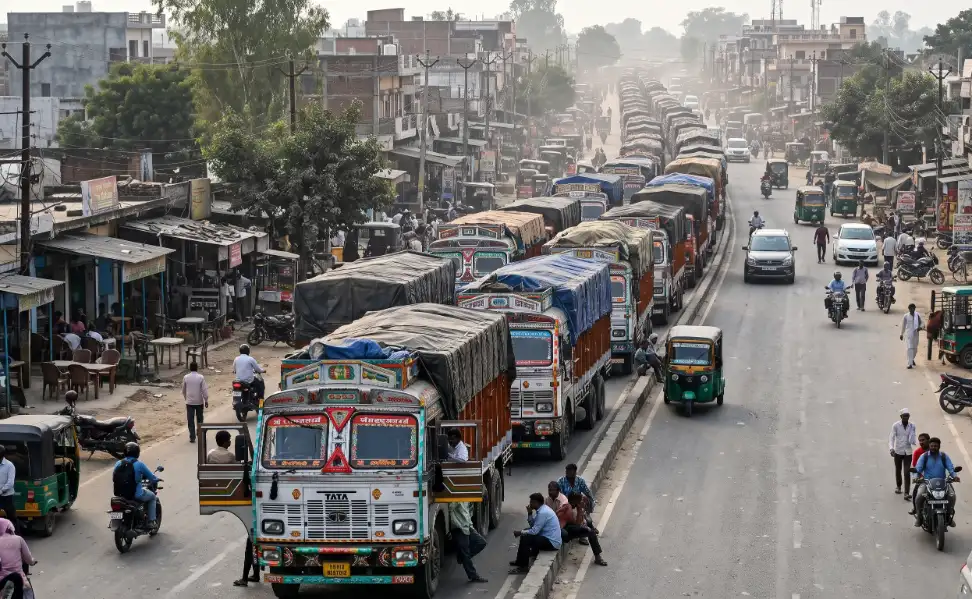
A five-kilometer queue of freight trucks formed at the Sonauli border crossing in Maharajganj district, Uttar Pradesh, as congestion that had been building for three days reached its peak on 17 November 2026. The backup was attributed to holiday-related closures and slowed customs processing on the Nepali side, which reduced the rate at which cargo vehicles could clear the border and caused the line of waiting trucks to extend progressively along the Indian approach road .
The congestion had been accumulating since at least 15 November, with a large number of freight vehicles stranded at the border for three consecutive days. The queue disrupted not only cargo movement but also general traffic in the Sonauli town area, where the border road passes through a congested urban stretch. Drivers waiting in the line reported difficulties in accessing food, drinking water, and other basic necessities during the prolonged delay .
In response to the growing backlog, officials from India and Nepal convened a meeting on the evening of 17 November to discuss measures for restoring traffic flow and clearing the stranded vehicles. The two sides agreed to designate a window until midnight on 17 November during which only freight trucks would be permitted to cross into Nepal, allowing cargo vehicles to move without competing with passenger traffic and other vehicles for border processing capacity .
The Sonauli crossing has experienced recurring congestion episodes in recent months, with previous jams of similar or greater length reported in late October and early November 2026. Those earlier disruptions were linked to factors including server and VCTS (Vehicle and Cargo Tracking System) outages on the Nepali side, increased security checks on empty returning trucks, and road encroachment in the Sonauli town area that narrows the available carriageway for large vehicles . The recurrence of the problem suggests that the current incident is not an isolated event but part of a pattern of capacity and processing constraints at the border.
The Sonauli route is a significant conduit for India-Nepal land trade, handling exports from India to Nepal and imports in the reverse direction. When congestion occurs, the impact extends beyond the immediate queue of trucks: exporters face delayed delivery schedules, transport operators incur idle time and fuel costs, and the reliability of the corridor as a trade route is undermined. The fact that the current jam followed holiday-related closures on the Nepali side points to the sensitivity of border throughput to even short interruptions in processing capacity .
The midnight crossing arrangement agreed on 17 November was described by officials as a temporary measure for a single day, rather than a structural solution to the recurring congestion problem. Kotwal Vishal Shukla of Sonauli stated that freight trucks were permitted to travel to Nepal until midnight on Tuesday, indicating that the arrangement was intended to clear the immediate backlog rather than establish a permanent extended-hours regime . Whether additional measures will be implemented to address the underlying causes of recurring jams has not been announced.
For the logistics sector, the Sonauli congestion highlights the vulnerability of road-based border trade to operational disruptions at land ports. Unlike seaports or airports, where multiple berths or terminals can provide redundancy, a single-lane border crossing with limited processing capacity has little buffer against surges or slowdowns. The pattern of repeated jams at this crossing suggests that capacity expansion, process improvements, or both may be needed to prevent future incidents from disrupting bilateral trade flows. For now, the immediate queue is expected to ease following the extended crossing window, but the structural constraints at Sonauli remain unaddressed.