
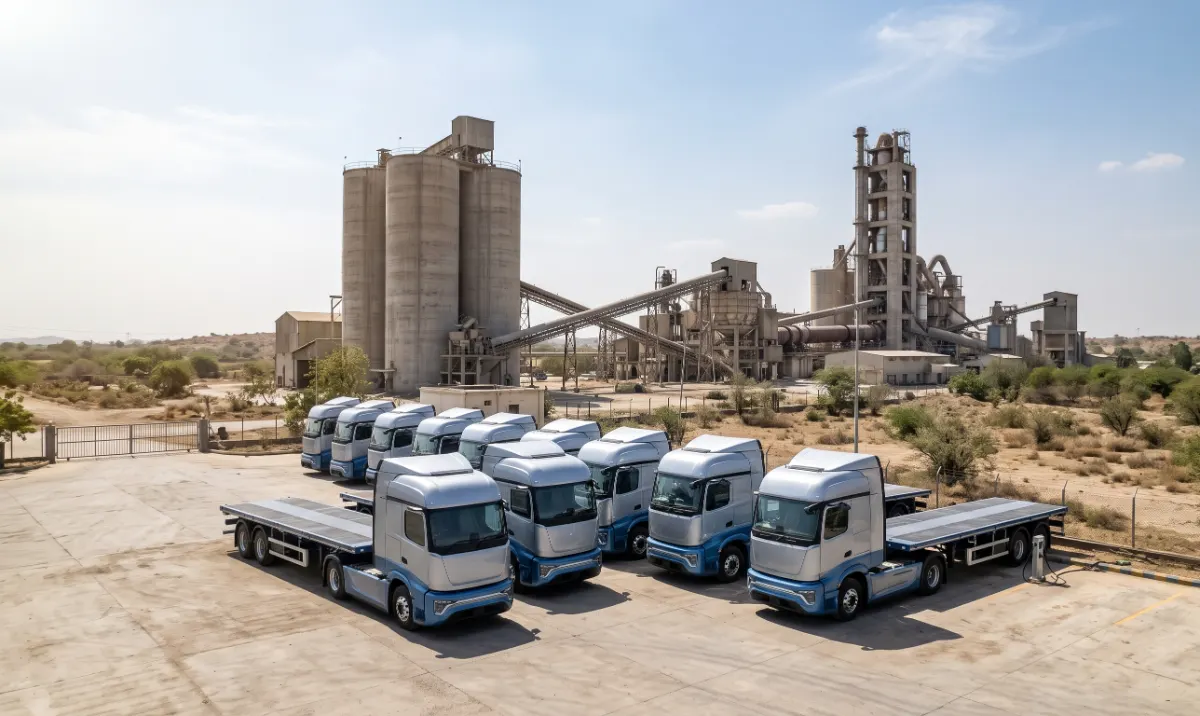
Adani Cement, the building materials arm of the Adani Group comprising Ambuja Cements Limited, ACC Limited, and Orient Cement Limited, flagged off heavy-duty electric trucks at its Sanghi Plant in Gujarat on 18 November 2026. The deployment marks the company's first-ever use of EV trucks for freight and represents the operational start of a green logistics programme that had been outlined in management discussions earlier in the year. The event was disclosed to stock exchanges through a media release filed by Ambuja Cements under Regulation 30 of the LODR regulations.
The first phase commits to deploying 410 electric trucks by March 2027 for the transport of clinker—the intermediate product in cement manufacturing—and finished cement. The 410-truck fleet is projected to reduce more than 25,000 tonnes of carbon dioxide emissions annually and displace approximately 11 million litres of diesel consumption per year. The company has not disclosed the truck manufacturer, battery specifications, charging infrastructure arrangements, fleet cost, or transport operators involved in the initial deployment.
Vinod Bahety, CEO of the Cement Business at Adani Group, positioned the Sanghi deployment as the starting point for a broader transition. "The deployment at Sanghi is just the beginning. We have identified multiple routes across India for EV-based transport of clinker and cement," he said in the company's announcement. "Every truck we electrify reduces our carbon footprint and insulates our logistics cost base from diesel price volatility. This is smart sustainability—it benefits the people, planet and the balance sheet".
The company's economic rationale rests on a decade of shifting cost structures in India's energy and transport sectors. According to Adani Cement, diesel prices rose 60% over the past decade, while lithium-ion battery pack costs fell by approximately 70% and solar tariffs declined 47%. The company describes these trends as having brought heavy-duty electric trucks in the cement sector to a "structural tipping point," making electrification both a decarbonisation lever and a hedge against diesel price exposure.
On the emissions side, Adani Cement cites diesel trucks as emitting approximately 0.7375 kg of CO₂ per kilometre. When electric trucks are charged with renewable energy, the company says up to 100% of these freight emissions can be eliminated. This makes logistics electrification a direct lever for reducing Scope 3 emissions—the indirect emissions in a company's value chain—which is significant for a bulk-materials business where transport forms a substantial part of the carbon footprint.
The longer-term target extends beyond the first 410 trucks. By 2030, Adani Cement aims to move 10% of its logistics road volume through electric trucks, which would require deploying more than 2,000 EVs across its operations. The company has said it will expand EV-based transport across additional routes and plants beyond Sanghi as the programme progresses, though specific timelines for subsequent phases have not been disclosed.
Adani Cement operates with an installed capacity of 113.5 million tonnes per annum and has committed to net-zero emissions by 2050, with targets validated by the Science Based Targets initiative. Its broader decarbonisation portfolio includes investments in 1 GW of renewable energy and 376 MW of waste heat recovery systems by FY28, alongside partnerships with Leilac and Coolbrook on low-carbon cement technologies. The EV truck deployment adds a logistics dimension to these efforts, addressing emissions from the movement of materials between plants, terminals, and customers. Ambuja Cements shares traded around ₹383.90 during morning trading on 18 November, down approximately 1.6% from the previous close, though no verified evidence directly linked the decline to the EV announcement.