
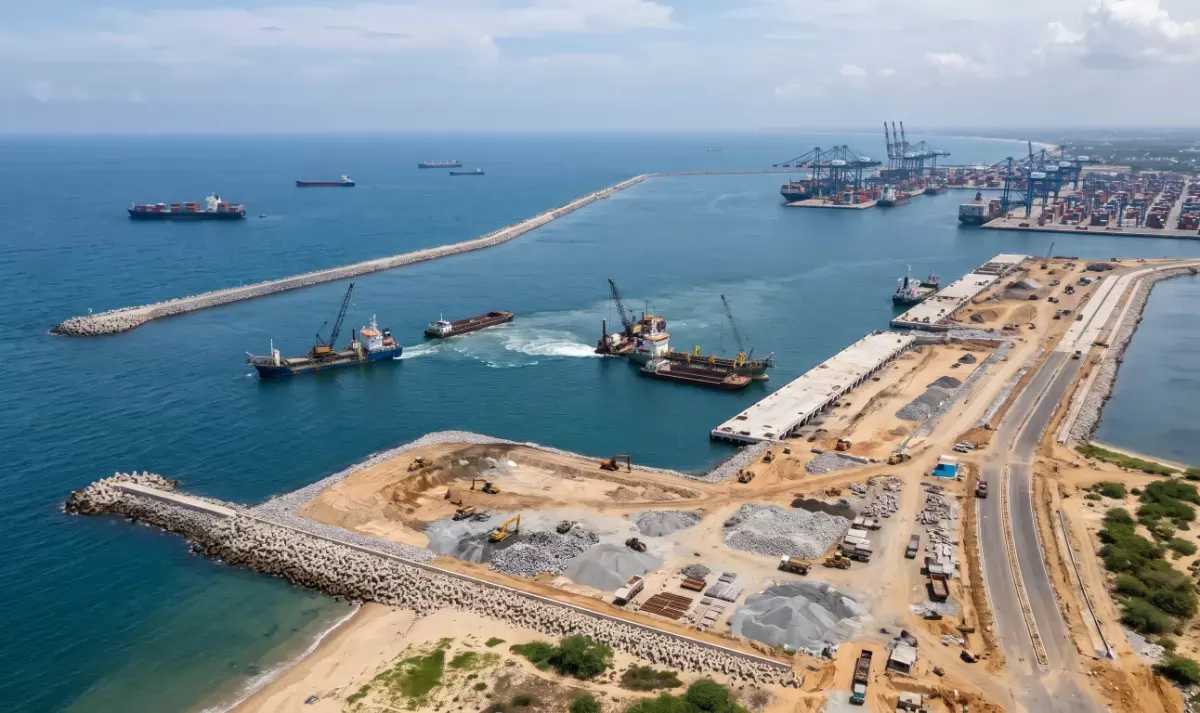
Three infrastructure firms are competing for the marine infrastructure contract at V.O. Chidambaranar Port in Thoothukudi, marking a critical juncture for a project that has struggled through repeated procurement failures since its initial announcement over a decade ago. Adani Ports and Special Economic Zone (APSEZ), Megha Engineering and Infrastructures (MEIL), and Vishwa Samudra Engineering submitted bids for the ₹11,733.28 crore package, with technical bids opened on 7 November 2026 . No contract award has been announced, and the port authority has not indicated a timeline for final selection.
The project has been restructured under the Hybrid Annuity Model (HAM) after two unsuccessful attempts under a Design, Build, Finance, Operate and Transfer (DBFOT) framework. In the first round, two bidders submitted proposals but neither met qualification criteria; the second round attracted no bids at all . The shift to HAM separates the basic marine infrastructure—breakwaters, dredging, reclamation, and wharfs—from the revenue-generating container terminal operations, which remain under a separate DBFOT concession .
The total appraised cost of the outer harbour development is approximately ₹17,167 crore, comprising ₹11,733.28 crore for the HAM component and ₹5,434.09 crore for terminal development under DBFOT . The marine works include breakwaters, rock bunds, wharfs, capital dredging, land reclamation, two 1,000-metre berths, and a gate-access corridor with a six-lane road. The two container terminals are designed for a combined annual capacity of 5.2 million TEUs .
A key revision in the restructured project is the increase in vessel draft from 16 metres to 18 metres, enabling the port to accommodate container ships of up to 24,000 TEUs, compared to the earlier design capacity of 18,000 TEUs . This change has significantly expanded the scope of dredging: the quantity has increased from 10.96 million cubic metres to 20.30 million cubic metres, while the approach channel will be extended from 8.6 kilometres to 10.5 kilometres and widened from 230 metres to 295 metres .
The port authority also amended the tender's qualification criteria after the failed rounds, replacing a dredging-and-reclamation experience requirement with a breakwater construction criterion. Bidders or consortium members must have completed at least two kilometres of breakwater construction in a single eligible project in India during the five years preceding the bid deadline . This change was designed to broaden the pool of eligible bidders beyond European dredging specialists and attract domestic infrastructure firms with relevant marine construction experience.
All three bidders qualify under the revised criteria. APSEZ's relevant experience includes the 2.96-kilometre breakwater at Vizhinjam Port in Kerala. MEIL constructed a 2.325-kilometre breakwater at Machilipatnam in Andhra Pradesh. Vishwa Samudra is developing a 3.435-kilometre breakwater at Mulapeta, also in Andhra Pradesh . The qualification pathway reflects the port authority's effort to break the dominance of specialised dredging contractors and attract bidders with demonstrated Indian coastal construction track records.
Under the HAM framework, the port authority will pay 45 percent of the relevant phase's bid project cost during construction through ten instalments, while the concessionaire arranges the balance and receives repayment through 20 half-yearly instalments. The appraisal provides for a four-year construction period and a ten-year annuity period. The separate DBFOT terminal concessions would run for 30 years, including a two-year construction period . The project's progress now depends on the evaluation of the three bids and the subsequent contract award, which would mark the transition from a decade of planning and failed procurement to actual construction.