
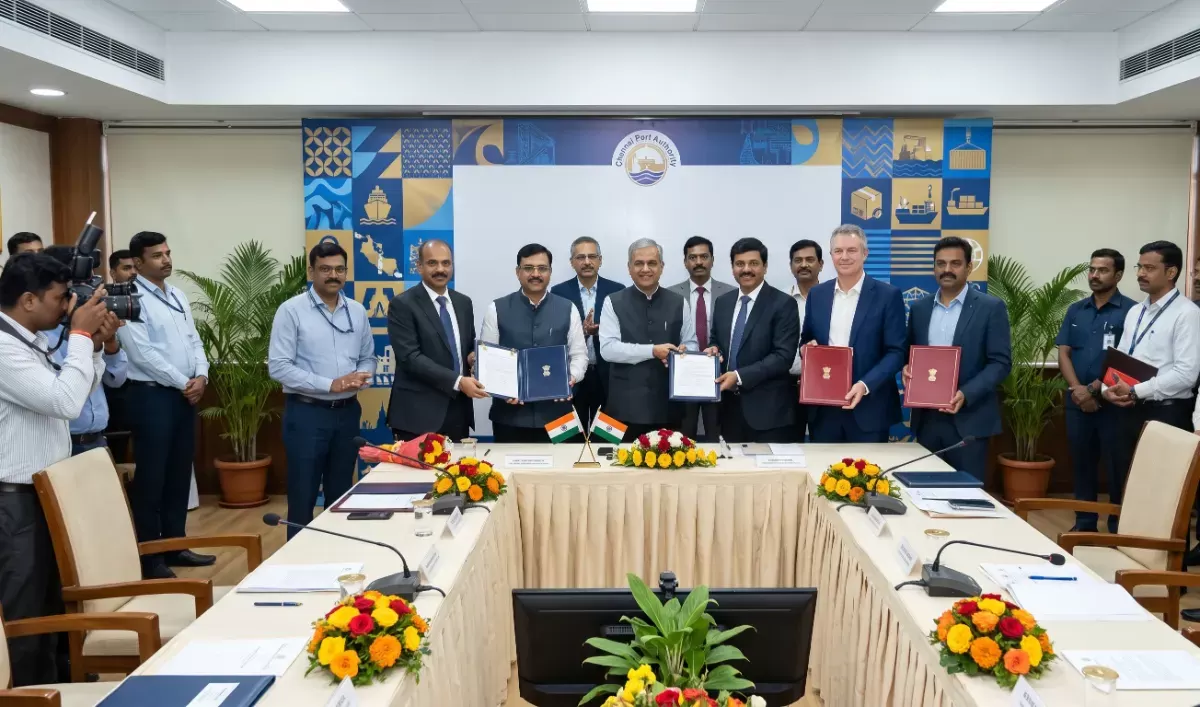
The Chennai Port Authority signed three separate Memorandums of Understanding on 14 November 2026, each targeting a distinct segment of the port's cargo and connectivity strategy. The agreements were exchanged in Chennai during a visit by Vijay Kumar, Secretary of the Ministry of Ports, Shipping and Waterways, who was at the port to review infrastructure development and consult with industry stakeholders. The three partnerships bring together a dry bulk cargo commitment, a regional container shipping link, and a rail connectivity arrangement, collectively aimed at expanding the port's cargo base and reinforcing its position as a gateway on India's eastern coast.
The first MoU, with MinSotrans, commits Chennai Port to handling approximately 1 million tonnes of dry bulk cargo over a three-year period under the port's Non-Containerised Cargo Incentive Scheme (NCCS). The commitment represents cumulative volume across the contract term rather than an annual figure. Dry bulk commodities—cargo transported unpackaged in large quantities—are a significant component of the port's non-containerised traffic, and the agreement is intended to support more efficient handling and movement of such cargo through Chennai's facilities. Specific commodity types, annual volume allocations, and vessel handling arrangements have not been publicly detailed.
The second agreement, with TCI Seaways, facilitates a proposed container service connecting Chennai Port with Ranong Port on Thailand's western coast under the BIMSTEC framework. The service had been under discussion between TCI Seaways and Chennai Port officials since October 2026, and the MoU moves the project from preliminary commercial talks into a formal cooperation phase. Ranong Port sits on the Andaman Sea, and the proposed link would provide a direct maritime connection between India's eastern seaboard and Thailand's western coast, adding a new option for containerised cargo movement between the two countries. The arrangement is expected to support greater maritime trade links among BIMSTEC member states and strengthen Chennai's role in regional container logistics.
The third MoU, with the Central Warehousing Corporation (CWC), focuses on improving railway connectivity and jointly promoting rail-based container traffic through Chennai Port. The partnership builds on earlier discussions between Chennai Port Authority Chairperson Sachin S. Kurve and CWC Managing Director Santosh Sinha regarding rail-linked hinterland expansion, with a focus on markets including Pollachi, Coimbatore, Hyderabad, and Mysore. Greater use of rail for container evacuation is intended to reduce reliance on road transport for suitable consignments, improve access to inland markets, and support more integrated multimodal logistics operations. Chennai Port's existing container rail promotion scheme already offers concessions on certain port rail charges and vessel-related fees for new rail cargo routes.
The MoUs were exchanged during a broader review of port operations and infrastructure by the Shipping Secretary, who inspected key facilities including Jawahar Dock (East and West), EXIM sheds, the Marshalling Yard, EC Landing, internal road infrastructure, and Bharathi Dock-II. He also took a tug ride to the proposed Outer Harbour Project area, which remains a central element of the port's long-term capacity expansion plans. The visit included a stakeholder consultation meeting with representatives from shipping lines, container train operators, terminal operators, logistics companies, and trade associations.
During the stakeholder meeting, industry representatives raised several infrastructure and operational demands. Companies including Hyundai, Indian Oil Corporation, and Suryadev Alloys and Power shared their cargo growth projections and highlighted the need for expanded port capacity. Key requests included additional storage facilities, dedicated berths for iron ore fines, and accelerated development of the proposed Outer Harbour Project to accommodate future cargo volumes. Stakeholders also noted that while Chennai Port's container export operations have been fully digitised, they called for extending digitisation to import processes to reduce manual handling and streamline cargo clearance.
The three agreements collectively reflect a multi-pronged approach to cargo development: securing committed dry bulk volume, opening a new regional container route under a multilateral framework, and strengthening the rail link between the port and its inland hinterland. Each addresses a different dimension of port competitiveness—volume certainty, geographic reach, and evacuation efficiency. The involvement of the Central Warehousing Corporation, a public sector warehousing entity, in the rail initiative signals an effort to integrate warehousing capacity with port-linked rail movement, potentially creating more seamless options for shippers moving goods between inland locations and the coast.
Whether these MoUs translate into sustained cargo growth will depend on execution. The MinSotrans commitment provides a volume floor for dry bulk operations over three years. The TCI Seaways arrangement requires the proposed Chennai–Ranong service to move from agreement to actual vessel deployment. The CWC partnership depends on operational coordination between port, rail, and warehousing entities to shift cargo from road to rail. For now, the port has secured formal commitments across all three fronts, and the next phase will test whether these partnerships deliver the cargo volumes and connectivity improvements they are designed to achieve.