
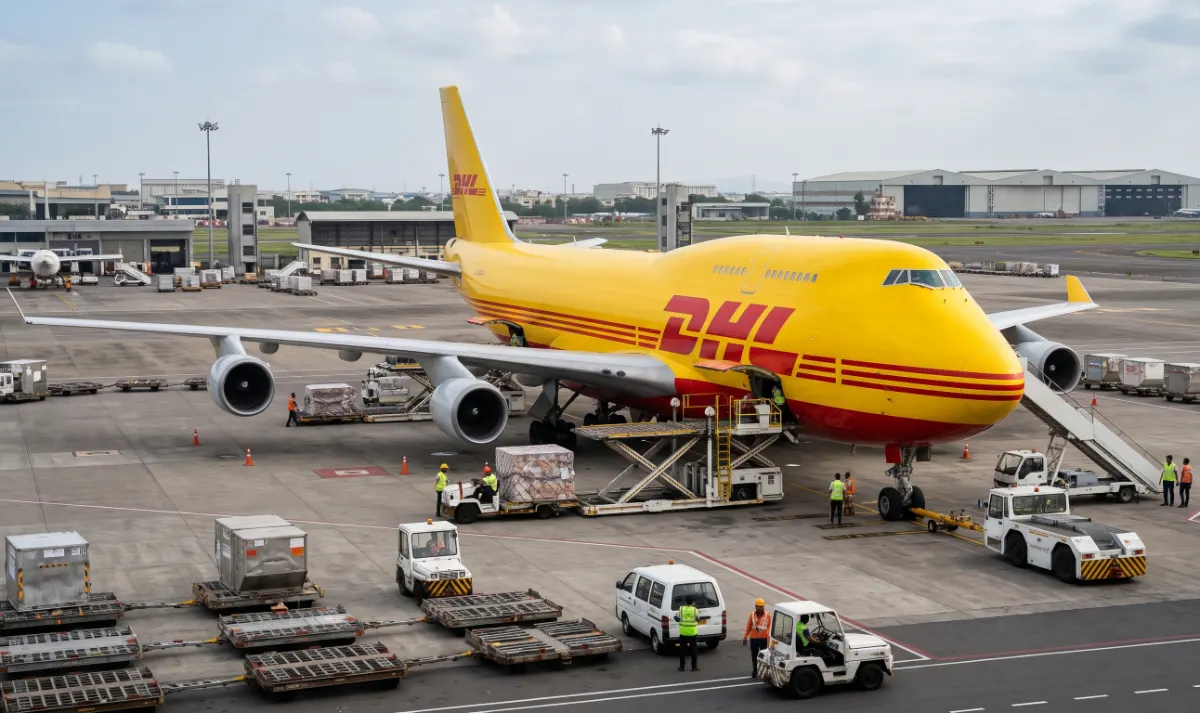
DHL Global Forwarding has formally launched a dedicated air freight connection linking Hong Kong, Navi Mumbai, and Liège, marking the first time the logistics giant has operated a dedicated freighter service specifically serving India. The twice-weekly rotation, operated with a Boeing 747 freighter under DHL Aviation as the airline supplier, is designed to provide reliable capacity on the China-India and India-Europe trade lanes at a time when demand for high-value air cargo continues to climb.
The new service carries approximately 100 tonnes of total aircraft capacity per flight. DHL Global Forwarding is initially targeting around 25 to 30 tonnes per flight for the India sectors, equivalent to roughly 50 to 60 tonnes per week, with room to scale as demand develops. The company described the launch as a response to strong growth in India's manufacturing and export sectors, particularly for products that require speed and reliability rather than purely cost-optimized routing.
From a network perspective, the Hong Kong–Navi Mumbai leg gives shippers in Hong Kong and mainland China direct dedicated access to the Mumbai region, while the Navi Mumbai–Liège segment opens additional capacity from India into Europe through DHL's European hub. From Liège, cargo can be connected onward across the broader European network, effectively extending the service's reach beyond the three named airports.
Henk Venema, Global Head of Air Freight at DHL Global Forwarding, framed the launch as a strategic bet on India's long-term role in global trade. "India is a strategic market for DHL Global Forwarding and an increasingly important part of our global air freight network," he said in the company's announcement. "With this new dedicated service, we are strengthening connectivity between China, India and Europe and providing our customers with reliable capacity and greater access to key growth markets".
The target cargo mix reflects the changing composition of India's export basket. DHL expects the service to support customers in life sciences and healthcare, technology and electronics, engineering, and advanced manufacturing. Typical shipments are expected to include pharmaceuticals, high-value technology components, industrial machinery, and precision parts—goods where air freight's speed premium is justified by product value or time sensitivity.
The India sector of the route is initially modest in scale, but DHL has signaled that the Mumbai service is not a standalone experiment. The company plans to add a Bengaluru-Europe freighter connection in March 2027, expanding its dedicated India-Europe connectivity beyond the Maharashtra gateway. Venema described the sequence as "part of our broader ambition to build a stronger air freight bridge between India and the rest of the world".
For shippers in western India, the service offers an alternative to relying on belly capacity or transshipment through third-country hubs for Europe-bound cargo. The direct Liège link reduces handling complexity and transit variability, which matters particularly for pharmaceutical shipments and electronics components that may be subject to tight delivery windows or temperature-controlled requirements.
The launch also underscores a broader pattern in South Asian air cargo: as manufacturing shifts and export complexity increase, dedicated freighter capacity is moving from a nice-to-have to a competitive necessity. DHL's decision to commit aircraft to the India sector, even at modest initial volumes, signals confidence that the trade lane will justify the investment. The March 2027 Bengaluru addition will be the next test of whether that confidence translates into sustained demand.