
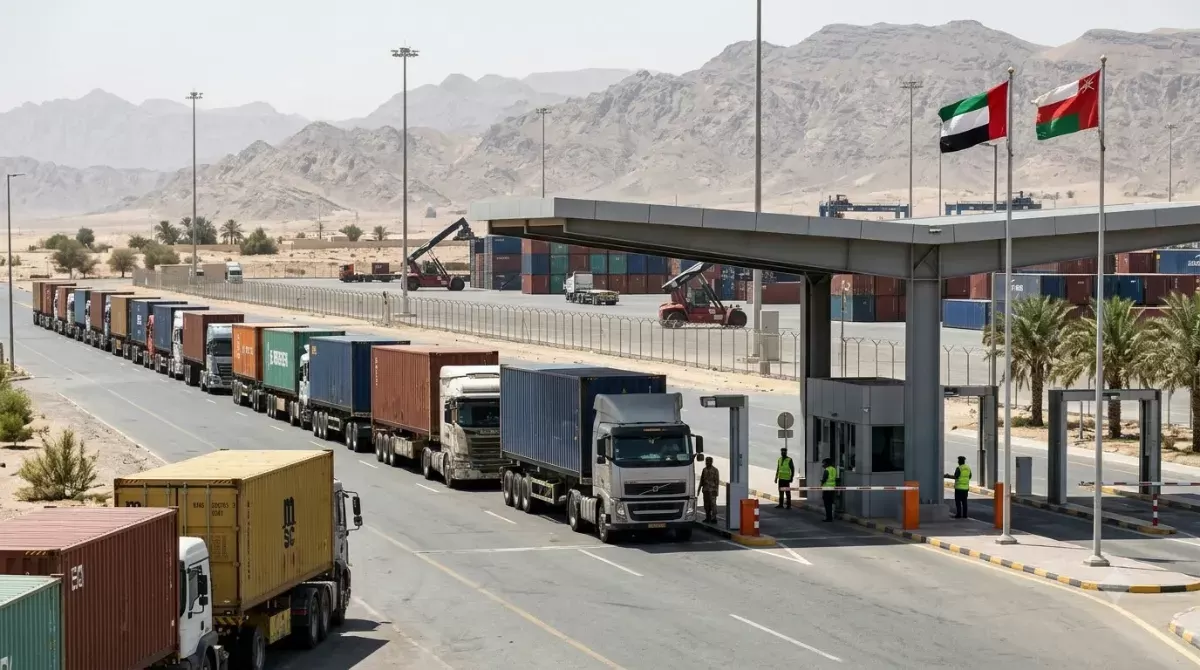
Oman and the United Arab Emirates have opened a new multimodal transport corridor linking Duqm Port on Oman's Arabian Sea coast to Khalifa Port in Abu Dhabi, creating an alternative route for cargo moving between the two countries and into the wider Gulf region . The corridor, reported by Belarusian state news agency BelTA citing Omani newspaper Al Shabiba, is already handling weekly shipments, with volumes expected to increase over time.
The operational model combines sea and road transport. Cargo is first shipped by sea to Duqm Port, then transported by truck through the Khatm ash-Shikla border crossing and Al Ain Dry Port before reaching Khalifa Port . From Khalifa, goods are dispatched to markets in other Gulf countries, making the corridor a transit route as well as a bilateral link between Oman and the UAE. The two countries have simplified customs procedures to accelerate border crossings, a critical enabler for time-sensitive cargo that cannot tolerate extended clearance delays.
The corridor is part of Oman's broader effort to develop its ports as regional logistics hubs. It complements existing routes from Duqm to Qatar and Saudi Arabia, and from Sohar to other Gulf states . Oman has been investing in its port infrastructure and land connections as part of a national strategy to capture a larger share of regional transit trade, and the Duqm–Khalifa corridor adds a direct link to the UAE's largest port complex.
For the region's logistics sector, the new corridor provides an alternative to routes that depend on the Strait of Hormuz. Duqm sits outside the chokepoint, on Oman's Arabian Sea coast, and cargo moving through Duqm to Khalifa bypasses the Hormuz transit entirely. This is significant in the context of the ongoing disruption to Hormuz shipping, as shippers and carriers seek routes that reduce exposure to the contested waterway. The corridor is not a substitute for the large-scale container transshipment operations at Jebel Ali or the other Gulf hubs, but it adds a land-based option for cargo moving between Oman and the UAE.
For Indian exporters and importers, the corridor has indirect relevance. India has been deepening its trade ties with both Oman and the UAE, and the new route could facilitate cargo movement between Indian ports and the UAE via Oman, bypassing Hormuz. However, the corridor's current scale is modest, with weekly shipments and no disclosed volume figures, and its impact on India–Gulf trade will depend on whether it attracts sufficient cargo to justify more frequent services and additional investment.
The timing of the corridor's opening aligns with the broader pattern of Gulf states developing alternative logistics routes in response to the Hormuz disruption. The UAE has been using land corridors to bypass Hormuz for its own trade, and Oman has been positioning Duqm as an alternative gateway. The Duqm–Khalifa corridor connects these two strategies, creating a route that uses Oman's outside-Hormuz geography and the UAE's distribution network.
Looking ahead, the key question is whether the corridor can scale beyond weekly shipments and attract cargo from a wider range of origins and destinations. The two countries have not disclosed investment figures or capacity targets, and the corridor's commercial viability will depend on whether shippers find it competitive with established routes. For now, the opening signals that Gulf states are actively building redundancy into their logistics networks, and that the Hormuz disruption is accelerating the development of land-based alternatives that may outlast the current crisis.