
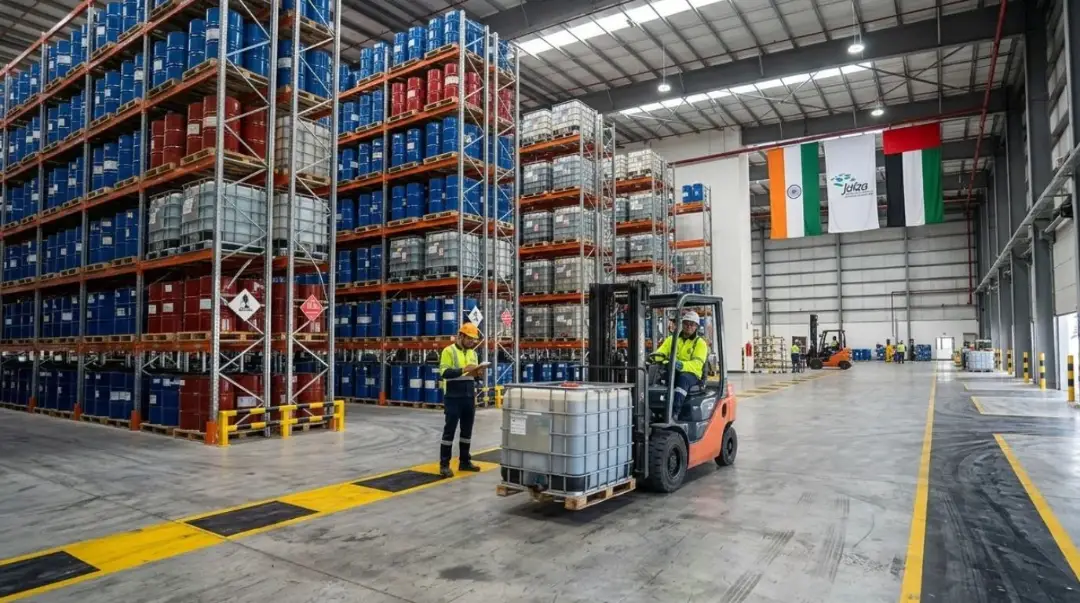
India has opened its first overseas chemical warehouse at Jebel Ali Free Zone in Dubai, giving Indian exporters a base to store products closer to buyers and accelerate deliveries across the Middle East, Africa, Europe, and Asia . The facility, inaugurated on 16 November 2026, was established by CHEMEXCIL under the Ministry of Commerce and Industry and Apex Logistics, in partnership with MOL INDU Warehousing and Logistics, with support from Jafza .
The warehouse is part of India's FLOW initiative—Facilitating Logistics, Overseas Warehousing and Fulfilment—under the Export Promotion Mission. Dubai is the starting point for a broader network of overseas chemical warehouses planned across 30 markets . The facility provides integrated logistics services including regulatory-compliant storage, real-time inventory monitoring, customs coordination, order fulfilment, labelling, and sorting .
The operational logic addresses a specific constraint that has limited Indian chemical exports to the Gulf. Vishal Ganju, Executive Director of CHEMEXCIL, explained that Indian MSMEs often lose orders because they cannot maintain stock close to buyers. With inventory held in Dubai, an exporter can promise next-day delivery to UAE customers, which changes the competitive dynamics of contract negotiations . India currently supplies only 6.3% of the UAE's chemical imports, leaving substantial room for expansion .
The facility is located within Jafza's chemical industry cluster, which hosts more than 532 petrochemical companies from over 70 countries and over 2,300 Indian businesses . Abdulla Al Hashmi, Global COO of Parks and Economic Zones at DP World, noted that more than 200 chemical companies have joined Jafza since 2021, with Indian businesses accounting for nearly a quarter—the largest share among individual countries . He highlighted the role of the UAE–India Comprehensive Economic Partnership Agreement in reducing tariffs and enabling Indian exporters to manufacture, store, and re-export from a single UAE hub .
The four-partner structure divides responsibilities: CHEMEXCIL mobilises Indian exporters, particularly MSMEs; Apex Logistics manages the programme including inventory monitoring and fulfilment; MOL INDU provides chemical-grade warehousing operations; and Jafza supplies the free-zone infrastructure, multimodal connectivity, and regulatory environment . The collaboration is intended to give Indian exporters reliable logistics services and improved access to Gulf, African, and other markets .
For India's export logistics sector, the Jafza warehouse represents a shift from port-to-port shipping to overseas stockholding as a competitiveness strategy. The FLOW initiative recognises that for MSME exporters, the ability to hold inventory near the customer can be as important as the cost of moving goods from India. The planned expansion to 30 markets indicates that the government views this model as scalable, and the chemical sector—with its specialised storage requirements and regulatory compliance needs—is a logical starting point.
Looking ahead, the key question is whether the warehouse delivers the order conversion improvements that CHEMEXCIL expects, and whether the model can be replicated in other markets and sectors. The launch comes as India targets more than doubling its chemical exports to $60 billion by 2030 . For now, the Jafza facility provides a concrete test of whether overseas warehousing can help Indian MSMEs compete for contracts that they currently lose to suppliers with local stock.