
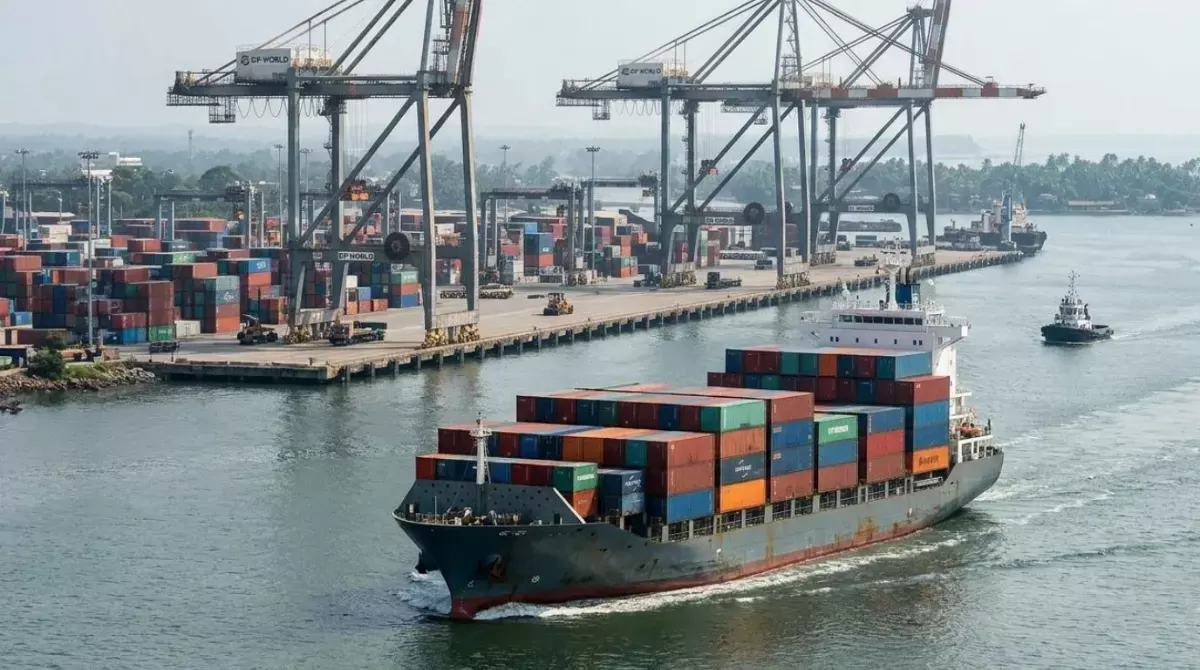
DP World has strengthened maritime connectivity between India and Sri Lanka with the introduction of a second weekly service connecting Cochin and Colombo, adding sailing frequency on a corridor that serves as a key transshipment link for southern India's exporters and importers . The new service, designated SIS, is operated by Bengal Tiger Line and follows a Mangalore–Cochin–Colombo–Mangalore rotation, calling at DP World's International Container Transshipment Terminal at Kochi .
The operational structure of the service reflects the role that the Cochin–Colombo corridor plays in southern India's trade. Cargo moving between Mangalore and Cochin is carried in both directions on the rotation, giving shippers on the Kanara coast and in Kerala a direct connection to Colombo's transshipment hub without relying solely on road transport or less frequent sailings . From Colombo, containers can connect to mainline services to Europe, the Middle East, and East Asia, extending the reach of southern India's export cargo beyond the regional feeder network.
The inaugural vessel, MV TC Symphony, berthed at DP World Cochin with a capacity of approximately 1,000 TEUs . That vessel size is appropriate for a regional feeder service, matching slot supply to the demand on the corridor rather than deploying capacity that the trade lane cannot absorb. The second weekly sailing effectively doubles the frequency on the Cochin–Colombo leg, giving cargo planners more options for meeting vessel cut-offs and managing inventory cycles.
Hemant Kumar Ruia, Country Manager for the Subcontinent at DP World, framed the service in terms of India's broader trade ambitions. "As India continues to strengthen its position as a global manufacturing and trade hub, seamless maritime connectivity with key regional markets is increasingly important to sustaining trade growth and competitiveness," he said . He added that the second weekly service offers businesses greater flexibility, improved access to international shipping networks, and more reliable supply chains .
The timing of the launch aligns with the broader pattern of DP World's India-focused investments. The company has also launched a twice-weekly export rail service connecting the National Capital Region to Mundra Port, and it handles a significant share of India's EXIM container market through its terminal network . The Cochin–Colombo service complements these rail and port investments by strengthening the southern gateway that connects Kerala and Karnataka's industrial and agricultural hinterlands to global markets.
For Cochin Port, the additional sailing reinforces its position as a transshipment gateway for southern India. The port has been investing in connectivity and operational efficiency, and the second weekly Colombo call adds frequency that can make the Cochin route more attractive to shippers who might otherwise route cargo through other gateways. The service also supports the port's broader role in Kerala's maritime economy, which the state government has been promoting through its Mission Samudra initiative.
Looking ahead, the sustainability of the second weekly service will depend on cargo uptake from southern India's exporters and importers. The inaugural sailing establishes the frequency, but the commercial success of the service will be measured by whether shippers on the Mangalore–Cochin–Colombo corridor adopt the additional sailing in sufficient volumes to justify its continuation. For now, the launch signals that DP World sees durable demand for southern India's transshipment connectivity, and that the Cochin–Colombo corridor is being strengthened as a complement to the larger gateways on India's western coast.