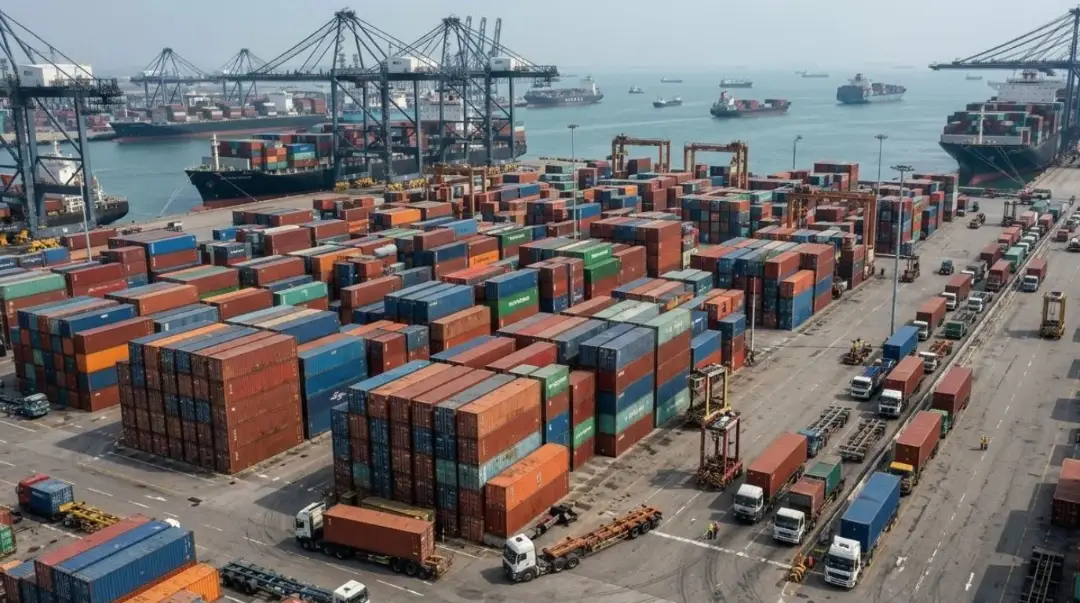
<p class="ds-markdown-paragraph" style="margin: 16px 0px; color: rgb(15, 17, 21); font-family: quote-cjk-patch, Inter, system-ui, -apple-system, BlinkMacSystemFont, "Segoe UI", Roboto, Oxygen, Ubuntu, Cantarell, "Open Sans", "Helvetica Neue", sans-serif; font-size: 16px;"><span class="">Western Carriers (India) Ltd has reported a 10% year-on-year growth in container volumes for the first half of FY 2026–27, reaching 117,604 TEUs despite what management described as global geopolitical challenges . The results, disclosed during the company's Q2 FY27 earnings call on 16 November 2026, provide a window into how a mid-sized Indian multimodal logistics operator is navigating the disruptions that have reshaped the sector throughout the year.</span></p><p class="ds-markdown-paragraph" style="margin: 16px 0px; color: rgb(15, 17, 21); font-family: quote-cjk-patch, Inter, system-ui, -apple-system, BlinkMacSystemFont, "Segoe UI", Roboto, Oxygen, Ubuntu, Cantarell, "Open Sans", "Helvetica Neue", sans-serif; font-size: 16px;"><span class="">The volume growth was driven primarily by the domestic segment. Domestic container volumes grew 21% quarter-on-quarter to 28,933 containers, supported by the Morbi multimodal logistics park and new customer additions . The company has been diversifying its customer base, reducing its dependence on metals from roughly 60% to nearly 50%, with growth in tiles, ceramics, chemicals, and FMCG sectors . This diversification reflects a deliberate strategy to reduce exposure to any single commodity cycle and to build a broader base of recurring logistics demand.</span></p><p class="ds-markdown-paragraph" style="margin: 16px 0px; color: rgb(15, 17, 21); font-family: quote-cjk-patch, Inter, system-ui, -apple-system, BlinkMacSystemFont, "Segoe UI", Roboto, Oxygen, Ubuntu, Cantarell, "Open Sans", "Helvetica Neue", sans-serif; font-size: 16px;"><span class="">The financial performance showed improvement at the operating level. EBITDA for Q2 FY27 increased 17% year-on-year to ₹21.9 crore, and profit after tax grew 4.25% quarter-on-quarter to ₹9 crore . These gains reflect improved operational efficiency and the benefit of higher domestic volumes, which partially offset the weakness in the EXIM segment. The company also inaugurated a general goods terminal at SMP Port Trust in Kolkata, which is expected to generate incremental volumes from Q3 FY27 onwards .</span></p><p class="ds-markdown-paragraph" style="margin: 16px 0px; color: rgb(15, 17, 21); font-family: quote-cjk-patch, Inter, system-ui, -apple-system, BlinkMacSystemFont, "Segoe UI", Roboto, Oxygen, Ubuntu, Cantarell, "Open Sans", "Helvetica Neue", sans-serif; font-size: 16px;"><span class="">The EXIM segment, however, presented a contrasting picture. EXIM volumes declined quarter-on-quarter to 30,410 TEUs from 34,352 TEUs, which management attributed to erratic vessel schedules, port congestion, and geopolitical disruptions . The company's EBITDA margins have compressed from high single digits to 4–5%, primarily due to supply chain inefficiencies and unpredictable EXIM trade conditions . This margin pressure is a direct consequence of the operational environment that has affected the entire logistics sector, and it illustrates how even a diversified operator with growing domestic volumes can see profitability eroded by external disruptions.</span></p><p class="ds-markdown-paragraph" style="margin: 16px 0px; color: rgb(15, 17, 21); font-family: quote-cjk-patch, Inter, system-ui, -apple-system, BlinkMacSystemFont, "Segoe UI", Roboto, Oxygen, Ubuntu, Cantarell, "Open Sans", "Helvetica Neue", sans-serif; font-size: 16px;"><span class="">Management provided a candid explanation of the margin dynamics. The CEO noted that complex supply chain disruptions, erratic vessel schedules, and port congestion affect margins because assets face congestion and damage at peak periods and then sit idle afterward . For example, if 1,000 containers that would normally be evacuated at 250 per week all arrive at once, the system is overwhelmed and then underutilised. The company has learned to manage these inefficiencies, and margins are now improving, but a normalisation of EXIM trade would be required for a major change in both top line and bottom line.</span></p><p class="ds-markdown-paragraph" style="margin: 16px 0px; color: rgb(15, 17, 21); font-family: quote-cjk-patch, Inter, system-ui, -apple-system, BlinkMacSystemFont, "Segoe UI", Roboto, Oxygen, Ubuntu, Cantarell, "Open Sans", "Helvetica Neue", sans-serif; font-size: 16px;"><span class="">On the cost side, Western Carriers has protected itself against some external risks. Road costs are covered by a Diesel Price Variation Clause with all large corporates, and rail haulage increases are a pass-through to customers . What is not passed through is the company's own operational inefficiency, which management is addressing through better planning and asset utilisation. The CEO also noted that increasing the share of rail-based logistics is expected to benefit operating costs and margins over the long term, with 75–80% of the company's work already linked to multimodal logistics.</span></p><p class="ds-markdown-paragraph" style="margin: 16px 0px; color: rgb(15, 17, 21); font-family: quote-cjk-patch, Inter, system-ui, -apple-system, BlinkMacSystemFont, "Segoe UI", Roboto, Oxygen, Ubuntu, Cantarell, "Open Sans", "Helvetica Neue", sans-serif; font-size: 16px;"><span class="">Looking ahead, the company sees scope for compounded growth on both domestic and EXIM cylinders. The Morbi facility is still only about one-third of optimal capacity utilisation, and Phase 2 is expected to be fully operational in the next couple of quarters . With EXIM also expected to recover as trade conditions normalise, management believes the company is positioned to benefit from growth in both segments. The key variable will be whether the EXIM recovery materialises, and whether the margin pressure from port congestion and vessel schedule disruptions eases as the global shipping environment stabilises.</span></p>
Western Carriers Reports 10% Volume Growth in H1 FY27 Despite EXIM Margin Pressure from Port Congestion
Western Carriers (India) Ltd reported a 10% year-on-year growth in container volumes for H1 FY27, reaching 117,604 TEUs despite global geopolitical challenges, according to its Q2 FY27 earnings call on 16 November 2026. Domestic container volumes grew 21% quarter-on-quarter to 28,933 containers, driven by the Morbi facility and new customer additions. EBITDA for Q2 FY27 increased 17% year-on-year to ₹21.9 crore, while PAT grew 4.25% quarter-on-quarter to ₹9 crore. However, EXIM volumes declined QoQ to 30,410 TEUs from 34,352 TEUs due to erratic vessel schedules, port congestion, and geopolitical disruptions.