
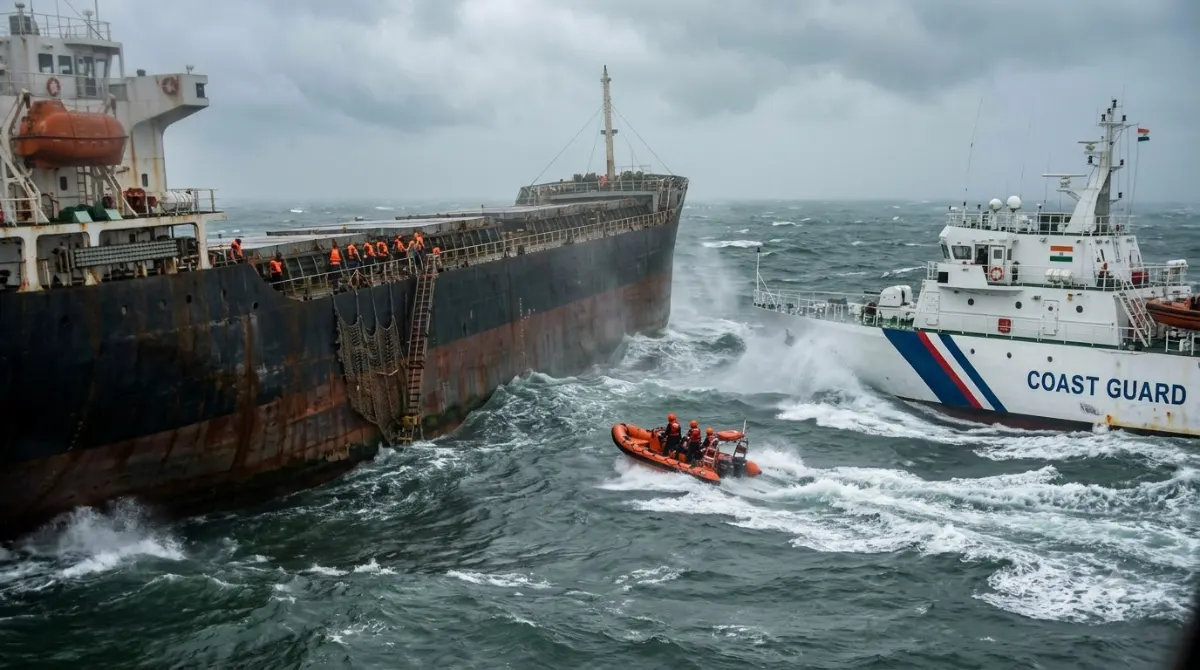
The Paradip Port Authority and the Indian Coast Guard averted a major maritime disaster off the Odisha coast, rescuing all 27 crew members of the distressed vessel MV Vishva Uday after it reported severe engine room flooding and a propeller shaft breakdown approximately 50 nautical miles off Paradip Port . The vessel was en route from Haldia Port in West Bengal to Mozambique in East Africa when its propeller shaft became dysfunctional, leaving it stranded in open sea as water began entering the hull .
The operation was initiated following an urgent communication from the Shipping Corporation of India, which reported the vessel's condition at coordinates 19°47'N 087°22'E . After receiving approval from the Directorate General of Marine Administration, two tugboats—Dolphin-25 and Dolphin-20—sailed from Paradip Port at 12:30 PM on 16 November . The operation was led by Harbour Master Captain Indranil Mukherjee, with Dolphin-25 taking the lead and Dolphin-20 providing support.
The Indian Coast Guard also deployed ICGS Amulya and ICGS Vijaya during the intervening night of 15–16 November after the vessel reported flooding caused by a damaged tail shaft . A specialist Damage Control Team boarded the distressed vessel, rigged submersible pumps, and successfully arrested the water ingress despite adverse sea conditions. The coordinated effort between the port authority and the Coast Guard was critical to preventing the vessel from sinking before the tugs could bring it under tow.
The vessel was successfully towed to safety and anchored off the outer port limits on the morning of 17 November . Paradip Port Chairman Sushanta Kumar Purohit commended the Marine Department and all teams involved, emphasising the importance of maritime safety, emergency response, and operational preparedness . The port's Public Relations Officer, Rati Ranjan Nayak, said the successful operation reflected the port's commitment to saving lives at sea and ensuring maritime safety.
The rescue highlights the operational capabilities that Paradip Port has developed for emergency response in the Bay of Bengal. The port maintains tugboats and trained personnel for maritime incidents, and the coordination with the Coast Guard and DGMA demonstrates the multi-agency framework that governs maritime search and rescue in Indian waters. The vessel's crew of 27 was exposed to significant risk during the flooding, and the outcome—all hands safe and the vessel salvaged—reflects the effectiveness of that framework when activated promptly.
For India's maritime sector, the incident is a reminder of the risks that commercial shipping faces even outside the high-profile conflict zones that dominate headlines. Mechanical failures, adverse weather, and flooding remain persistent hazards for vessels operating in the Bay of Bengal, and the response capability that Paradip demonstrated is a critical component of India's maritime safety infrastructure. The successful salvage also avoids the environmental consequences that a sinking vessel could have caused, particularly given the vessel's voyage from Haldia to Mozambique.
Looking ahead, the vessel will require repairs before it can resume its voyage, and the investigation into the propeller shaft failure may inform maintenance and inspection protocols for similar vessels. For Paradip Port, the operation reinforces its role as a first responder for maritime emergencies on India's eastern coast, and it provides a case study in the coordination between port authorities, the Coast Guard, and the DGMA that underpins India's maritime safety regime.