
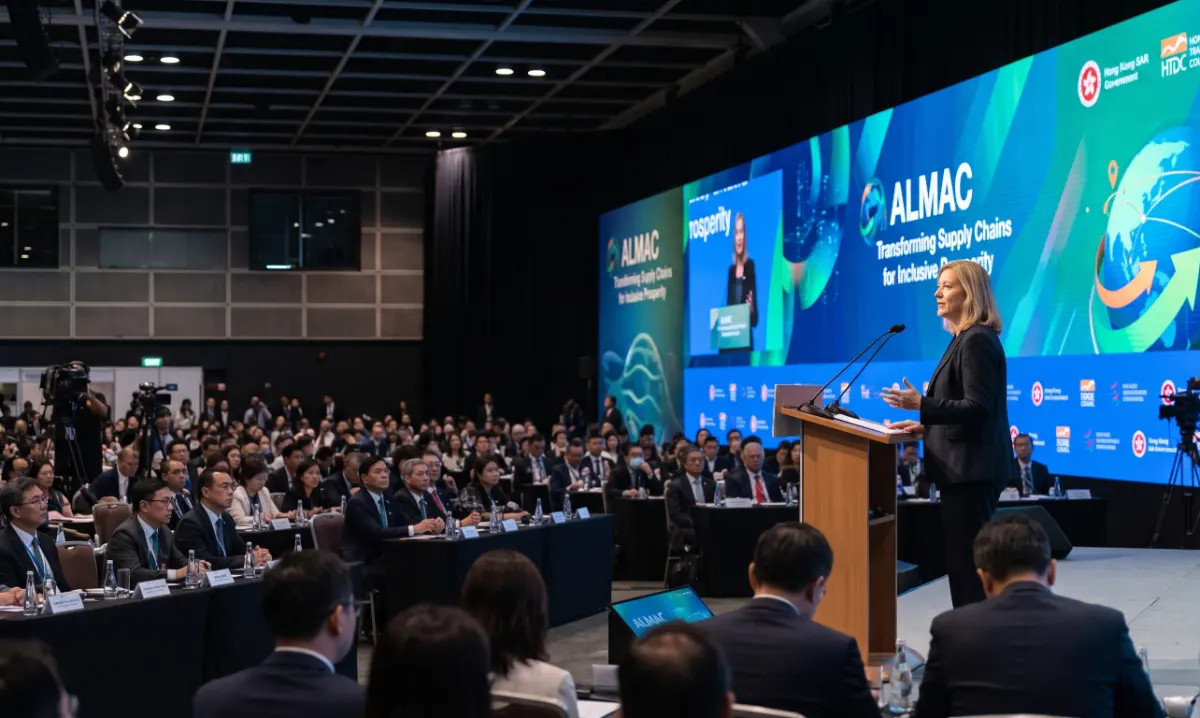
Nordquist delivered the keynote address titled “Global Spectrum: Transforming Supply Chains for Inclusive Prosperity” on November 16 at the conference co-hosted by the Hong Kong SAR Government and the Hong Kong Trade Development Council . She noted that WTO members introduced 466 trade facilitation measures in the first half of 2026 alone, exceeding the total for all of 2025, with much of the work focused on responding to disruptions caused by the Hormuz situation .
Nordquist revealed that global merchandise trade volume is expected to grow 3.9% in 2026, double the earlier forecast of 1.9%, and further expand 4.1% in 2027; commercial services trade is projected to grow 3.3% this year and 6.4% next year . She attributed this resilience to strong demand for AI-related goods and businesses' ability to adapt to changing trade conditions, stating: “Global trade is not disappearing in the face of uncertainty; it is adapting and evolving” .
For policymakers, Nordquist outlined four priorities: maintaining fair trade policies, investing in infrastructure, simplifying border procedures, and strengthening international cooperation . She particularly emphasized that simplifying cross-border procedures can directly reduce logistics time and costs, which is of practical significance for improving supply chain efficiency. She also noted that 72% of global goods trade currently operates under the WTO's most-favoured-nation framework, while governments are increasingly concerned about economic and national security risks and “over-dependence” .
For businesses, Nordquist recommended supplier diversification to reduce over-reliance on a few markets, active adoption of digital technologies, and building cross-network partnerships in new markets . This advice directly addresses the logistics and procurement challenges businesses face amid geopolitical uncertainty. In the South Asia and Middle East contexts, the series of shipping disruptions caused by the Hormuz situation has precisely demonstrated the practical value of supplier and route diversification.
Nordquist's remarks were widely reported by Hong Kong media, with outlets such as Hong Kong Commercial Daily and Hong Kong Economic Times both highlighting “maintaining fair trade policies” and “simplifying cross-border procedures” as core messages in their headlines . This indicates that policy certainty and trade facilitation are among the issues of greatest concern to the Asian logistics industry.
The 16th ALMAC, themed “Driving Inclusive Growth through Innovation and Sustainability,” brought together approximately 80 speakers and over 2,300 participants from more than 40 countries and regions . The conference agenda also covered supply chain resilience, green energy transition, the Silk Road Maritime thematic seminar, and other topics, aligning with the direction of regional logistics policy discussions.