
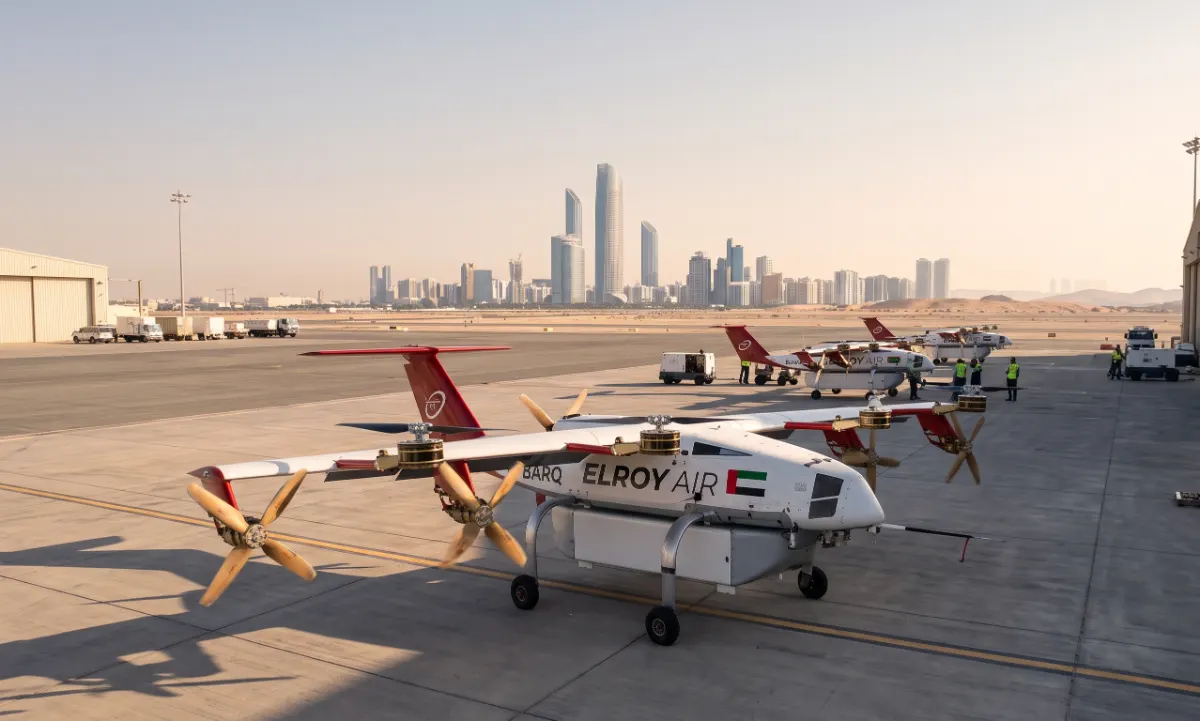
The agreement was announced jointly by Elroy Air and Barq Group, marking one of the largest commitments to autonomous heavy-cargo drone technology in the MENA region. The deal covers five firm orders, for which Barq Group has made a binding commitment and funded 50% of each aircraft's price through the initial deposit. The remaining fifteen aircraft are deposit-backed production slot reservations, with additional pre-delivery payments to secure those positions.
The Chaparral aircraft is designed to carry payloads of up to 500 pounds over a range of up to 450 miles without a pilot on board. Its hybrid-electric powertrain delivers the reliability of electric propulsion without requiring bespoke charging infrastructure, and its vertical takeoff and landing capability eliminates the need for runways or fixed receiving infrastructure. These characteristics make it suitable for operations in remote, austere, or contested locations that conventional aviation and logistics platforms struggle to reach.
Kratos Defense & Security Solutions, Chaparral's exclusive U.S. manufacturer, will produce the aircraft at its expanding facility in Sacramento, California, with initial production scheduled to commence in late 2026. This timeline aligns with Elroy Air's broader production plans, which also include a $46 million U.S. Army contract for further development of the Chaparral platform.
Ahmed AlMazrui, Founder and CEO of Barq Group, framed the order within Abu Dhabi's broader ambitions in autonomous aviation. He cited initiatives such as the SAVI cluster and "Make it in the Emirates" as enabling Barq to bring the Chaparral to the region, adding that the partnership aims to "redefine how critical cargo moves across the Middle East and North Africa while reinforcing Abu Dhabi's position as a global hub for autonomous aviation".
The purchase agreement builds on a previously announced collaboration between the two companies, which established a framework for a proposed $200 million joint venture to fund a manufacturing and services facility in Abu Dhabi. That facility would support production and distribution of the Chaparral across the MENA region, subject to definitive documentation and regulatory approvals. The JV remains a separate undertaking from the aircraft purchase agreement.
In a related incentive arrangement, Barq Group and Elroy Air signed a warrant agreement tied to UAE regulatory work and market penetration milestones. Under its terms, Barq Group is eligible to earn up to 5 million Elroy Air warrants, each with a strike price of $12.00 per share, vesting based on performance milestones related to the heavy-cargo drone's entry into the UAE market.
From a logistics perspective, the order signals growing interest in autonomous cargo aircraft as a complement to traditional air freight and road transport in the Gulf region. The Chaparral's ability to operate without runway infrastructure could open routes to offshore energy platforms, remote military outposts, and disaster-stricken areas where conventional logistics chains are slow or unavailable. For the Middle East's air cargo sector, which is already a global transshipment hub, the introduction of autonomous heavy-lift drones represents a potential new layer of connectivity for time-sensitive and hard-to-reach cargo.
Elroy Air is also in the process of becoming a publicly traded company through a business combination with Inflection Point Acquisition Corp., with the combined entity expected to trade on Nasdaq under the ticker ELRY. A shareholder vote on the transaction is scheduled for November 25, 2026. The Barq Group order provides a commercial backlog signal ahead of that listing.