
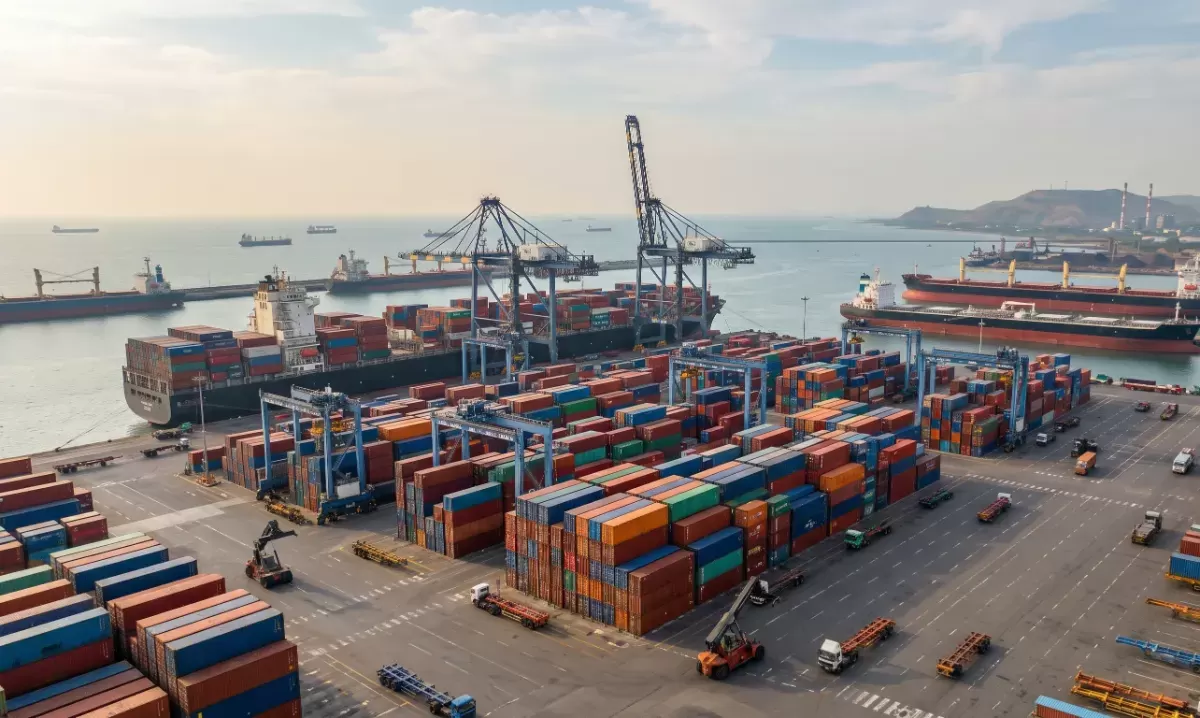
The Commerce Ministry data released in mid-November showed that India's merchandise exports hit a record $49.47 billion in October 2026, compared with $34.11 billion in the same month last year, marking the highest monthly growth rate in five years . Total exports including services reached $89.99 billion, up nearly 30% year-on-year . Commerce Secretary Rajesh Agrawal attributed the growth to broad-based diversification, noting that 43 of India's top 50 export destinations recorded positive growth during the month .
The surge was heavily concentrated in five sectors—engineering goods, petroleum products, electronic goods, gems and jewellery, and organic and inorganic chemicals—which together accounted for approximately 83% of the incremental export value . Engineering goods exports rose 36% to $12.74 billion, while petroleum product shipments surged 140.2% to $8.89 billion, reflecting India's position as a key beneficiary of the global diesel supply crunch . Electronic goods exports increased 62.7% to $6.64 billion .
However, the record export performance coincided with a sharp widening of the merchandise trade deficit to $39.88 billion, a one-year high and well above economists' expectations of $32.25 billion . The deficit expansion was driven partly by a near-tripling of gold imports to $5.51 billion ahead of Diwali, as well as elevated energy import costs amid West Asia disruptions . India imports roughly 85% of its crude oil requirements, leaving the import bill vulnerable to international price movements .
From a logistics and EXIM perspective, the sustainability of this export momentum hinges on several factors. Analysts at GTRI cautioned that the increase in export values may partly reflect higher global commodity and input prices rather than an equivalent rise in shipment volumes, noting that imports of rough diamonds rose 63.6% and petroleum products 57% during the month . This distinction matters for freight forwarders and transport operators, as volume growth—not just value inflation—determines actual cargo movement and logistics demand.
Editorial analysis published on November 17 highlighted that while trade agreements with the UK, New Zealand, and the forthcoming EU deal improve market access, Indian exporters—particularly smaller firms—face persistent challenges including non-tariff barriers in partner countries, ad hoc import restrictions on raw materials and intermediate inputs, and delays in shipments and customs clearances . These bottlenecks directly affect EXIM logistics efficiency and add to the cost of cross-border trade.
The trade deficit dynamics also have implications for the current account. The services surplus of approximately $19.8 billion helped cushion the overall trade deficit to $20.09 billion, down from $25.15 billion a year earlier . The Reserve Bank of India has projected a current account deficit of 1.2% of GDP for FY27, but sustained merchandise import growth could pressure that estimate if export volumes fail to keep pace with value gains .
For the logistics sector, the October data presents a mixed picture. Record export values translate into higher cargo throughput at ports and container terminals, but the concentration in petroleum and engineering goods means bulk and project cargo handling will benefit disproportionately compared with containerized consumer goods. The sustainability question will be answered in the coming quarters by whether export volumes—rather than just prices—continue to expand, and whether policymakers address the procedural and infrastructure friction points that exporters have consistently flagged.