
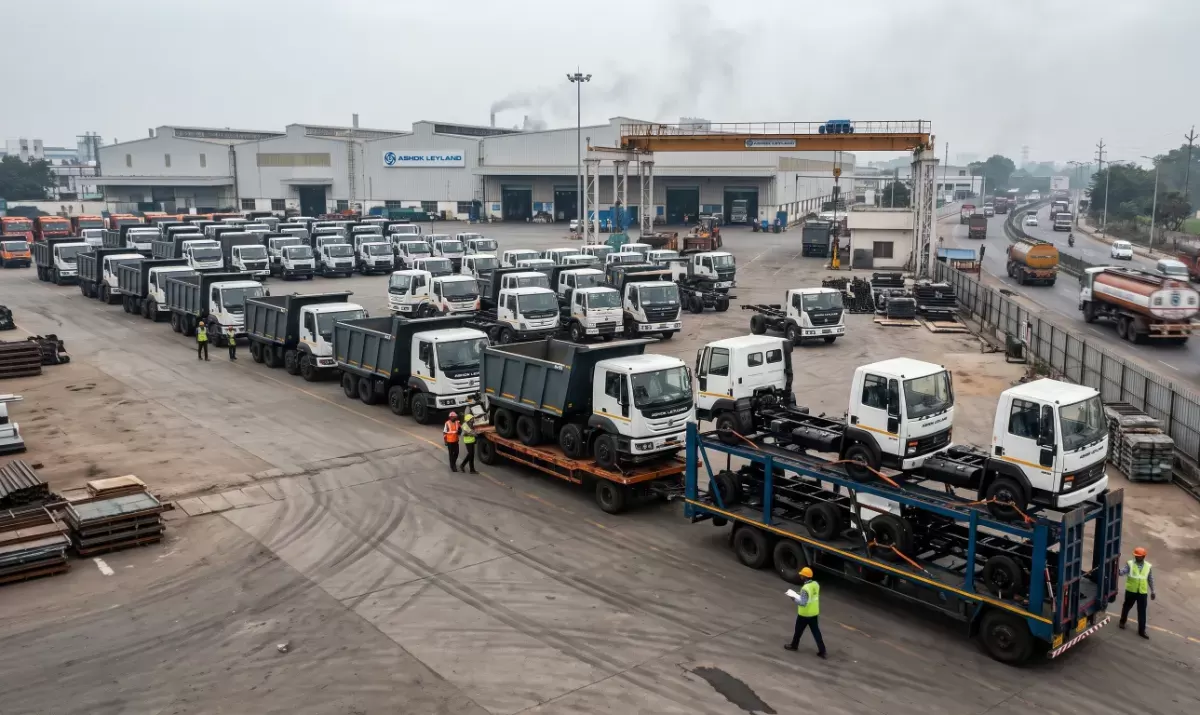
Ashok Leyland Managing Director and CEO Shenu Agarwal told analysts on November 16 that the cost of moving finished trucks and buses from factories to dealers had increased by more than 50% per vehicle over roughly one year . The disclosure came during the company's earnings call for the quarter ended September 30, 2026.
Chief Financial Officer K.M. Balaji attributed the increase to changes in diesel prices and higher rates sought by transport contractors. He noted that the company had accepted some of the rate revisions requested by transport operators, and that the freight cost is recorded under "other expenses," a line item that rose to ₹1,296 crore in the July–September quarter, up about 20% sequentially and 36% year-on-year .
The logistics cost inflation emerged against a backdrop of strong operational performance. Ashok Leyland reported its highest-ever second-quarter domestic commercial vehicle volume of 59,575 units, up 34% year-on-year, while standalone revenue from operations rose approximately 39% to ₹13,364 crore . However, EBITDA margin came in at 10.1%, flat sequentially but down from 12.1% a year earlier, partly reflecting the pressure from materials costs and higher expenses including logistics .
Agarwal framed the higher freight rates as a double-edged signal. While the increase weighs on Ashok Leyland's own distribution costs, firmer freight rates in the broader market reflect stronger demand for road transport, which in turn supports sales of new trucks. Domestic medium and heavy commercial vehicle sales rose 44% year-on-year, while light commercial vehicle volumes increased 21% to 21,371 units .
The company also faced separate pressures on its international operations. International volumes rose 7% to 5,102 units in the quarter, but Ashok Leyland said disruption in West Asia affected shipping availability, freight costs, and transit times. The company noted that the disruption also impacted production and dispatches linked to its Ras Al Khaimah facility in the United Arab Emirates .
The Ras Al Khaimah plant, which serves Gulf Cooperation Council markets and African countries, had previously experienced more severe disruptions earlier in 2026 when West Asia tensions escalated. At that time, shipping routes around the Strait of Hormuz were disrupted, forcing the company to temporarily scale down production and adjust workforce deployment . By November, the situation had eased to the point where vessels were available with waiting periods of roughly 15 days to a month, rather than the complete absence of shipping capacity seen earlier .
For fleet operators and transporters, the disclosure serves as a signal to monitor the freight-rate component when reviewing route economics. Diesel is one of the cost inputs specifically named on the call, alongside carrier capacity demand. However, the 50% figure applies specifically to Ashok Leyland's factory-to-dealer distribution leg and does not translate directly into a corresponding increase in vehicle retail prices .
The outbound logistics inflation at Ashok Leyland reflects a broader pattern across India's commercial vehicle sector, where manufacturers are navigating elevated fuel costs, constrained carrier capacity, and geopolitical disruptions to international shipping simultaneously. The company's ability to maintain volume growth despite these pressures suggests resilient underlying demand, but margin performance will remain sensitive to further movements in fuel prices and freight rates in the coming quarters.