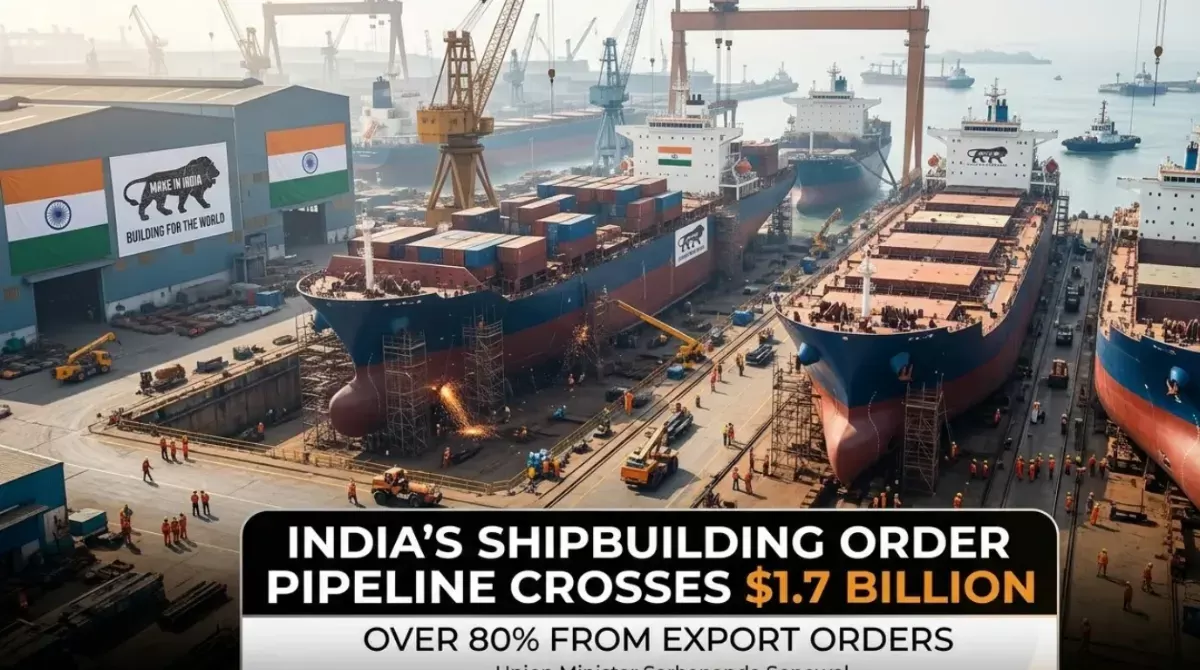
<p class="ds-markdown-paragraph" style="margin: 16px 0px; color: rgb(15, 17, 21); font-family: quote-cjk-patch, Inter, system-ui, -apple-system, BlinkMacSystemFont, "Segoe UI", Roboto, Oxygen, Ubuntu, Cantarell, "Open Sans", "Helvetica Neue", sans-serif; font-size: 16px;"><span class="">India's shipbuilding order pipeline has crossed $1.7 billion in value, with export orders accounting for more than 80% of the total, Union Minister for Ports, Shipping and Waterways Sarbananda Sonowal said on 16 November 2026 . Speaking at the India Shipbuilding Investment Conclave 2026 in New Delhi, Sonowal said the active pipeline comprises more than 150 vessels, and he framed the figures as evidence of growing international confidence in Indian shipbuilding capabilities and engineering standards.</span></p><p class="ds-markdown-paragraph" style="margin: 16px 0px; color: rgb(15, 17, 21); font-family: quote-cjk-patch, Inter, system-ui, -apple-system, BlinkMacSystemFont, "Segoe UI", Roboto, Oxygen, Ubuntu, Cantarell, "Open Sans", "Helvetica Neue", sans-serif; font-size: 16px;"><span class="">The composition of the order book is significant because it indicates that India's shipbuilding sector is not solely dependent on domestic demand. Sonowal cited CMA CGM's orders for emerging-fuel and dual-fuel LNG vessels with Indian shipyards as a reflection of trust in Indian engineering capabilities, and he highlighted South Korea's KSOE interest in developing the Thoothukudi mega greenfield shipyard as a sign of confidence in India's long-term maritime opportunities . The 80% export share suggests that Indian yards are winning work from international shipowners who are assessing them against global competitors, not simply benefiting from domestic procurement preferences.</span></p><p class="ds-markdown-paragraph" style="margin: 16px 0px; color: rgb(15, 17, 21); font-family: quote-cjk-patch, Inter, system-ui, -apple-system, BlinkMacSystemFont, "Segoe UI", Roboto, Oxygen, Ubuntu, Cantarell, "Open Sans", "Helvetica Neue", sans-serif; font-size: 16px;"><span class="">The existing shipbuilding base is also expanding. Sonowal said current Indian shipyards are investing more than $1 billion in capacity expansion, indicating that the private sector is committing capital to meet the order pipeline . This is a meaningful detail because shipbuilding capacity cannot be created overnight, and the willingness of existing yards to invest suggests that they see durable demand rather than a temporary spike in orders.</span></p><p class="ds-markdown-paragraph" style="margin: 16px 0px; color: rgb(15, 17, 21); font-family: quote-cjk-patch, Inter, system-ui, -apple-system, BlinkMacSystemFont, "Segoe UI", Roboto, Oxygen, Ubuntu, Cantarell, "Open Sans", "Helvetica Neue", sans-serif; font-size: 16px;"><span class="">The government's longer-term ambitions provide the policy context. India is targeting a place among the world's top 10 shipbuilding nations by 2030 and among the top five by 2047, with an annual shipbuilding capacity target of approximately 4.5 million gross tonnes . To support these goals, the Centre and the governments of Andhra Pradesh, Gujarat, Maharashtra, Odisha, and Tamil Nadu are working together to develop five greenfield shipbuilding clusters . These clusters are to be developed through dedicated special purpose vehicles, supported by central and state incentives, and designed to provide investors with ready land on long-term leases, common marine infrastructure, connectivity, and utilities.</span></p><p class="ds-markdown-paragraph" style="margin: 16px 0px; color: rgb(15, 17, 21); font-family: quote-cjk-patch, Inter, system-ui, -apple-system, BlinkMacSystemFont, "Segoe UI", Roboto, Oxygen, Ubuntu, Cantarell, "Open Sans", "Helvetica Neue", sans-serif; font-size: 16px;"><span class="">Sonowal stressed that the next challenge for India is converting growing international interest into consistent performance by delivering vessels that meet international quality standards within committed timelines . This is a candid acknowledgment that order bookings are not the same as successful execution, and that India's shipbuilding reputation will depend on whether its yards can deliver on their commitments. He also encouraged marine equipment manufacturers to establish operations in India, develop local supply chains, and use the country as a base for global exports, recognizing that a shipbuilding industry requires a broader ecosystem of component suppliers.</span></p><p class="ds-markdown-paragraph" style="margin: 16px 0px; color: rgb(15, 17, 21); font-family: quote-cjk-patch, Inter, system-ui, -apple-system, BlinkMacSystemFont, "Segoe UI", Roboto, Oxygen, Ubuntu, Cantarell, "Open Sans", "Helvetica Neue", sans-serif; font-size: 16px;"><span class="">The timing of the conclave aligns with the broader push to attract investment into Indian shipbuilding. The government has earmarked substantial funding for shipbuilding development, and the conclave was designed to move discussions toward concrete investment decisions, with global participants scheduled to visit proposed shipbuilding locations to assess their infrastructure and investment potential . The involvement of state governments in developing cluster SPVs indicates that the shipbuilding agenda is being operationalised at the state level, not just announced at the central level.</span></p><p class="ds-markdown-paragraph" style="margin: 16px 0px; color: rgb(15, 17, 21); font-family: quote-cjk-patch, Inter, system-ui, -apple-system, BlinkMacSystemFont, "Segoe UI", Roboto, Oxygen, Ubuntu, Cantarell, "Open Sans", "Helvetica Neue", sans-serif; font-size: 16px;"><span class="">For India's maritime sector, the $1.7 billion order pipeline is a tangible indicator that the shipbuilding strategy is beginning to generate commercial results. The Thoothukudi project with HD Hyundai/KSOE is the flagship, but the export orders flowing to existing yards show that India's shipbuilding capability is broader than a single mega-project. If the order pipeline continues to grow and the yards deliver on their commitments, India could establish a credible position in a market that has been dominated by China, South Korea, and Japan.</span></p><p class="ds-markdown-paragraph" style="margin: 16px 0px; color: rgb(15, 17, 21); font-family: quote-cjk-patch, Inter, system-ui, -apple-system, BlinkMacSystemFont, "Segoe UI", Roboto, Oxygen, Ubuntu, Cantarell, "Open Sans", "Helvetica Neue", sans-serif; font-size: 16px;"><span class="">Looking ahead, the key milestones are the conversion of the order pipeline into delivered vessels, the progress of the five greenfield clusters, and the ability of Indian yards to meet international quality and delivery standards. The $1.7 billion figure provides a benchmark against which future growth can be measured, and the export share indicates that India's shipbuilding ambitions are being tested in the global market rather than protected behind domestic demand. For now, the conclave has provided a platform for the government to articulate its shipbuilding vision and for industry to engage with the investment opportunities, and the coming years will show whether the pipeline translates into a durable shipbuilding industry.</span></p>
India's Shipbuilding Order Pipeline Crosses $1.7 Billion, Over 80% from Export Orders: Sonowal
Union Minister for Ports, Shipping and Waterways Sarbananda Sonowal said on 16 November 2026 that India's active shipbuilding order pipeline comprises more than 150 vessels valued at over $1.7 billion, with export orders accounting for more than 80% of the total value. Speaking at the India Shipbuilding Investment Conclave 2026 in New Delhi, Sonowal cited CMA CGM's orders for dual-fuel LNG vessels with Indian shipyards and South Korea's KSOE interest in the Thoothukudi greenfield yard as evidence of growing global confidence. Existing Indian shipyards are also investing more than $1 billion in capacity expansion, and five greenfield shipbuilding clusters are being developed with state governments.