
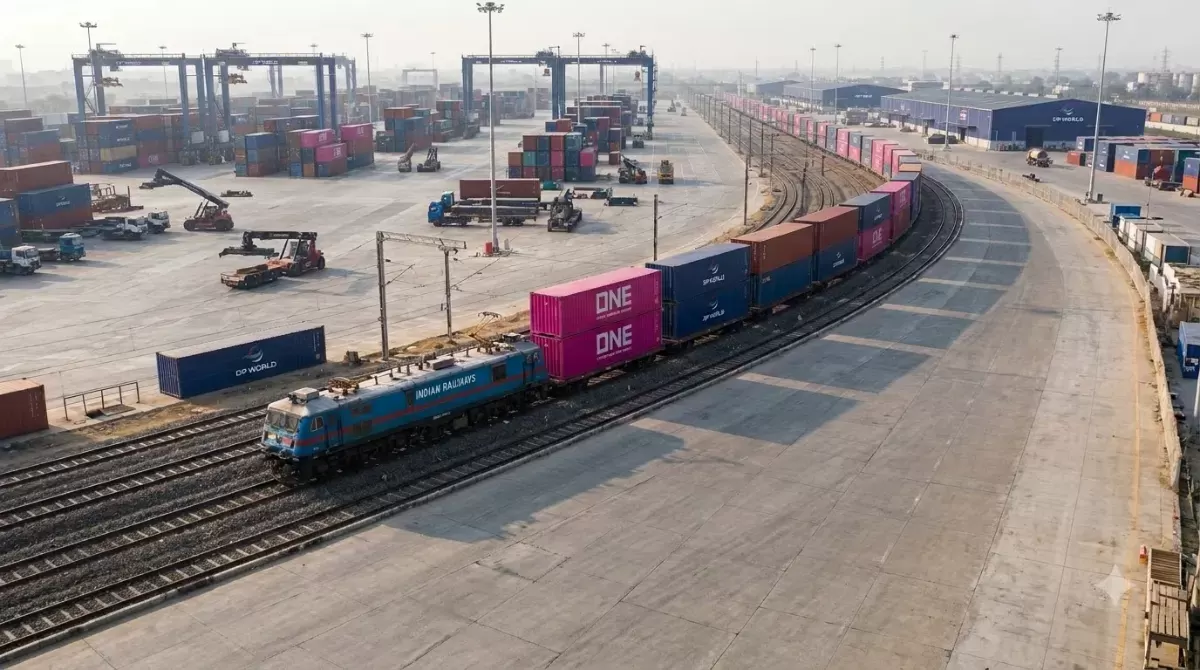
DP World has launched a dedicated export rail service for Ocean Network Express connecting India's National Capital Region with Mundra Port, with the first service operating on 16 November 2026 . The twice-weekly service runs on the Dedicated Freight Corridor from DP World's inland container depots at Panipat, Pali, and Modinagar, with a capacity of up to 180 TEU per run .
The operational model is designed around schedule alignment rather than simply moving containers. Departures are timed to match ONE's vessel schedules, so that cargo arriving at Mundra can be loaded directly onto the intended ship without extended dwell time at the port . A single rake can carry multiple commodities, giving shippers the flexibility to consolidate different cargo types on the same train. This is a meaningful operational detail: it means exporters with smaller volumes in different product categories can share rail capacity that would otherwise require separate movements.
The NCR's industrial profile explains why the service is commercially viable. The region is a manufacturing and export hub for automotive products, auto components, industrial goods, FMCG, and textiles . These are sectors where predictable transit times to the port matter for meeting vessel cut-offs and customer delivery commitments. By offering scheduled departures aligned with ONE's services, DP World is providing a product that addresses the reliability concern that has driven some shippers away from rail in the past.
Hemant Kumar Ruia, Country Manager for the Subcontinent at DP World, framed the service in terms of connectivity between inland manufacturing and international shipping. "Through our dedicated rail service for Ocean Network Express, we are strengthening the link between inland manufacturing centres and international shipping networks, offering customers greater reliability, flexibility and efficiency in moving their cargo" . Masahiro Sakikubo, Managing Director for India at ONE, said dedicated capacity and scheduled departures would "enhance supply chain reliability while supporting seamless cargo movement between inland markets and international trade routes" .
The scale of DP World's rail and terminal network provides context for the service. The company handles a quarter of India's EXIM container market through five container terminals with a combined installed capacity of 6 million TEU a year . It is one of India's largest private rail freight operators, with more than 16,000 owned containers and eight inland rail terminals . This infrastructure allows DP World to offer integrated rail-plus-port services rather than relying on third-party operators for either leg.
The timing of the launch aligns with the broader expansion of rail-linked container services that we have documented in recent weeks. CONCOR has launched a Kanpur–Mundra service, JSW Infrastructure has secured a Gati Shakti terminal at New Shambhu, and the dedicated freight corridor network has been setting records for train interchanges and double-stack operations. The common thread is that rail is becoming a more credible alternative to road for long-haul container movement, and the operators that control both inland terminals and port capacity are best positioned to capture that shift.
For exporters in the NCR, the service adds a dedicated rail option to Mundra with a published schedule and vessel alignment. This is particularly relevant for shippers who have faced uncertainty in container availability and vessel schedules amid the broader shipping disruptions of 2026. A scheduled rail departure with a known connection to an ONE vessel gives them a degree of predictability that ad hoc road haulage cannot match.
Looking ahead, the key question is whether the twice-weekly frequency will be sufficient to meet demand, or whether DP World and ONE will need to add departures. The service's success will depend on cargo uptake from the NCR's automotive, industrial, and textile exporters, and on whether the vessel alignment delivers the reliability that the partners have promised. For now, the launch marks another step in the integration of India's inland manufacturing centres with its port gateways, and it signals that dedicated rail services with published schedules are becoming a standard offering rather than a niche product.