
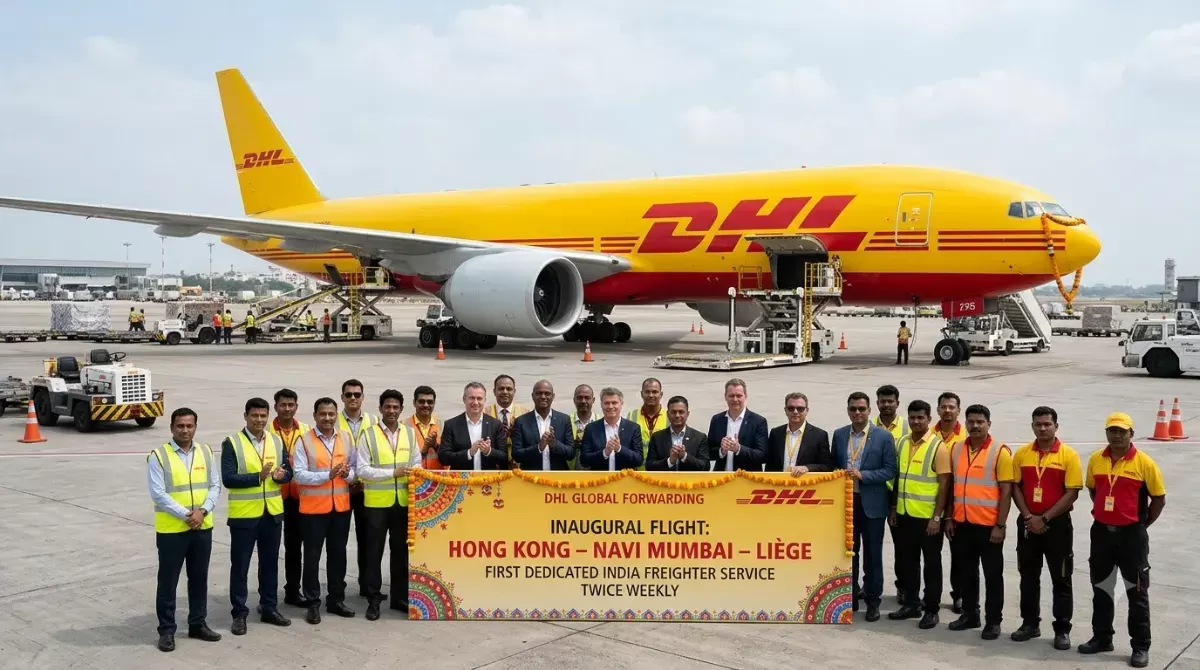
DHL Global Forwarding has strengthened its air freight network between China, India, and Europe with the launch of a dedicated freighter service connecting Hong Kong, Navi Mumbai, and Liège . The service, announced on 16 November 2026, marks DHL Global Forwarding's first dedicated flight serving the Indian market, and it reflects the company's assessment that India has become a strategic air freight node rather than simply a market served through connecting capacity.
The operational structure is a twice-weekly Boeing 747 freighter rotation linking the three airports . The aircraft offers approximately 100 tonnes of total capacity per flight, and DHL Global Forwarding is initially targeting around 25–30 tonnes per flight for the India sectors, equivalent to roughly 50–60 tonnes per week . That initial allocation leaves considerable room for growth, and the company has indicated that it will scale the India volumes as demand develops.
The cargo mix that the service is designed to carry reflects the segments where air freight is most competitive. DHL Global Forwarding identified life sciences and healthcare, technology and electronics, and engineering and advanced manufacturing as the sectors the service will support . The specific goods expected include pharmaceuticals, high-value technology components, industrial machinery, and precision components—categories where delivery speed and reliability justify the air freight premium, and where India has been expanding its export footprint.
For India's air cargo sector, the service adds dedicated freighter capacity at a time when capacity has been constrained by Middle East disruptions and by infrastructure work at Mumbai's existing airport. Navi Mumbai International Airport has been positioning itself as a cargo hub for western India, and DHL's decision to use it for its first dedicated India freighter service validates that positioning. The service gives exporters in the Mumbai region direct access to a dedicated freighter rotation rather than relying on belly-hold capacity or transshipment through other hubs.
The timing of the launch aligns with the growth in India's air cargo volumes. DHL Global Forwarding noted that India is one of the fastest-growing air freight markets in Asia, supported by manufacturing and export growth, with particularly strong demand for high-value and time-sensitive products . The service is also part of DHL's broader strategy of expanding dedicated connectivity between India and Europe, with a Bengaluru–Europe service planned for March 2027 . That follow-on route would extend the network beyond Mumbai and give southern India's exporters a dedicated freighter option to European markets.
For Indian exporters, particularly in pharmaceuticals and technology, the service provides additional capacity on the India–Europe lane and a connection to DHL's Liège hub, from which cargo can be distributed across the European network . The Hong Kong leg adds inbound capacity for Chinese goods destined for the Mumbai region, creating a two-way flow that improves the economics of the rotation. The service does not directly address the India-origin rate environment that has seen air cargo spot rates surge approximately 80% year-on-year, but it adds dedicated capacity that could marginally ease the supply-demand imbalance on the routes it serves.
Looking ahead, the key milestones are the ramp-up of India-sector volumes toward the 25–30 tonnes per flight target and the launch of the Bengaluru–Europe service in March 2027. DHL has not disclosed the exact start date of the Mumbai service beyond the announcement date, nor has it specified the freighter operator beyond DHL Aviation serving as its airline supplier . For now, the launch signals that a major global forwarder sees enough durable demand in India's air cargo market to commit dedicated freighter capacity, and that Navi Mumbai is emerging as a viable alternative to the constrained Mumbai airport for freighter operations.