
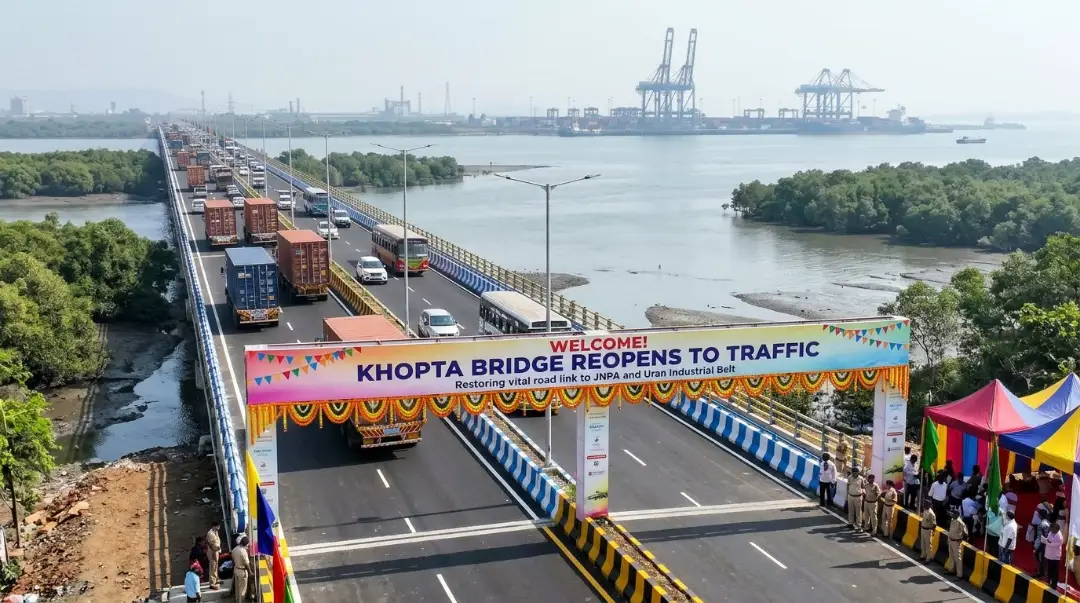
The old Khopta Bridge in Uran has reopened to traffic after remaining closed for nearly a year, restoring a critical road connection for the Jawaharlal Nehru Port Authority, the Dronagiri Industrial Area, and the container yards that serve India's largest container gateway . The bridge reopened on 14 November 2026 and is now accessible to light vehicles and commercial vehicles weighing up to 16 tonnes .
The bridge's closure had created significant operational pressure on the surrounding road network. When it was shut in November 2025 for structural restoration, traffic was diverted onto the adjoining bridge, increasing congestion for residents, industrial workers, and transporters serving the port complex . The reopening is expected to ease that pressure by allowing some of the diverted traffic to return to the old crossing .
The restoration work was more extensive than initially anticipated. The Public Works Department began repairs in December 2025 with an initial allocation of ₹5 crore, but engineers discovered that the internal damage was greater than inspections had indicated, requiring an additional ₹5 crore and bringing the total cost to ₹10 crore . The work strengthened all five spans, replaced four central hinge bearings and eight roller-rocker bearings, installed new expansion joints, and reconstructed the deck slab .
A notable technical feature of the restoration was the use of Ultra High-Performance Fibre-Reinforced Concrete, an advanced material based on Malaysian methods that has been used at only a handful of locations in India . The deck slab was constructed using M-80 grade concrete, with approximately 268 metres of concreting undertaken. Because the work required precise temperature control, concreting was carried out at night with ice used to maintain the required conditions .
The bridge's history illustrates the tension between legacy infrastructure and expanding port activity. Built in 1990, the 7.5-metre-wide structure was originally designed for light vehicles and local passengers . But the growth of JNPA and the industrial development around Uran brought increasing volumes of commercial traffic onto a bridge that was never engineered for those loads. Inspections eventually revealed cracks in internal portions and damage to bearings, prompting the closure .
For the port and logistics sector, the 16-tonne weight limit is a crucial operational detail. The bridge can now carry some commercial vehicles, but heavier container trucks must still use alternative routes . This partial reopening provides relief without fully restoring the heavy-vehicle capacity that some port-linked operators may need. PWD officials have identified the need for a new six-lane cable-stayed bridge to accommodate future traffic, projecting that volumes on the existing bridge infrastructure could exceed 15,000 vehicles daily as port and industrial activity expands .
The timing of the reopening aligns with JNPA's record container performance. The port handled 864,255 TEUs in October 2026, up 27.05% year-on-year, and 5.53 million TEUs during April–October, a 19% increase . The reopening of an additional road link serving the port's hinterland provides marginal relief to the road network that supports these volumes, though the 16-tonne limit means the heaviest container traffic will continue to rely on other routes.
Looking ahead, the key question is whether the restored bridge can handle the traffic that will use it without further deterioration, and whether the proposed six-lane cable-stayed replacement advances from proposal to construction. For now, the reopening restores a vital link for Uran's residents and for the industrial and logistics operations that depend on the road network around JNPA, and it provides a measure of relief to a port complex that has been operating at record volumes.