
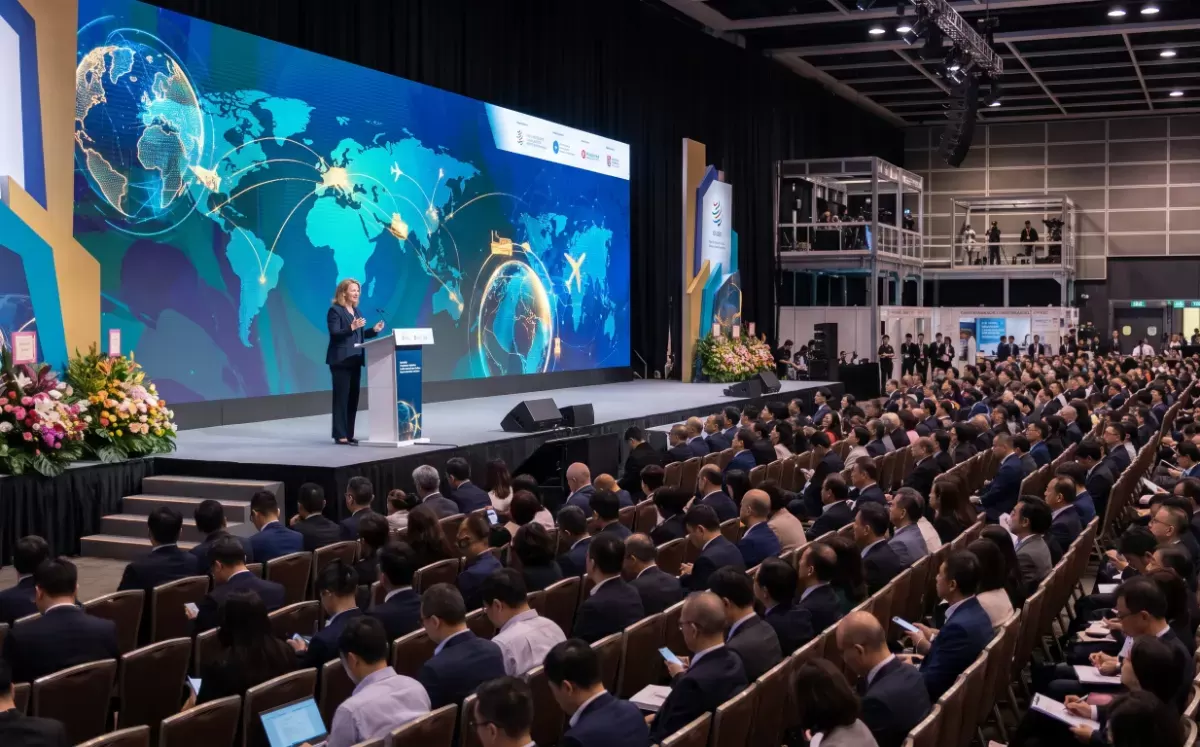
The keynote address by WTO Deputy Director-General Jennifer Nordquist opened the supply chain resilience segment of ALMAC 2026, a two-day conference jointly organized by the Hong Kong SAR Government and the Hong Kong Trade Development Council, bringing together approximately 80 speakers and over 2,300 participants from more than 40 countries and regions . Nordquist's remarks focused on the structural pressures reshaping global trade flows and the institutional responses required to prevent further disintegration of the multilateral trading system.
According to the conference program, Nordquist's address examined how governments and enterprises can strengthen collaboration to reduce uncertainties in global trade and supply chains, and how forward-looking strategies and practical solutions can promote inclusive growth while reinforcing international supply chains for sustainable development . Her participation underscored the WTO's engagement with the logistics sector as a frontline stakeholder in the debate over trade fragmentation, given that shipping, air cargo, and port operators are the primary transmission channels through which policy shifts translate into real economic costs.
The context for Nordquist's warnings was evident throughout the conference agenda. ALMAC 2026 was structured around the theme "Driving Inclusive Growth through Innovation and Sustainability," with discussions explicitly addressing geopolitical developments, trade barriers, tariff policies, climate change, technological disruption, and logistics bottlenecks as converging forces creating unprecedented challenges for businesses . The conference organizers noted that supply chain leaders must transform volatility into opportunities for growth while integrating new technologies across systems, processes, and operational capabilities to build resilience .
Nordquist was joined on the program by a roster of multilateral and industry figures addressing complementary dimensions of the fragmentation problem. Steven Beck, Director of the Trade and Supply Chain Division at the Asian Development Bank, and Dr. Yann Duval, Chief of the Trade Policy and Facilitation Section at UNESCAP, participated in sessions on trade facilitation and regional connectivity . Emmanuelle Ganne, Chief of Digital Trade and Frontier Technologies at the WTO, contributed perspectives on how digital trade infrastructure and emerging technologies can offset some of the friction introduced by policy fragmentation .
The Hong Kong setting for these discussions carried symbolic weight. HKTDC Chairman Professor Frederick Ma noted in his opening remarks that global supply chains are undergoing profound transformation, with digitalization, emerging technologies, and the green transition reshaping cross-border flows of goods and services, and that Hong Kong must function not merely as a connector of markets but as a "super-connector" adding value through high-value-added supply chain services . The conference aligned its themes with China's 15th Five-Year Plan and Hong Kong's first Five-Year Plan, reflecting the city's effort to position itself as a resilient node amid systemic restructuring .
From the perspective of South Asian and Middle Eastern logistics stakeholders, the WTO's emphasis on fragmentation risks at ALMAC 2026 resonates with the operational realities documented throughout the year. The diversion of Gulf cargo through land corridors following the Strait of Hormuz disruption, the rerouting of South Asian transshipment flows, and the surge in contingency infrastructure investment across the GCC all reflect the private sector's response to the policy uncertainty Nordquist described. The WTO's message—that government-enterprise collaboration and institutional predictability are prerequisites for supply chain stability—carries direct implications for how trade-dependent economies in these regions approach infrastructure planning and trade facilitation.
The conference also featured the inaugural Silk Road Maritime Forum, examining port connectivity across 160 designated routes linking 153 ports in 50 countries, alongside a new Green Energy Zone with nearly 100 exhibitors showcasing decarbonization technologies . These sessions reflected the parallel tracks of physical connectivity and sustainability that conference organizers positioned as complementary to the policy resilience agenda. Nordquist's address served as the institutional anchor for these discussions, framing the logistical and technological responses within the broader question of whether the multilateral trading system can retain coherence amid centrifugal political pressures.