
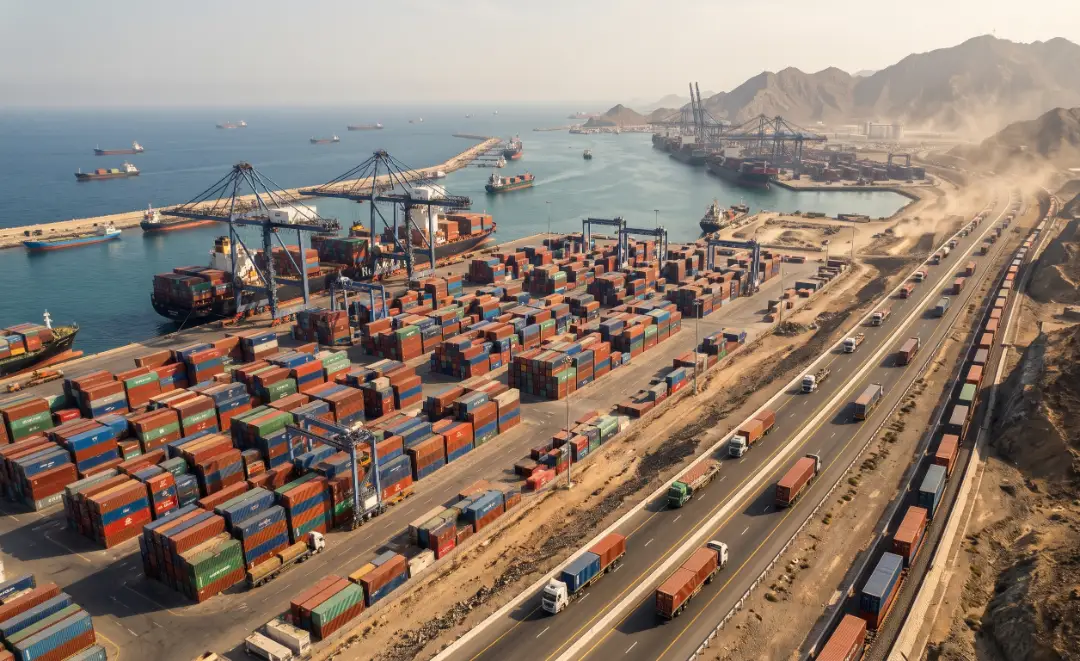
The scale of the disruption at the Strait of Hormuz has reshaped the hierarchy of global container ports. According to Alphaliner data, Dubai's Jebel Ali, long ranked among the world's top ten container terminals, tumbled to 32nd place in the first half of 2026 after throughput collapsed by more than 90% year-on-year in the second quarter to just 374,000 TEU, compared with 3.8 million TEU in the same period of 2025 . Abu Dhabi's Khalifa Port suffered a similar fate, dropping out of the global top 50 after volumes fell by at least 50% . These figures represent one of the most dramatic reversals ever recorded in global port rankings.
DP World's response has become a case study in contingency logistics at scale. The operator redeployed 200 engineers, operators, and mobile equipment to activate the UAE's eastern ports of Fujairah and Khorfakkan, which sit outside the Strait of Hormuz on the Gulf of Oman . A bonded land corridor was established linking these east coast gateways to Jebel Ali, supported by a fleet of 3,000 trucks handling approximately 3,500 TEU daily . By August 2026, DP World had moved 500,000 TEU through GCC road and rail corridors since March, and by November the figure had surpassed one million TEU . The company also opened a 100,000-square-meter inland empty container depot in Al Awir to reduce unnecessary container movements.
The economic logic of these workarounds is sobering. DP World Group CEO Yuvraj Narayan warned that replacing ocean shipping with land corridors is four to five times more costly in some instances, and that the ultimate consumer bears the burden through higher prices . Container freight rates from China to the UAE surged from approximately $2,000 before the disruption to $10,000–$12,000, while marine insurance costs per container jumped from $120 to $1,000 . Transit times from China to the UAE doubled to 60 days, with cargo often stranded at transshipment hubs in Mundra or Colombo awaiting onward movement .
The strategic pivot extends beyond temporary contingencies into permanent infrastructure investment. In July 2026, DP World signed a 50-year concession agreement with the Fujairah Port Authority to develop two deep-water terminals on the UAE's east coast: the Al Rugaylat container and multipurpose terminal, which will eventually offer 2.5 million TEU of annual capacity, and the Dibba general cargo terminal . Both will be connected to Jebel Ali and Jafza through an inland logistics network, creating a direct route to global trade that bypasses the Strait of Hormuz entirely. The project is being developed in phases over approximately 30 months .
The carrier response has mirrored the port operators' shift toward modular, resilient networks. Container alliances have restructured their service designs for 2026 around simplified trunk services supported by hub-and-spoke connectivity, rather than complex multi-port long-haul loops . The Gemini Cooperation (Maersk and Hapag-Lloyd) explicitly built its 2026 network around dedicated shuttle loops feeding selected hubs, while the Premier Alliance trimmed port calls on Asia-Europe services to concentrate volume around core hubs . This design philosophy allows carriers to absorb shocks at individual nodes without derailing entire rotations, a lesson drawn directly from the Hormuz experience.
The implications for South Asia and the Middle East are particularly acute. India's Mundra and Nhava Sheva ports have absorbed some redirected cargo but also faced congestion as transshipment volumes surged from cargo unable to reach Gulf destinations . Saudi Arabia's Red Sea ports of Jeddah and King Abdullah have emerged as alternative gateways for cargo destined for the kingdom's interior and neighboring GCC states, with overland transport replacing direct Gulf calls . Oman's Sohar and Duqm ports have similarly benefited from their position outside the chokepoint. The Gulf Cooperation Council's railway project, signed into agreement in November 2026, reflects the same imperative to build redundancy into regional logistics infrastructure.
The broader lesson for global logistics is that the "geopolitical premium" has become a permanent line item in supply chain costs. The shortest route is no longer automatically the cheapest or most reliable; security, insurance, and corridor diversification now enter the equation alongside distance and fuel . Governments and operators are investing in alternatives before they are needed, a geoeconomic race that is revitalizing logistics infrastructure in locations that would have been uneconomical under normal conditions . For port operators in South Asia and the Middle East, the imperative is clear: chokepoint dependence is a strategic vulnerability, and the capacity to route around disruption is becoming as valuable as the capacity to handle volume.