
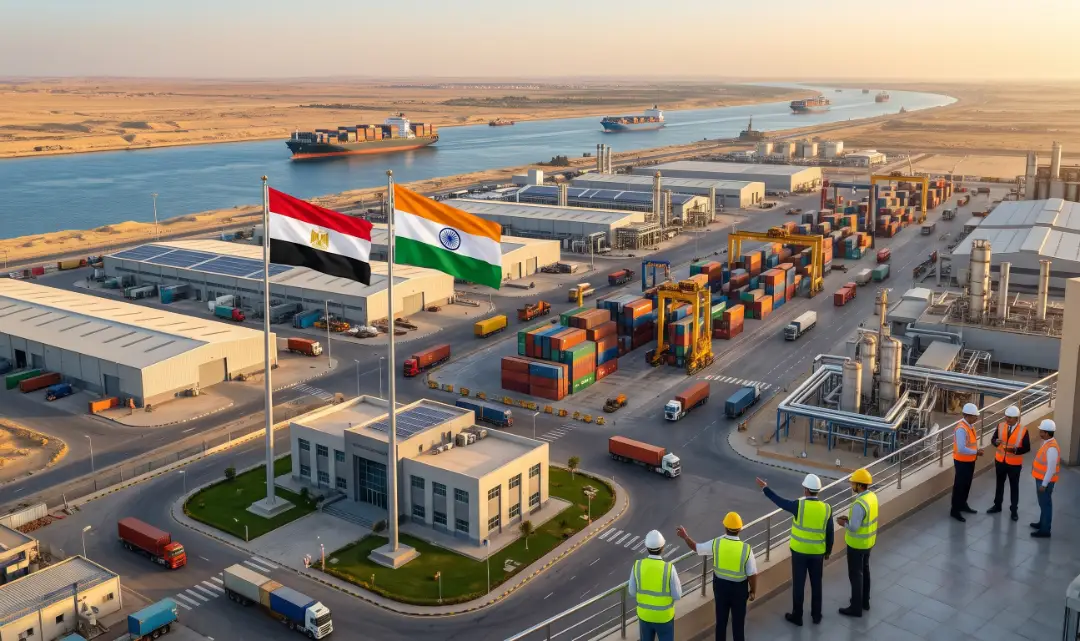
The economic dimension of the India-Egypt relationship took center stage in Cairo during Commerce and Industry Minister Piyush Goyal's official visit, which included the 7th Joint Trade Committee meeting co-chaired with Egypt's Minister of Investment and Foreign Trade, Mohamed Farid Saleh, along with a Joint Business Council meeting and a Business Forum involving over 300 companies from both sides . The discussions explicitly identified the Suez Canal Economic Zone (SCZONE) as a focal point for industrial collaboration, with Egypt's Minister Saleh announcing that both sides are working to accelerate the establishment of the first Indian industrial zone within the SCZONE, drawing on Indian expertise in renewable energy, green hydrogen, energy storage, pharmaceuticals, and data centers .
The trade trajectory underpinning these ambitions is substantial. Bilateral merchandise trade reached USD 6.5 billion in FY2025-26, a 35% increase over the previous year, and surged by 65% to USD 5.04 billion during April-September 2026 alone . India's exports to Egypt in FY2025-26 stood at USD 3.87 billion, comprising primarily petroleum products, organic chemicals, machinery, meat products, and cotton, while imports from Egypt totaled USD 2.60 billion, dominated by crude petroleum, fertilizers, cotton, and mineral products . The stated target of USD 12 billion by 2030, if achieved, would represent a near-doubling of current volumes within four years .
For Indian logistics and manufacturing companies, the Suez Canal Economic Zone offers a distinctive value proposition that extends beyond the bilateral trade relationship. Egypt's Minister Saleh emphasized that the country's geographical position and network of trade agreements provide access to more than 1.5 billion consumers across Africa, the Arab world, and Europe, while its domestic market exceeds 110 million consumers . The SCZONE, which encompasses ports and industrial zones along the Suez Canal corridor, has been actively courting Indian investment. In June 2026, Indian textile manufacturer Prestige Denim Mills committed USD 20 million to build a denim fabric plant in the West Qantara Industrial Zone, marking the first Indian investment in that specific zone and producing up to 20 million meters of denim annually with 70% earmarked for export .
The institutional framework supporting this deepening relationship is also being strengthened. Both sides agreed to establish a Joint Working Group to explore the Terms of Reference for a Preferential Trade Agreement or Free Trade Agreement . On the investment side, Egypt's General Authority for Investment and Free Zones (GAFI) and Invest India are activating cooperation to establish a joint investment information platform designed to help companies identify opportunities, access data, and convert proposals into executable projects . GAFI's CEO noted that Egypt currently hosts 1,040 Indian companies operating primarily in industrial, services, and information technology sectors, a figure that underscores the existing depth of commercial engagement .
The logistics implications of these developments extend to transport corridors and port connectivity. The Joint Trade Committee discussions explicitly covered cooperation in transport and logistics, ports, and regional value chains . Egypt's Suez Canal is the critical maritime chokepoint linking the Indian Ocean and Mediterranean Sea, and Indian exporters already rely on this route for access to European and North African markets. The prospect of an Indian industrial zone within the SCZONE would allow Indian manufacturers to position production facilities closer to these markets while utilizing Egypt's port infrastructure and free trade agreements to reduce tariff barriers and transit times.
From a supply chain diversification perspective, Egypt's appeal to Indian businesses lies in its combination of low-cost manufacturing potential, strategic location, and preferential access to multiple trade blocs. The SCZONE offers customs and tax incentives supported by international free trade agreements that facilitate access to major global markets, according to the zone's chairman . For Indian companies in sectors ranging from textiles and chemicals to engineering goods and pharmaceuticals, establishing operations in Egypt could serve both as a hedge against disruptions in direct India-Europe routes and as a platform for serving African and Middle Eastern markets that are costly to reach directly from India.
The visit also reflected the broader strategic convergence between the two countries. Minister Goyal noted that approximately 70 Indian companies operate in Egypt with investments exceeding USD 5 billion, generating direct and indirect employment for Egyptians, and described the current trade volume as "only the beginning" of the partnership . The 8th Joint Trade Committee is scheduled to convene in New Delhi in 2028 to assess progress on the agreements and action plans reached in Cairo . For logistics operators monitoring India-Middle East-Africa corridors, the Cairo outcomes signal a deliberate effort to institutionalize commercial flows through the Suez Canal gateway, with industrial co-location as the mechanism for capturing value that currently passes through the corridor without touching Egyptian or Indian production networks.