
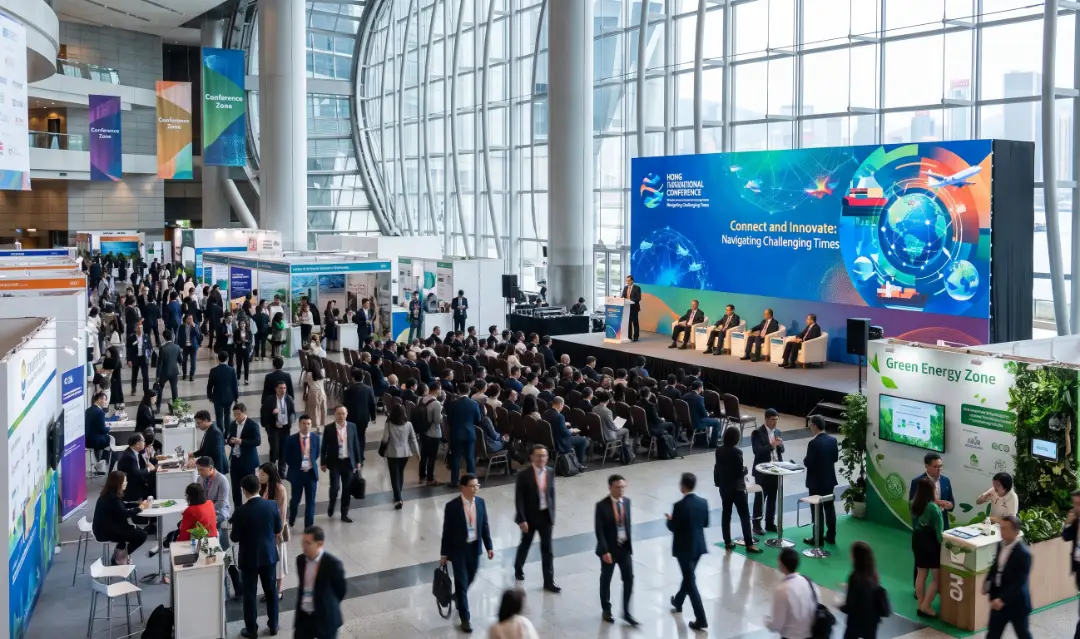
The 16th edition of ALMAC commenced on November 16, 2026, as a flagship event of Hong Kong Maritime Week, running concurrently with the World Maritime Merchants Forum at the Hong Kong Convention and Exhibition Centre . The conference is jointly organised by the Hong Kong Special Administrative Region Government and the Hong Kong Trade Development Council (HKTDC), reflecting the city’s policy priority to consolidate its position as an international trade, maritime, and aviation hub .
In his opening address, HKTDC Chairman Professor Frederick Ma noted that global supply chains are undergoing profound transformation, reshaped by geopolitical tensions, economic fragmentation, digitalisation, emerging technologies, and the green transition. He emphasised that Hong Kong must function not merely as a connector of markets but as a “super-connector” that adds value by linking mainland China’s innovation and manufacturing capabilities with global markets . The conference theme, “Connect and Innovate: Navigating Challenging Times,” was designed to address these structural shifts .
A key focus of the opening day was the evolving role of ASEAN as a trade partner for Hong Kong. ASEAN is Hong Kong’s second-largest trading partner and export market after mainland China. In the first nine months of 2026, Hong Kong’s exports to Vietnam and Thailand grew by 55.2% and 64.2% year-on-year, respectively . Reflecting this trend, the conference featured a dedicated session titled “Vietnam-Hong Kong Air Cargo Logistics Hub Seminar: Deepening Multimodal Cooperation, Creating New Market Opportunities,” examining how policy, customs innovation, and cross-sector collaboration can facilitate freight flows between the two markets .
The international dimension of the conference was underscored by the participation of WTO Deputy Director-General Jennifer Nordsvedt, who delivered a keynote address on supply chain resilience, exploring how governments and businesses can deepen collaboration to reduce trade and supply chain uncertainty . Other speakers included representatives from the Asian Development Bank, the United Nations Economic and Social Commission for Asia and the Pacific, JD Logistics, and SF Supply Chain, among others . The programme covered three thematic pillars: resilience, green, and connectivity.
A notable addition to the 2026 programme was the inaugural “Silk Road Maritime” thematic seminar. The Silk Road Maritime alliance has been formally incorporated into China’s 15th Five-Year Plan, and the session aimed to promote global connectivity and port collaboration. Simon Bennett, Deputy Secretary-General of the International Chamber of Shipping, was scheduled to share insights on port synergy and supply chain risk response . The conference also introduced a Green Energy Zone in the exhibition, featuring over 100 exhibitors showcasing green energy consultancy, infrastructure, storage, and decarbonisation technologies, alongside established zones for supply chain management, maritime and port services, and logistics technology .
From a logistics industry perspective, ALMAC 2026 serves as a barometer of the sector’s strategic priorities. The emphasis on supply chain resilience reflects lessons drawn from recent disruptions, including maritime chokepoint vulnerabilities and geopolitical fragmentation. The focus on green energy signals the accelerating decarbonisation agenda in shipping and aviation. The spotlight on ASEAN and the inaugural Silk Road Maritime session indicate a recalibration of trade corridors toward Southeast Asia and the maritime routes connecting China, Southeast Asia, and South Asia. For logistics operators in India, South Asia, and the Middle East, the conference provides a platform for tracking policy signals, forging partnerships, and assessing how Hong Kong’s evolving role as a “value port” rather than merely a throughput hub may affect regional cargo flows and multimodal connectivity .