
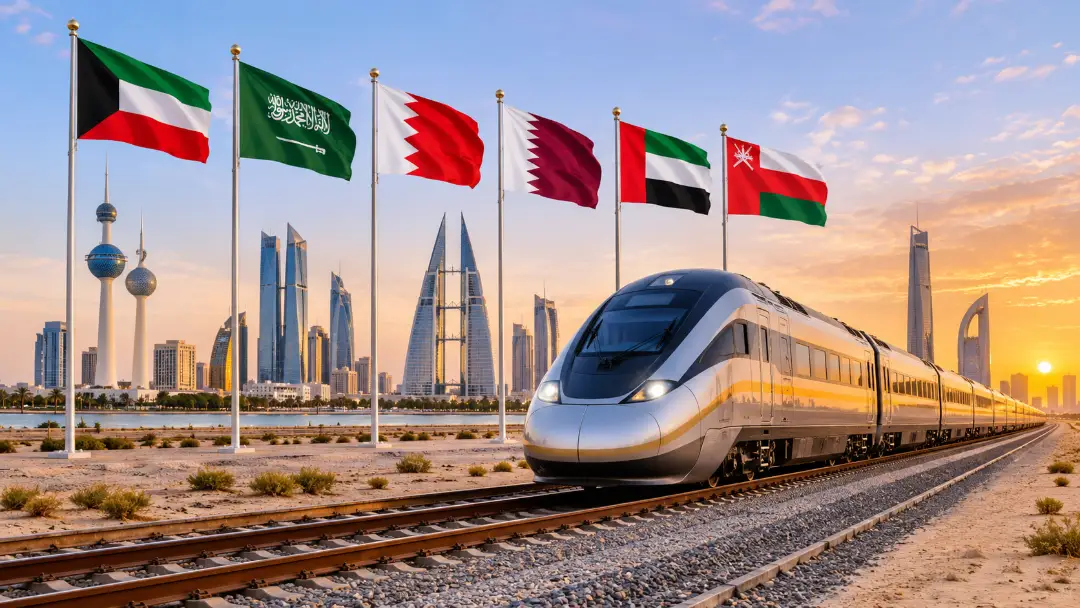
The signing ceremony took place at Riffa Al Zahir Palace in Bahrain, under the patronage of Bahrain's Crown Prince and Prime Minister, Prince Salman bin Hamad Al Khalifa. GCC Secretary-General Jasem Mohamed Albudaiwi participated alongside the transport and communications ministers of all six member states . The agreement represents the culmination of years of planning and coordination, moving the long-envisioned Gulf railway from concept to a binding operational framework. Albudaiwi described it as "a significant step in bolstering Gulf integration in the transport sector" and a mechanism for regulating railway transport across the bloc .
The core function of the General Agreement is to establish the legal and operational architecture for the network. It defines the obligations of each member state regarding implementation and operation, sets out coordination mechanisms, and harmonizes technical and safety standards to ensure interoperability between national railway systems . Each country is responsible for financing and implementing the section within its own territory, though private-sector participation remains possible for specific components subject to feasibility studies . The Gulf Railway Authority, established by a GCC Supreme Council decision in 2021, oversees coordination and monitors progress.
The physical scale of the project is substantial. The network will span approximately 2,117 kilometers, linking Kuwait in the north to Oman in the southeast, passing through Saudi Arabia, Bahrain, Qatar, and the UAE . Passenger trains are designed to operate at speeds of up to 200 kilometers per hour, while freight services will run at 80 to 120 kilometers per hour . Projections indicate the railway will carry approximately 6 million passengers and 200 million tons of freight in 2030, rising to more than 8 million passengers and 271 million tons by 2045 . These volumes underscore the network's intended role as a logistics backbone for intra-Gulf trade, connecting industrial centers, ports, and logistics hubs across the region.
As of the signing, the overall project stands at 55.9% completion, according to Albudaiwi . Several bilateral and sub-regional links are advancing ahead of the full network. Trial operations for the Oman-UAE railway connection are scheduled to begin in the fourth quarter of 2027, covering 238 kilometers between Suhar and Abu Dhabi . The Saudi-Kuwait corridor, spanning approximately 650 kilometers, is expected to be ready around 2028 . Bahrain's connection to the network depends on the proposed King Hamad Causeway, which would link the island kingdom to Saudi Arabia via a combined rail and road connection, with studies and procedures still underway . The agreement allows completed cross-border sections to enter service progressively rather than waiting for the entire network to be finished .
The timing of the agreement reflects heightened awareness of supply chain vulnerabilities in the region. Maritime disruptions in the Strait of Hormuz and Bab al-Mandab have reduced vessel traffic and increased reliance on road transport and alternative ports, elevating freight and insurance costs . GCC officials framed the railway as a means of diversifying trade routes and strengthening economic security. Bahrain's Minister of Transportation and Telecommunications, Dr. Sheikh Abdulla bin Ahmed Al Khalifa, stated that the disruptions demonstrated that "the readiness and integration of transport networks are cornerstones of Gulf economic security" . The GCC's transport and storage sector recorded real growth of 5.7% in 2025, making it one of the fastest-growing non-oil economic activities in the bloc .
From a logistics perspective, the railway's significance lies in its potential to reduce dependence on road haulage for cross-border freight within the Gulf. Currently, the majority of intra-GCC cargo moves by truck, subject to border delays, fuel costs, and capacity constraints. A functioning rail network connecting the six economies would offer a lower-cost, higher-capacity alternative for bulk and containerized cargo moving between ports and inland industrial zones. The planned integration with ports and logistics hubs is explicitly embedded in the project's design, with the network intended to link maritime gateways on the Gulf and Indian Ocean coasts to hinterland markets . However, the project's success will depend on member states adhering to implementation schedules, integrating border and operational systems, and transforming the network into a genuinely unified Gulf transportation system rather than a collection of disconnected national railways .