
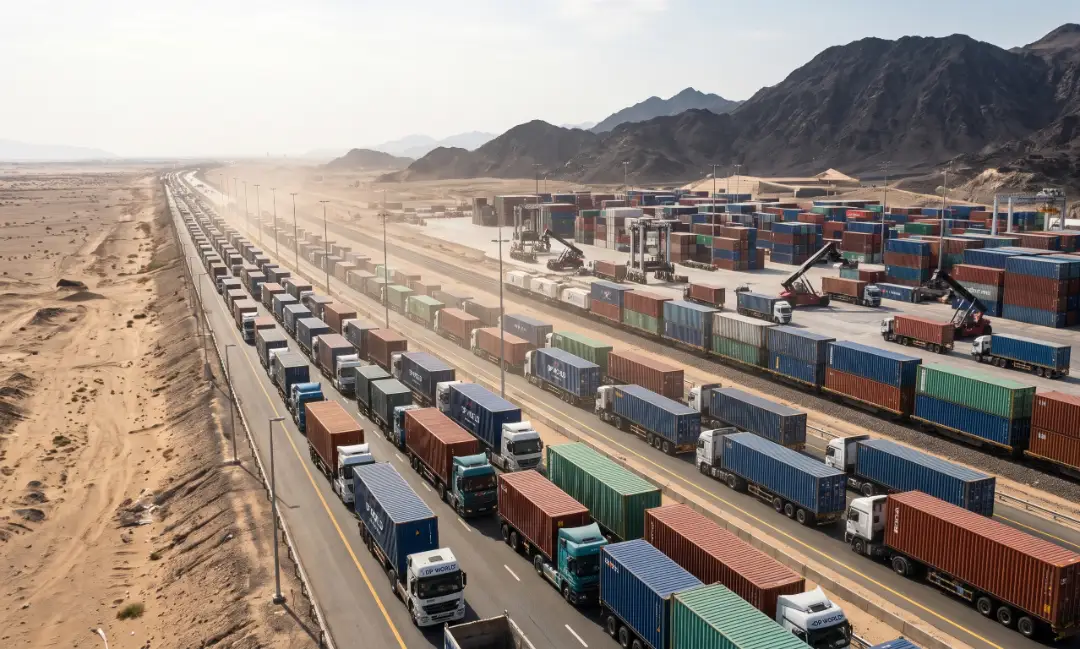
The disclosure came at a media roundtable in Dubai in early November 2026, where Ahmad Yousef Al-Hassan, CEO of DP World GCC, detailed the logistics response to the prolonged disruption of maritime access through the Strait of Hormuz. According to Al-Hassan, DP World moved approximately 1.1 million TEU between the UAE's east coast ports and Jebel Ali via road and rail since the first week of March 2026, establishing a bonded corridor that bypasses the chokepoint entirely . The operation required building a trucking capability from scratch, scaling to a managed fleet of 3,000 vehicles, of which 700 are owned by DP World, handling roughly 3,500 TEU daily across the land bridge .
The corridor architecture relies on discharge at Fujairah and Khorfakkan, both located on the UAE's eastern seaboard facing the Gulf of Oman and situated outside the Strait of Hormuz. Cargo is then moved under customs-bonded transit directly to Jebel Ali for final clearance, storage, and distribution . DP World also developed additional routing options through the Omani ports of Sohar and Duqm, and leveraged Red Sea connections via Jeddah Islamic Port's South Container Terminal, creating a multi-path network rather than a single alternative . These arrangements required close coordination with other port operators, government authorities, and customs agencies, with DP World providing equipment and personnel to support operations at east coast ports it does not operate .
The cost implications of replacing sea miles with road miles have been severe. Al-Hassan noted that container freight rates from China to Dubai surged from approximately $2,000 before the disruption to $10,000–$12,000, while longer trucking distances, congestion, and higher diesel prices added further expense . DP World absorbed some transportation costs and worked with shipping lines on mitigation measures, including the repositioning of empty containers through alternative ports . The company also opened a 100,000-square-meter inland empty container depot in Al Awir, Dubai, with direct access to Emirates Road and potential for future rail-based movement through Etihad Rail, reducing unnecessary container movements to the port .
Jebel Ali itself remained operational throughout the crisis, closing for only six hours since the onset of the conflict, but container volumes were devastated by the loss of maritime access. In DP World's second-quarter 2026 results, Jebel Ali volumes were down 90.1% for the quarter . The port, which handled 15.6 million TEU in 2025 and has annual capacity exceeding 20 million TEU, is connected to more than 80 weekly services reaching 150 ports worldwide . DP World has spent the past nine months maintaining equipment and operational readiness in anticipation of shipping lines returning, with Al-Hassan stating that meetings with nine carriers in Asia reinforced confidence that Jebel Ali would regain its status as a port of call .
The strategic response extends beyond temporary contingencies. DP World is proceeding with a $2–3 billion investment in two new terminals at Fujairah, intended to provide a permanent alternative gateway outside the Strait of Hormuz . Al-Hassan argued that the disruption had demonstrated the need to accelerate cross-border rail connectivity and establish contingency arrangements that could be activated quickly during future crises, stating that "even if the Strait opens up tomorrow, our contingency planning has to be all ready" . The Jebel Ali Free Zone, home to more than 12,000 companies, maintained occupancy above 90% across asset classes during the disruption, supported by demand from major UAE infrastructure and construction projects .
Recovery projections remain uncertain. Al-Hassan indicated that Jebel Ali's traffic could take one to three months to recover after safe passage through the Strait resumes, depending on how quickly shipping lines can reposition services and networks . The broader supply chain impact has drawn attention from industry leaders, with DP World Group CEO Yuvraj Narayan warning that replacing ocean shipping with land corridors is four to five times more costly in some instances, and that prolonged disruption risks feeding higher costs through into consumer prices well beyond the Gulf region . For logistics operators across South Asia and the Middle East, the DP World experience offers a case study in the operational feasibility and economic limits of land-based contingency planning at scale, demonstrating that while alternative corridors can maintain cargo flow, they cannot replicate the cost structure and capacity of maritime transit through a major chokepoint.