
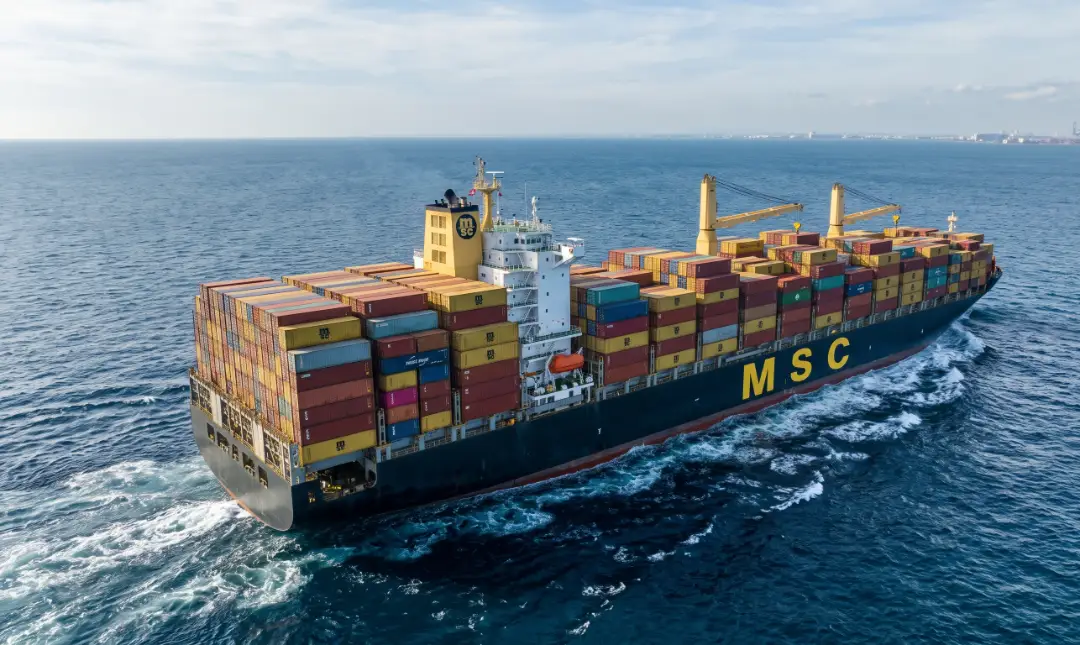
According to shipping industry sources, MSC's planned North India–Red Sea service is scheduled to commence operations in late November 2026. The port rotation has been confirmed as Mundra (India) → Port Qasim (Pakistan) → Jeddah (Saudi Arabia) → King Abdullah Port (Saudi Arabia) → Mundra . This direct routing represents a notable development for shippers who have historically relied on transshipment hubs to move cargo between the Indian subcontinent and Saudi Arabia's western seaboard.
The vessel deployment strategy reflects the niche nature of the corridor. MSC intends to assign container ships with capacities in the 2,500 to 3,000 TEU range . These mid-sized feeder vessels are appropriate for a regional shuttle service of this length, allowing the carrier to match slot supply to demand without flooding the lane with excess capacity. As of the latest reports, MSC has not yet disclosed the specific vessels assigned to the loop, the sailing frequency, or the exact date of the maiden voyage .
On the subcontinent side, the service draws from two significant container gateways. Mundra Port, located in Gujarat, is India's largest private commercial port and serves as a critical outlet for cargo originating from northern and northwestern India, with an electrified rail connection at Adipur linking it to the Indian Railways network . Port Qasim, situated in the Karachi metropolitan area, handles a substantial portion of Pakistan's container traffic. By including both ports in a single rotation, MSC creates a combined cargo pool from two major South Asian economies.
The Saudi port calls cover both the established and emerging Red Sea gateways. Jeddah Islamic Port is the kingdom's long-standing primary Red Sea container facility, serving the western region and transit cargo. King Abdullah Port, located further north at the King Abdullah Economic City, is a newer commercial port that has been actively building its container business . Serving both ports on the same voyage gives shippers options across different catchment areas along Saudi Arabia's Red Sea coast.
The launch of this dedicated loop is part of a broader recalibration of MSC's Red Sea network. In parallel, MSC is expanding its existing Zephyr service to include calls at Jeddah and King Abdullah Port while removing Salalah from that rotation. The revised Zephyr routing is Colombo → Djibouti → King Abdullah Port → Jeddah → Colombo, with the carrier significantly increasing vessel sizes from an average of 4,800 TEU to approximately 16,000 TEU per ship . Together, these two separate products—the new India-Pakistan shuttle and the enlarged Zephyr service—layer additional depth into MSC's Saudi Red Sea coverage.
Competitive dynamics on this corridor are already established. Emirates Shipping Line has operated a service linking Jeddah with Mundra and Djibouti since June 2026, and Maersk has also deployed services connecting Jeddah and King Abdullah Port with Mundra, Nhava Sheva, and Salalah . MSC's new offering differentiates itself by incorporating Port Qasim into the rotation, thereby capturing Pakistan-origin cargo that competitors have not bundled into a direct Saudi Red Sea loop.
For logistics operators and shippers, the practical implication is a reduction in handling steps and transit uncertainty. Direct port-to-port routing eliminates the need to transfer containers at an intermediate hub, which reduces the risk of delays and damage while potentially compressing overall transit times. However, the absence of published transit times, frequency details, and first-sailing dates means that cargo planners cannot yet build firm schedules around the service . The commercial impact will depend on whether MSC establishes a reliable weekly or fortnightly cadence that exporters in Gujarat and Punjab can integrate into their order cycles.
From a strategic standpoint, the service signals MSC's confidence in sustained demand between the Indian subcontinent and Saudi Arabia's Red Sea market. While the corridor is not among the world's largest trade lanes, it carries significant volumes of textiles, agricultural products, chemicals, and manufactured goods from South Asia to the Middle East. The deployment of dedicated feeder tonnage rather than the rerouting of existing deep-sea capacity suggests that MSC views this as a growth lane worth cultivating with purpose-built service design, rather than a temporary adjustment to network disruptions.