
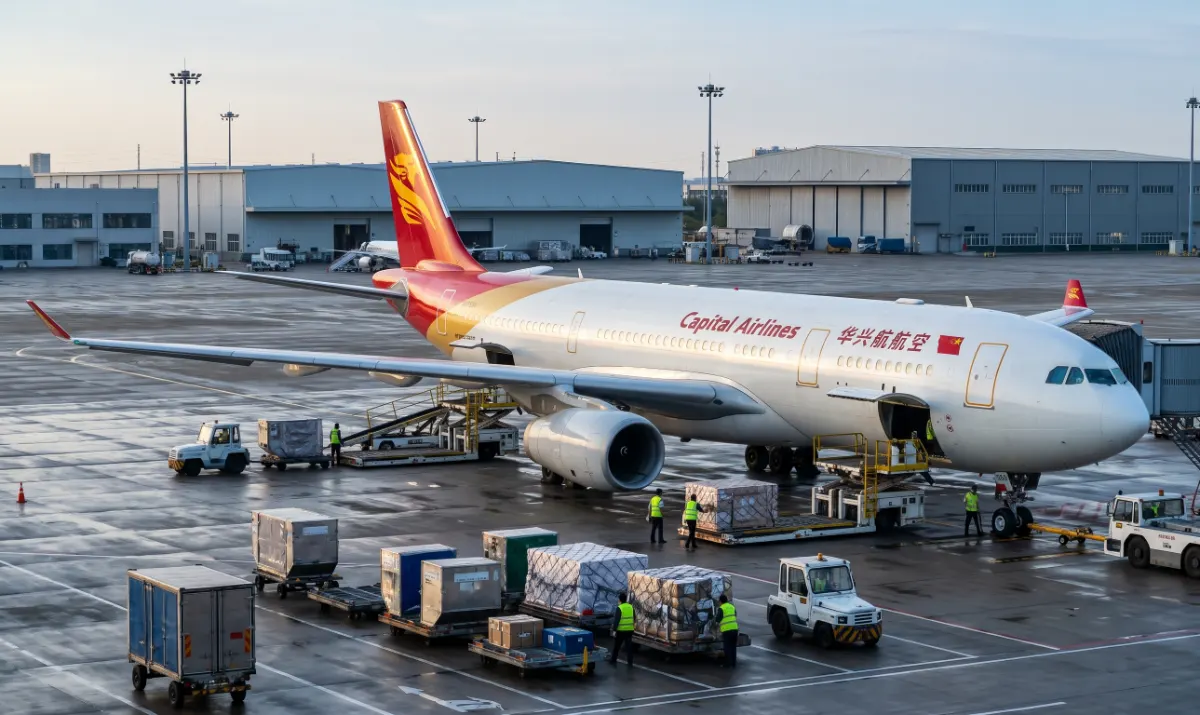
The inaugural flight departed Jiaxing Nanhu Airport in the early hours of November 13, 2026, carrying nearly 58 tonnes of general cargo, primarily fabric rolls, yarn, and solar chips, according to airport logistics staff . The route operates as a round-trip service with the A330-200P2F full freighter, initially scheduled for three weekly frequencies on Tuesdays, Fridays, and Sundays, with a one-way flight time of approximately 6.5 hours . Bengaluru, often described as India's "Silicon Valley," is a major hub for electronics manufacturing, aerospace, biotechnology, and information technology, making it a natural counterpart to the Yangtze River Delta's industrial and technological base .
The launch came just one week after the maiden flight of the Jiaxing–Delhi route on November 6, 2026, operated by Jinpeng Airlines using a Boeing 777F long-range widebody freighter. That flight carried nearly 100 tonnes of exports, including auto parts and textiles, to Indira Gandhi International Airport . Together, the Delhi and Bengaluru routes cover India's two major economic belts—the northern consumer market centered on the capital region and the southern technology and manufacturing corridor—positioning Jiaxing as a transit node for cargo moving from Europe through the Yangtze River Delta to South Asia .
The strategic significance of the new route lies in the efficiency gain it delivers for shippers in Zhejiang and neighboring provinces. Previously, goods bound for India from Zhejiang were typically transshipped through Shanghai, Hong Kong, or Singapore, with total transit times of 20 to 30 hours . The direct flight reduces this to roughly six hours, enabling same-day delivery for time-sensitive categories such as fresh produce, pharmaceuticals, and electronic components . For exporters of solar components, textiles, and machinery—key sectors in the Yangtze River Delta—the route lowers logistics costs and improves supply chain reliability toward South Asian markets.
From a cargo structure perspective, the route reflects a complementary two-way flow. Outbound shipments from China consist primarily of mechanical and electrical products, auto parts, photovoltaic modules, textiles, pharmaceutical ingredients, and cross-border e-commerce parcels. Return traffic can carry Indian products such as spices, aquatic goods, pharmaceutical intermediates, and electronic components, creating a balanced utilization of capacity . The airport's proximity between the cargo terminal and apron allows for rapid transfer, with goods able to move from aircraft to warehouse immediately upon arrival, supporting efficient customs clearance under Jiaxing Customs' advance declaration and inspection mechanisms .
The launch also marks a milestone in Jiaxing Nanhu Airport's rapid expansion as a specialized air cargo hub. Since opening to foreign freight flights in August 2026 and launching its first international cargo route to Dhaka on May 28, 2026, the airport has added routes to Budapest, Los Angeles, Chicago, Luxembourg, Tokyo, Osaka, Amsterdam, and Delhi, reaching ten international destinations across Asia, Europe, and North America . The airport now positions itself as a gateway hub for the Yangtze River Delta, with a route network that supports both bulk general cargo and the growing cross-border e-commerce segment, according to He Yaoqi, general manager of Jiaxing Airport Port Development Co. .
For the logistics sector in India and South Asia, the route offers an additional direct air freight option connecting the region's technology and manufacturing clusters with Chinese production networks. While the immediate impact is concentrated on China-origin exports, the round-trip structure creates potential for Indian exporters to access Northeast Asian markets through Jiaxing's onward connections. The airport's stated ambition to develop international transit distribution and cross-border e-commerce handling suggests that the route could evolve into a broader South Asia–Northeast Asia air cargo corridor, complementing maritime and overland links that currently dominate India-China trade flows .
From a policy perspective, the route aligns with China's broader push to integrate the Yangtze River Delta into global supply chains and with India's growing air cargo demand. India has emerged as one of the fastest-growing aviation freight markets globally, driven by e-commerce expansion and electronics manufacturing under production-linked incentive schemes . The new corridor does not resolve the structural imbalances in India-China merchandise trade, but it adds a time-sensitive option for high-value goods that cannot wait for ocean freight or transshipment through Southeast Asian hubs. For logistics operators on both sides, the key question will be whether cargo volumes sustain the three weekly frequencies and whether return loads materialize to make the route commercially viable beyond its initial launch phase.