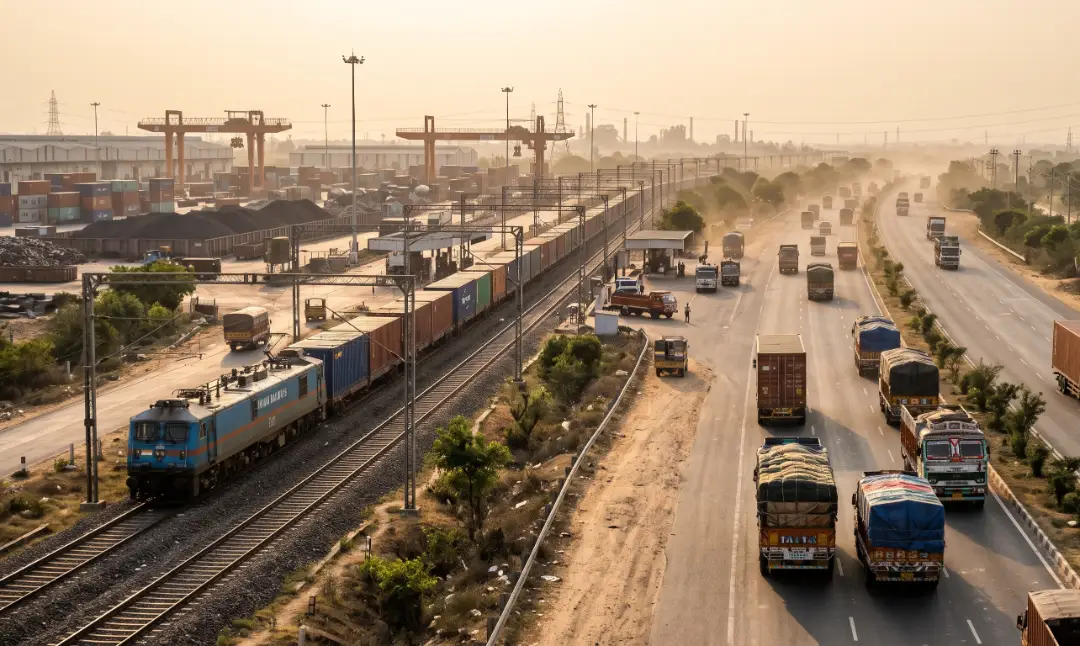
Indian Railways is entering a new phase in freight transportation, with the eastern and western Dedicated Freight Corridors (DFCs) now fully operational and unlocking capacity for faster, more reliable freight movement . The infrastructure investment has delivered results in absolute terms: freight loading rose from 1,098 million tonnes in fiscal 2015 to a record 1,670 million tonnes in fiscal 2026, and October 2026 alone saw the highest-ever monthly loading of 145.07 million tonnes, an 8.32% increase year-on-year . The Dedicated Freight Corridor Corporation of India (DFCCIL) recorded 951 freight train interchanges on November 7, 2026, its highest single-day tally, while double-stack container trains rose 27.43% year-on-year in October .
Yet these impressive operational numbers mask a structural weakness. A parliamentary committee recently estimated rail's share of national freight tonnage at only about 27% in fiscal 2025, well below the National Rail Plan's goal of 45% by 2030 . The KPMG analysis from April 2026 placed rail's share at approximately 25%, with roads handling nearly 70% of India's freight . The gap between rail's cost advantage—approximately ₹1.9 per tonne-km versus up to ₹3.78 per tonne-km for road—and its actual market share underscores that pricing alone is not driving modal choice .
The competitive pressure is visible even in commodities that have traditionally been rail strongholds. Coal, iron ore, steel, and cement remain the backbone of railway freight earnings, with coal alone contributing nearly half of freight revenue . However, road's share of raw-coal dispatches increased from 24.4% in fiscal 2021 to 33.8% in fiscal 2024 before easing slightly to 31.1% in fiscal 2025, while rail's share fell from 53.9% to 47.4% before recovering to 50.5% . Railways moved about 178 million tonnes of iron ore in fiscal 2025 against production of roughly 289 million tonnes, implying that a substantial portion of bulk freight still moves outside the rail network .
The reasons extend beyond pricing. India's freight geography is undergoing a fundamental shift driven by urbanisation, rising incomes, and e-commerce. Consumption is moving away from a handful of metropolitan centres towards hundreds of Tier II and III cities. India's urban population is estimated to have reached 522 million in 2025 and is projected to approach 600 million by 2036, with Tier II and III cities generating around two-thirds of incremental direct-to-consumer orders last fiscal . Warehousing, distribution, and industrial activity are following the same trajectory, creating a logistics network that is increasingly dispersed and ill-suited to rail's line-haul model.
Road transport has adapted quickly to this reality. The national highway network has expanded nearly 60%, from 91,287 km in 2014 to 146,204 km by March 2025, enabling trucks to reach new warehouses, distributors, factories, and construction sites directly . Trucks offer flexibility, minimal handling, and a single point of accountability from origin to destination. Rail, by contrast, remains primarily a line-haul business. Its challenge is not its dependence on trucks for first-mile and last-mile connectivity—every major freight system relies on multimodal logistics. The problem is that the transition between rail and road often remains fragmented, creating additional handling, delays, and uncertainty for customers .
The National Rail Plan's 45% target by 2030 appears increasingly ambitious given these structural headwinds. A CII and Knight Frank India report from May 2026 estimated that India would need around 215 large multimodal logistics parks by 2047 to support the rail-based cargo movement required to meet the government's long-term target, noting that India currently has only 30 operational MMLPs handling around 129 million tonnes annually, or just 2% of total freight movement . The Comptroller and Auditor General has also initiated a first-of-its-kind audit of the railways' multi-modal transport logistics initiative, with particular emphasis on first-mile and last-mile connectivity with logistics hubs, to assess preparedness for the 45% target .
Some progress is being made on the multimodal front. Indian Railways has approved 306 Gati Shakti Multi-Modal Cargo Terminals with a combined capacity of 192 million tonnes per annum, of which 118 are already operational. Over ₹8,600 crore of private investment has flowed into these terminals, and freight revenues from GCTs have grown nearly fourfold to ₹12,608 crore between FY23 and FY25 . The Unified Logistics Interface Platform now connects 44 systems across 11 ministries, improving real-time visibility and coordination across transport modes . However, these initiatives address the aggregation and digital layers of the problem; they do not resolve the fundamental service quality gap that leads a cement producer or steel manufacturer to choose trucks despite rail's lower line-haul cost.
The path forward requires Indian Railways to compete on outcomes rather than tariffs. A cement producer or steel manufacturer does not evaluate only the railway tariff; it evaluates the cost, speed, and reliability of the entire journey. A lower rail rate becomes irrelevant if cargo must be handled multiple times, delivery windows are uncertain, or information is unavailable . Customers buy logistics outcomes, not transport modes. The DFCs will improve transit times, but faster line-haul movement is only part of the solution. Customers also need assured wagon availability, predictable departures, reliable arrival schedules, and real-time shipment visibility . Until these service quality dimensions are addressed, the infrastructure investment represented by the DFCs and multimodal terminals will struggle to translate into the modal shift that the National Rail Plan envisions.