
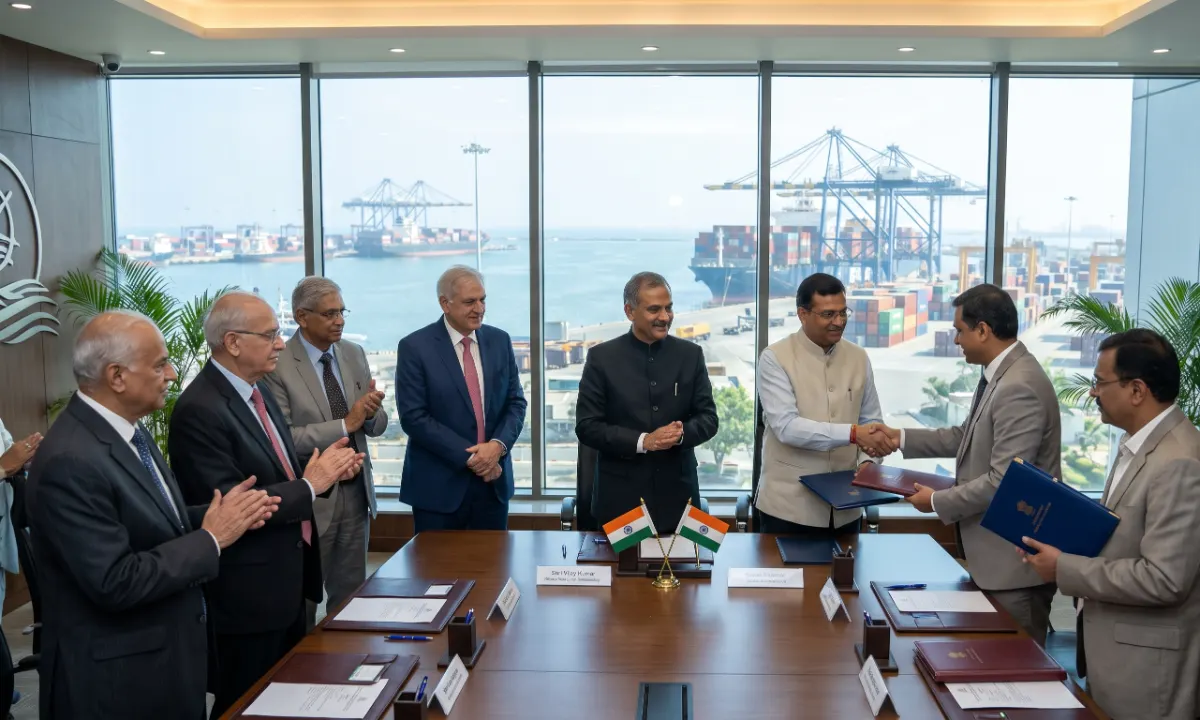
The three MoUs were exchanged in the presence of Shri Vijay Kumar, IAS, Secretary of the Ministry of Ports, Shipping and Waterways, who visited Chennai Port Authority on November 13, 2026, to review the port’s operational performance and infrastructure development initiatives . The agreements represent a coordinated effort to diversify cargo streams, expand regional maritime connectivity, and strengthen multimodal logistics linkages between maritime, road, and rail networks .
The first agreement, signed with MinSotrans, is focused on promoting dry bulk cargo movement through Chennai Port. Under the port’s Non-Containerised Cargo Incentive Scheme, the partnership entails a commitment to handle approximately one million metric tonnes of dry bulk cargo over a three-year period . This arrangement is expected to contribute to steadier cargo volumes at the port, which has historically relied on a mix of container, bulk, and break-bulk traffic.
The second MoU, with TCI Seaways, will facilitate a proposed container shipping service connecting Chennai Port with Ranong Port on Thailand’s western seaboard under the BIMSTEC framework . The proposed service had been under discussion between TCI Seaways and Chennai Port officials since at least October 2026, when a delegation led by TCI Seaways President and CEO R. U. Singh met with Chennai Port Authority Chairman Sachin S. Kurve to explore the commercial viability of the route . The signing of the MoU moves the project from preliminary commercial discussions into a more formal phase of cooperation, though specific operational details such as vessel deployment, sailing frequency, and commencement date have not been disclosed .
The third agreement, with the Central Warehousing Corporation, focuses on improving railway connectivity and jointly promoting rail-bound container traffic through Chennai Port . Greater utilization of rail transportation is expected to improve cargo evacuation efficiency, facilitate smoother movement of containers between the port and inland markets, and support more efficient multimodal logistics operations . This aligns with broader policy objectives of reducing reliance on road transport for port-related cargo movement.
The signing ceremony was accompanied by a stakeholder consultation meeting involving representatives from shipping lines, container train operators, terminal operators, logistics companies, and trade associations . During the discussions, industry representatives raised several operational priorities, including the need for additional storage facilities, dedicated berths for iron ore fines, and accelerated development of the proposed Outer Harbour Project to meet future cargo requirements . Stakeholders also emphasized extending digitization initiatives to import operations, building on the port’s fully digitized container export processes .
Secretary Vijay Kumar also inspected key port facilities during his visit, including Jawahar Dock (East and West), EXIM sheds, the Marshalling Yard, EC Landing, internal road infrastructure, and Bharathi Dock-II. A tug ride to the proposed Outer Harbour Project area was also undertaken . These inspections reflect the ministry’s oversight role in reviewing port development and ensuring that infrastructure investments align with cargo growth projections.
From a strategic perspective, the three agreements reinforce Chennai Port’s position as a key maritime gateway on India’s eastern coast. The BIMSTEC container service to Ranong, if launched, would provide shippers with a direct connection between India’s east coast and Thailand’s western seaboard, potentially reducing reliance on transshipment through other regional hubs . The dry bulk commitment with MinSotrans provides volume visibility for the port’s non-containerized cargo operations, while the CWC partnership addresses the longstanding challenge of rail-based container evacuation.
The MoUs also reflect the broader policy thrust of India’s Act East Policy and BIMSTEC transport connectivity agenda. Port-level cooperation between Chennai and Ranong dates back to a sister-port agreement signed in November 2019 at the first BIMSTEC Ports’ Conclave, alongside similar agreements with Visakhapatnam and Kolkata . The current agreements build on that institutional foundation, translating policy-level cooperation into commercial arrangements with specific operational objectives. However, the absence of disclosed timelines, investment figures, or performance benchmarks suggests that the practical implementation of these initiatives will depend on further detailed planning and market response.