
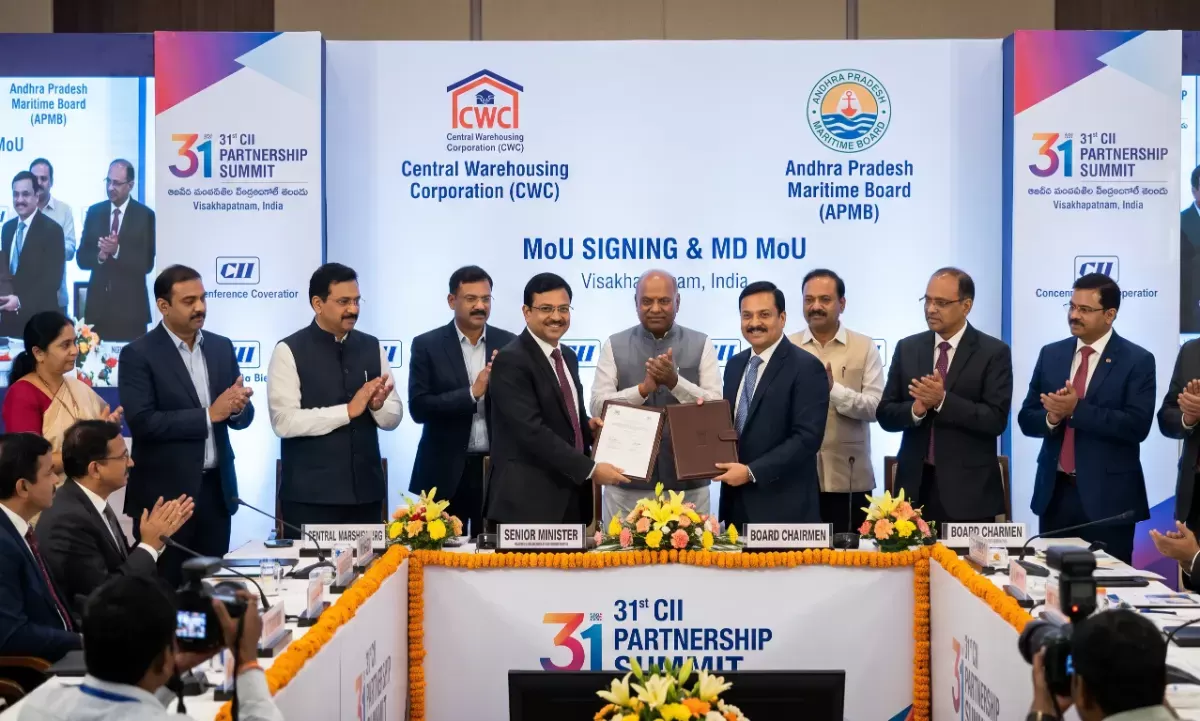
The agreement was exchanged at the 31st Confederation of Indian Industry (CII) Partnership Summit in Visakhapatnam, marking a significant step in strengthening port-led logistics infrastructure along India’s eastern coast. The MoU was signed on behalf of CWC by Sandeep Kumar Reddy Dodla, Regional Manager of the Amaravati Regional Office, and on behalf of APMB by Praveen Adhithya C.V., IAS, Chief Executive Officer. The exchange took place in the presence of Andhra Pradesh Minister B.C. Janardhan Reddy, APMB Chairman Damacharla Satyanarayana, CWC Executive Director B. Nirmal, and other senior officials .
The core objective of the collaboration is to create integrated logistics facilities that bridge the gap between inland production centers, warehousing operations, and port gateways. The proposed Multi-Modal Logistics Parks are designed to serve as consolidation and distribution hubs where shippers can store cargo, group smaller consignments for export, and transfer goods between road and rail modes. For importers, these facilities will enable the consolidation of onward deliveries from ports to manufacturing centers and other destinations, thereby streamlining the entire supply chain from vessel discharge to final delivery .
A critical aspect of the agreement is its alignment with Andhra Pradesh’s broader industrial development strategy. The state’s Industrial Development Policy for 2024–29 explicitly calls for logistics facilities positioned near manufacturing clusters to hold imported and domestically sourced raw materials closer to production sites. It also prioritizes road connectivity between freight rail corridors and existing and upcoming seaports. The CWC-APMB partnership directly supports these policy objectives by leveraging CWC’s nationwide warehousing network and APMB’s coordination role over the state’s port and coastal infrastructure .
The timing of the MoU reflects the growing cargo volumes moving through Andhra Pradesh’s maritime gateways. Visakhapatnam Port, one of the state’s established major ports along with Gangavaram and Krishnapatnam, handled a record 91.17 million tonnes of cargo in financial year 2025–26, representing approximately 10% growth over the previous year. This volume trajectory underscores the need for efficient inland logistics infrastructure to prevent port congestion and ensure smooth cargo evacuation. However, the MoU itself did not specify which gateways the proposed parks would serve, nor did it identify individual sites, transport links, handling capacities, investment commitments, or construction schedules .
From an operational standpoint, the partnership envisions multimodal logistics parks that can accommodate rail connectivity where available, enabling seamless transfer between rail and road transportation. This is particularly relevant for bulk and container cargo where rail offers cost advantages over long-haul road transport. Exporters using the parks would be able to concentrate cargo at a single facility before dispatch to port, potentially reducing handling costs and improving predictability of port arrivals. Similarly, importers could use the parks as inland depots to break bulk and stage deliveries based on production schedules rather than port storage constraints .
The signing ceremony took place at a high-profile industry event, signaling the commercial significance of the initiative. The CII Partnership Summit brought together government officials, industry leaders, and logistics stakeholders, providing a platform for the announcement. The presence of senior officials from both CWC and APMB, along with state ministerial representation, indicates institutional commitment to advancing the project beyond the MoU stage. However, the absence of specific timelines or investment figures suggests the partnership is still in an exploratory phase, with detailed feasibility studies and site selection likely to follow .
The MoU also reflects a broader trend in India’s logistics policy landscape, where multimodal logistics parks are being positioned as critical enablers of cost reduction and supply chain efficiency. By integrating warehousing with transport connectivity and port access, such facilities can address the fragmentation that has historically characterized India’s logistics sector. For Andhra Pradesh specifically, the initiative supports the state’s ambition to emerge as a leading logistics gateway on India’s eastern coast, competing with established corridors in Tamil Nadu and Maharashtra for cargo originating from or destined to the hinterland .