
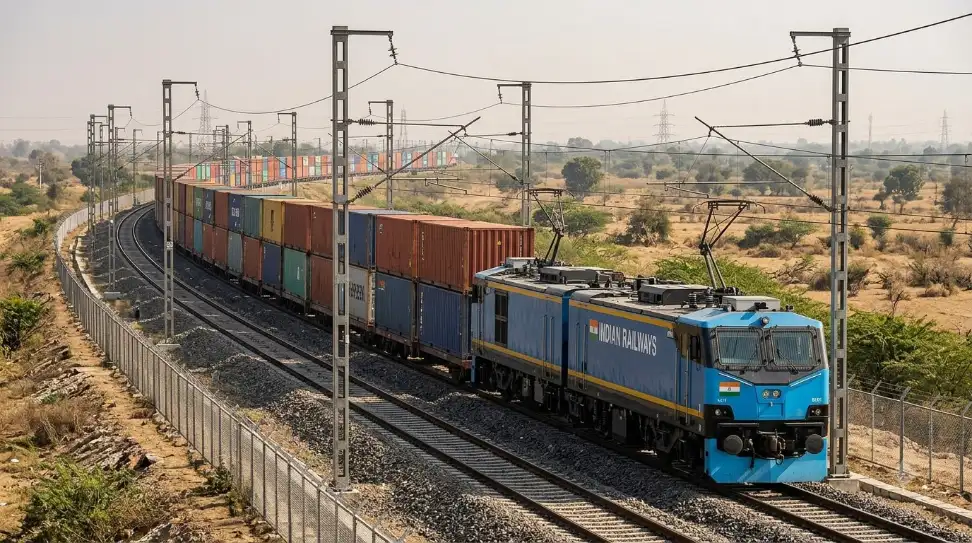
The Dedicated Freight Corridor Corporation of India has set a new single-day record for freight train interchanges, recording 951 handovers on 7 November 2026 across the Eastern and Western Dedicated Freight Corridors . The figure surpassed the previous benchmark of 946 interchanges set on 6 October 2026, and it reflects the growing operational intensity of the dedicated freight network as it matures.
An interchange is a train handover at a junction where a dedicated freight corridor meets the conventional Indian Railways network. Trains enter the corridor for the long-haul leg of a journey or leave it to reach terminals, yards, and other destinations . The interchange tally is therefore a measure of how effectively the dedicated corridors are integrating with the broader rail network, rather than simply counting trains that run entirely on DFC track.
The double-stack container performance provides the more commercially significant metric. DFCCIL operated 1,203 double-stack trains in October 2026, up from 944 in October 2025, an increase of 259 runs or 27.43% . Double-stack operations allow two tiers of containers to be carried on a single train, substantially increasing capacity per train and reducing the cost per container moved. The Western Dedicated Freight Corridor is the primary route for this type of operation, and its full commissioning has been the key enabler of the growth.
Average daily freight train movements across both corridors rose to 472 in October, compared with 385 a year earlier . That represents 87 additional movements per day, a 22.78% increase. This metric captures the overall utilisation of the corridor network, and the growth indicates that the DFCs are carrying a larger share of India's rail freight than they were a year ago.
The Eastern Corridor accounted for 516 of the 951 interchanges on 7 November, while the Western Corridor recorded 435 . The Eastern Dedicated Freight Corridor runs from Ludhiana in Punjab to Sonnagar in Bihar, serving the coal and steel belts of northern and eastern India. The Western Corridor connects Dadri in Uttar Pradesh with Jawaharlal Nehru Port in Maharashtra, and it is the primary route for container traffic between northern India and the west coast ports.
The record interchange figure comes as JNPA has commissioned two lines in its common rail yard to handle double-stack and long-haul freight trains of up to 1.5 kilometres . The port's rail report for 11 November recorded six double-stack rakes among the 15 rakes handled in the preceding 24 hours, showing how the corridor connects with container terminal operations at India's largest container gateway. The integration between the DFC network and port rail infrastructure is a critical determinant of whether the corridor's capacity translates into faster and cheaper cargo movement for exporters and importers.
For India's logistics sector, DFCCIL's performance illustrates the incremental but compounding benefits of the dedicated freight corridor programme. The corridors were designed to separate freight from passenger traffic, allowing faster and more reliable freight movement on the dedicated lines while freeing capacity on the conventional network for passenger services. The growth in double-stack operations and daily train movements suggests that those benefits are beginning to materialise at scale, even if the full potential of the network has not yet been realised.
Looking ahead, the key question is whether the interchange and double-stack growth can be sustained as the DFC network approaches full utilisation. The corridors have capacity headroom, but terminal capacity, rolling stock availability, and last-mile connectivity will determine how much of that headroom can be used. For now, the 951 interchanges and 1,203 double-stack trains provide concrete benchmarks: the dedicated freight corridors are carrying more freight, more efficiently, than at any point in their operational history.