
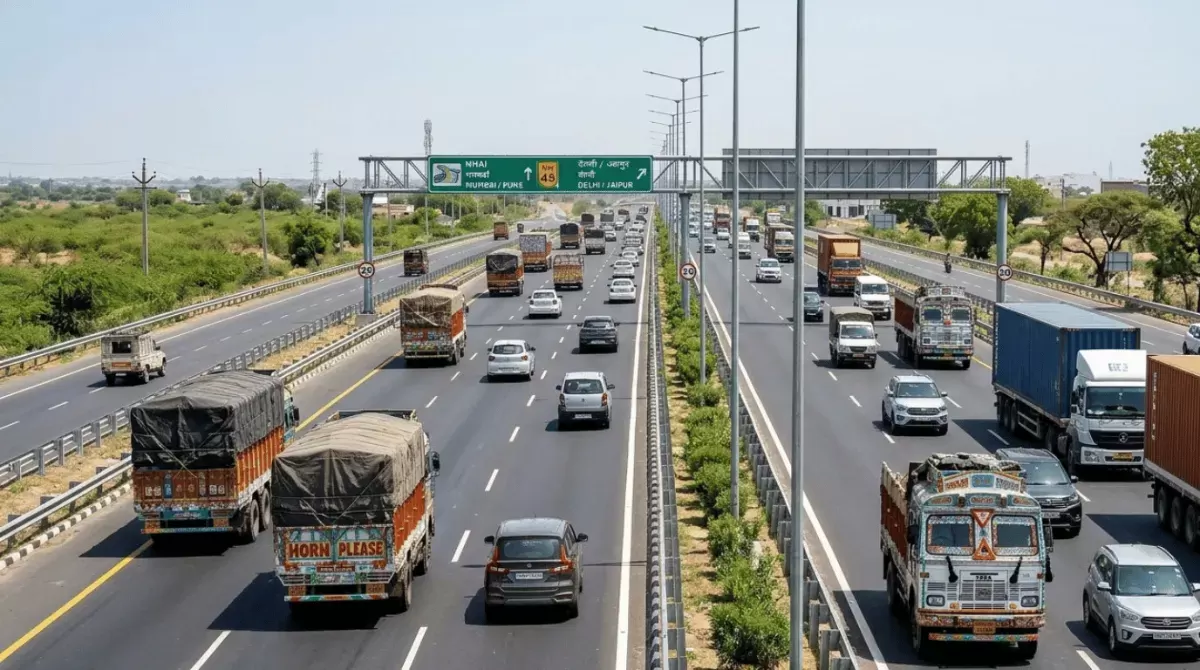
Union Minister for Road Transport and Highways Nitin Gadkari has said that India's logistics cost has declined to around 9% of GDP, a significant reduction from the previously estimated level of approximately 16% . Speaking at the 31st CII Partnership Summit 2026 in Visakhapatnam on 13 November 2026, Gadkari cited studies conducted by IIM Bengaluru and IIT Kanpur around six months ago that found India's logistics cost had declined by 6–10 percentage points, and he said the current level could be considered at around 9% .
The claim is notable because logistics cost is a key determinant of export competitiveness. Higher logistics costs make Indian goods more expensive in international markets relative to competitors from countries with more efficient transport networks. A reduction from 16% to 9% would represent a substantial improvement in the cost structure of moving goods within India and to ports and borders, potentially narrowing the gap with developed economies where logistics costs typically range from 8% to 10% of GDP.
Gadkari attributed the decline primarily to road infrastructure improvements. He said India now has the world's largest highway network, with construction progressing at an unprecedented pace . The minister has previously linked logistics cost reduction to the government's infrastructure push, and the IIM and IIT studies provide an academic validation of the claim, though the methodology and the precise scope of what is included in the logistics cost calculation are not detailed in the report.
The timing of the statement aligns with the broader narrative of India's export performance. October 2026 recorded all-time high exports of nearly $90 billion, and the government has set a $1 trillion annual export target. If logistics costs have genuinely declined, that would support the competitiveness of Indian exports and help explain the resilience of export growth despite global shipping disruptions and elevated freight rates. However, the relationship between domestic logistics costs and international freight costs is complex: even if moving goods within India becomes cheaper, the ocean freight and port handling components of export costs are determined by global market conditions that India cannot control.
Gadkari also outlined several major highway projects that are intended to further reduce logistics costs. The Bengaluru–Kadapa–Vijayawada corridor is 70% complete and expected to be operational by December 2027. The ₹16,000-crore Raipur–Visakhapatnam economic corridor has achieved 96% completion and is expected to reduce travel time between the two cities from 13 hours to around five hours. A ₹45,000-crore, approximately 1,000-kilometre corridor connecting Surat through Nashik, Ahmednagar, and Kurnool is expected to reduce travel distance by 300 kilometres and cut travel time from 31 hours to around 17 hours .
For India's logistics sector, the logistics cost claim is significant but requires cautious interpretation. The 9% figure is lower than many previous estimates, and if accurate, it represents a meaningful improvement. However, logistics cost measurement is contested, with different studies using different methodologies and scope. The government has an interest in presenting a favourable figure, and the IIM and IIT studies were commissioned by the government. Independent verification of the 9% figure would strengthen the claim, but for now it provides a benchmark against which future progress can be measured.
Looking ahead, the key question is whether the decline in logistics costs can be sustained and extended as the remaining highway projects are completed. The corridors under development in Andhra Pradesh and the north-south link are intended to further improve connectivity and reduce transport times. If they deliver the expected savings, India's logistics cost could decline further, strengthening the competitiveness of Indian exports and supporting the government's broader economic ambitions. For now, Gadkari's statement provides a policy claim that connects infrastructure investment to trade outcomes, and the academic studies he cited provide a basis for taking the claim seriously even as its precise measurement remains open to debate.