
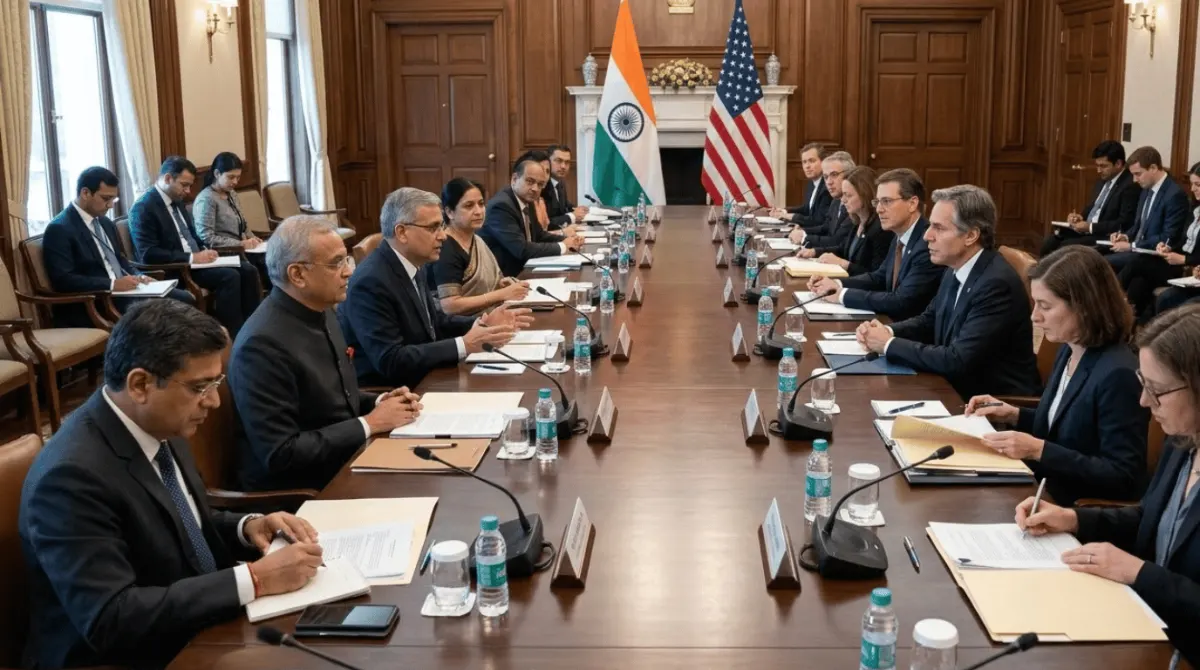
External Affairs Minister S. Jaishankar has said that India and the United States have resolved the bulk of the issues in their proposed bilateral trade deal, including detailed discussions on individual tariff lines, and that the agreement is now at the "finishing line" . Speaking at an interactive session on 14 November 2026, Jaishankar framed the progress in terms of the painstaking nature of the negotiations: "If you are serious, you go tariff line by tariff line. That takes time. Now we've done it the painstaking way. Not everybody has had the patience or frankly the understanding to bear with it" .
The minister's assessment suggests that the deal is closer to conclusion than at any point since negotiations began in early 2025. He said most issues had been sorted out, but some concerns remained, with several of them arising from the American side . "The hope is that we should close it out soon. It's always the case that in that last period, everybody's impatient," he said .
The timing of the statement is significant. Prime Minister Narendra Modi is likely to visit the United States for the G20 Summit in Miami on 14–15 December, and he and US President Donald Trump are expected to have an opportunity to discuss the trade agreement on the sidelines . There has been speculation that the two countries could announce the deal following a meeting between the leaders .
Jaishankar framed India's objectives in the negotiations in terms of comparative advantage rather than absolute gains. "For us the key is that we want a trade deal which is beneficial, it is balanced and which would give us a comparative advantage over groups of comparable economies," he said . This reflects India's concern that the deal should not simply match the terms that competitor economies have secured, but should improve India's relative position in the US market.
The background to the negotiations includes a period of tension in India-US relations. Washington imposed punitive tariffs on Indian goods in 2025, and ties were further complicated by Trump's claim that he had helped de-escalate the India-Pakistan military conflict in May 2025, a claim that drew sharp reactions from Indian officials . The trade deal is intended to resolve the tariff-related differences that have weighed on bilateral trade and to establish a more predictable framework for market access.
For India's export logistics sector, the conclusion of a trade deal with the United States would have direct implications. The US is India's largest export destination, with goods shipments rising 14.5% year-on-year to $59.52 billion in April–October 2026 . A deal that reduces tariff barriers would support continued growth in Indian exports to the US, translating into higher cargo volumes across ports, airports, and inland logistics networks. It would also reduce the uncertainty that has surrounded India-US trade since the tariff impositions of 2025.
The timing of the deal's potential announcement, if it coincides with the G20 Summit in December, would align with the government's broader trade policy momentum. India has implemented trade deals with the UK and New Zealand this year, and a landmark agreement with the European Union is expected to be implemented early next year . A US deal would add the largest market to this network, and it would complete a year in which India has substantially expanded its preferential trade access.
Looking ahead, the key milestone is the G20 Summit in Miami on 14–15 December, where Modi and Trump may have the opportunity to finalise and announce the agreement. Jaishankar's statement that the deal is at the "finishing line" suggests that the remaining issues are narrow, but the history of the negotiations counsels caution about predicting a specific timeline. For now, the minister's remarks signal that both sides are committed to concluding the agreement, and that the painstaking work of tariff-line negotiations has brought it close to completion.