
India's exports recorded their highest-ever monthly performance in October 2026, with total outbound shipments of merchandise and services reaching $89.99 billion, a 29.9% increase over October 2025 . The data, released by the Commerce Ministry on 13 November, confirms the export momentum that Commerce Minister Piyush Goyal had signalled earlier in the week, and it positions India on track toward its $1 trillion annual export target for the fiscal year.
The merchandise export performance was particularly striking. Goods exports rose to $49.47 billion, surpassing the previous monthly record and registering a 45.06% year-on-year increase . Commerce Secretary Rajesh Agrawal noted that this was the highest-ever monthly merchandise export value recorded by India, alongside the highest monthly growth rate in the past five years . The growth was broad-based, with 43 of India's top 50 export destinations recording positive growth in October.
Five sectors accounted for the bulk of the merchandise surge. Engineering goods exports rose 36% to $12.74 billion, petroleum products surged 140.2% to $8.89 billion, electronic goods increased 62.7% to $6.64 billion, gems and jewellery grew 40.06% to $3.21 billion, and organic and inorganic chemicals rose 36.2% to $2.89 billion . Together, these five sectors accounted for 83% of the incremental merchandise export growth, reflecting both higher global commodity prices and volume expansion in key categories.
The import side of the ledger presents a more complex picture. Merchandise imports rose to $89.35 billion, up 16.5% year-on-year, driven by crude oil (up 54% to $22.8 billion) and electronics (up 50% to $14.2 billion) . The resulting merchandise trade deficit of $39.88 billion was the highest in a year and exceeded economist expectations, reflecting the pressure of higher import costs on India's external balance.
The services sector provided a crucial offset. Services exports were estimated at $40.51 billion in October, up from $35.17 billion a year earlier, and the services trade surplus helped narrow the overall trade deficit to $20.09 billion from $25.15 billion in October 2025 . This divergence between the merchandise and overall trade balances underscores the importance of services exports in India's external position, particularly as goods imports remain elevated due to energy and electronics demand.
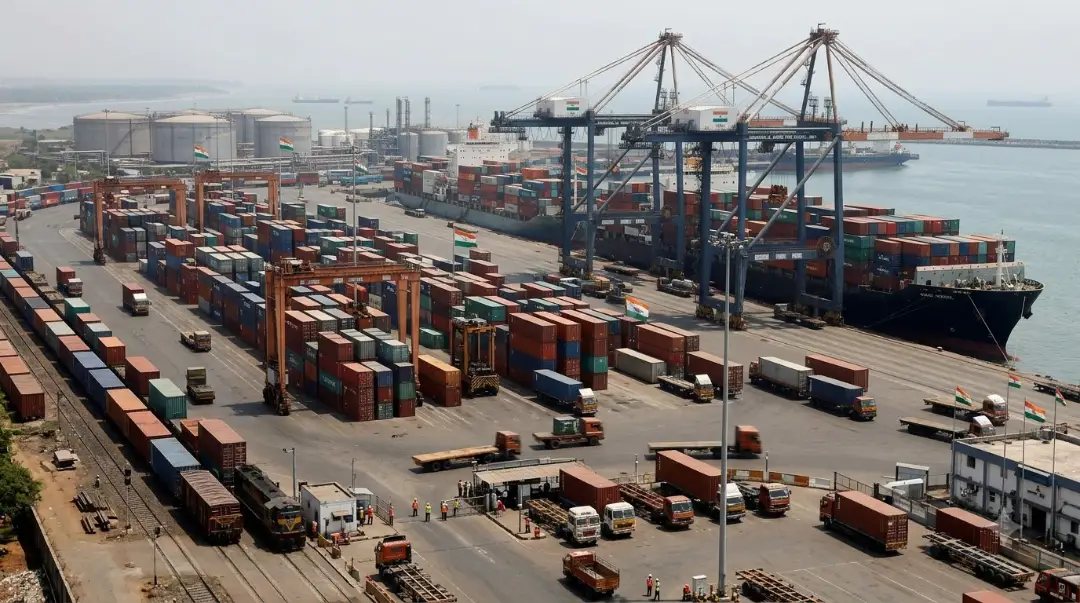
For India's trade logistics sector, the October data translates into specific cargo flows. The surge in petroleum product exports reflects the elevated refining margins that Indian refiners have enjoyed during the global energy disruption, and it means increased tanker movements from Indian ports. The electronics export growth, while partly price-driven, adds air and container cargo volumes. The engineering goods expansion supports the container and breakbulk trades that move machinery and components. On the import side, the crude oil and electronics volumes represent the inbound flows that Indian ports and airports handle, and the higher values reflect both volume and price effects.
The record export figure comes amid a challenging global environment. The Hormuz crisis, Red Sea security concerns, and elevated freight rates have disrupted shipping throughout 2026, yet India's exports have continued to grow. The diversification of export destinations, with strong growth to the US (39.25%), Spain (352.07%), Singapore (139.1%), Malaysia (280.72%), and China (48.15%), has provided resilience against disruptions in any single market . The government's focus on free trade agreements and export promotion schemes has supported this diversification.
Looking ahead, the sustainability of India's export momentum will depend on whether the drivers of October's growth persist. Petroleum product exports are tied to global refining economics, which could shift if crude prices or product cracks change. Electronics exports reflect both genuine capacity expansion and price effects. The merchandise trade deficit, meanwhile, is a reminder that import dependence for energy and components remains a structural feature of India's economy, and the overall trade balance depends on services continuing to offset the goods gap. For now, the October data provides a concrete benchmark: $89.99 billion in total exports, $49.47 billion in merchandise, and a record monthly performance that supports the government's confidence in reaching the $1 trillion target.