
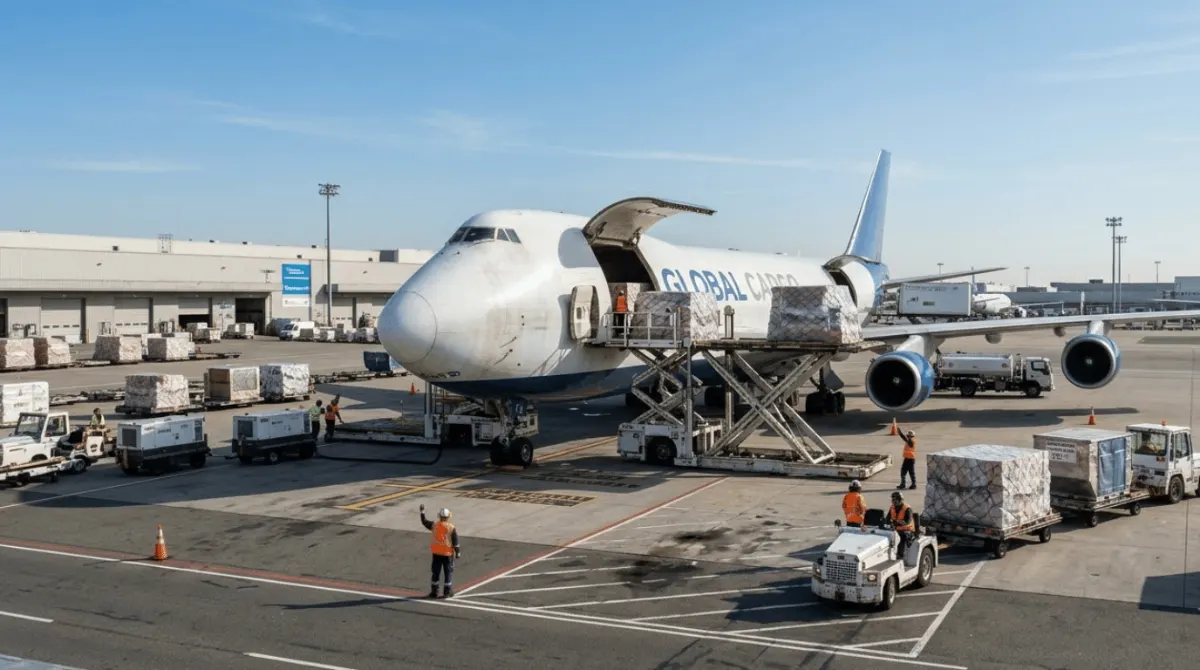
Jiaxing Nanhu Airport has opened a direct all-cargo route to Bangalore, the first from Zhejiang province to southern India, with a Capital Airlines A330-200P2F freighter departing on 13 November 2026 carrying 58 tonnes of general cargo . The shipment included fabric rolls, yarn, and solar chips, reflecting the industrial profile of the Yangtze River Delta's export base and the demand for faster connectivity to India's technology and manufacturing hub.
The route follows the Jiaxing–Delhi service launched on 6 November by Suparna Airlines using a Boeing 777F, which carried nearly 100 tonnes of auto parts and textiles . Within a single week, Jiaxing has established two Indian destinations—Delhi in the north and Bangalore in the south—covering the country's two major economic belts and filling a longstanding gap in direct freighter connectivity between Zhejiang and India . The airport now operates 10 international cargo routes, including Dhaka, Tokyo, and Osaka, building a network that radiates across Asia.
The time savings are the route's primary competitive advantage. Before the direct flights, cargo from Zhejiang to India typically transited through Shanghai, Hong Kong, or Singapore, with total transit times of 20–30 hours . The Jiaxing–Bangalore flight covers approximately 4,700 kilometers in about six hours, enabling same-day delivery for time-sensitive goods such as fresh produce, pharmaceuticals, and electronic components . This reduction in transit time lowers logistics costs and improves supply chain stability for exporters in the Yangtze River Delta.
Bangalore's role as a destination explains the route's commercial logic. As the capital of Karnataka and India's "Silicon Valley," the city hosts electronics manufacturing, aerospace, biopharmaceuticals, and information technology industries, making it a key node in global aviation supply chains . The route is structured as a round-trip service, allowing Indian goods to access the Chinese market through Jiaxing, though the return cargo mix has not been disclosed.
Jiaxing's customs authorities have adapted their procedures to support the new service. The airport's nighttime flight schedule required the implementation of appointment-based customs clearance and inspection mechanisms, alongside smart inspection technologies including intelligent image review and robotic patrols, to compress clearance times while maintaining oversight . These measures are intended to ensure that the airport's freight-first design translates into operational speed for shippers.
For Indian exporters and importers, the new route adds direct air cargo capacity between India and China, complementing the maritime and overland corridors that have faced disruption. While the primary flow is China-origin cargo to India, the round-trip structure creates a channel for Indian goods to reach Chinese markets without transiting through Southeast Asian hubs. The route also reflects the broader growth of India–China air cargo connectivity, which has expanded as shippers seek alternatives to volatile ocean freight.
Looking ahead, the sustainability of the Jiaxing–Bangalore service will depend on cargo uptake in both directions and the airport's ability to maintain schedule reliability. The airport has not disclosed the frequency of the new route or the expected annual volume, and the commercial viability will depend on whether Zhejiang's exporters adopt the direct option at sufficient scale. For now, the launch marks another step in the expansion of China–India air cargo links, and it provides shippers with a faster alternative for time-sensitive cargo that cannot tolerate the 20–30 hour transit times of the previous routing.