
The approval of the commission's composition provides an institutional framework for advancing cooperation between the two countries across energy, trade, transport, and industry. The resolution was signed with the stated aim of "further expanding cooperation and significantly strengthening bilateral economic relations" between Turkmenistan and Pakistan. The commission had been in preparation for months, with preparatory discussions held on the sidelines of UN events in May 2026.
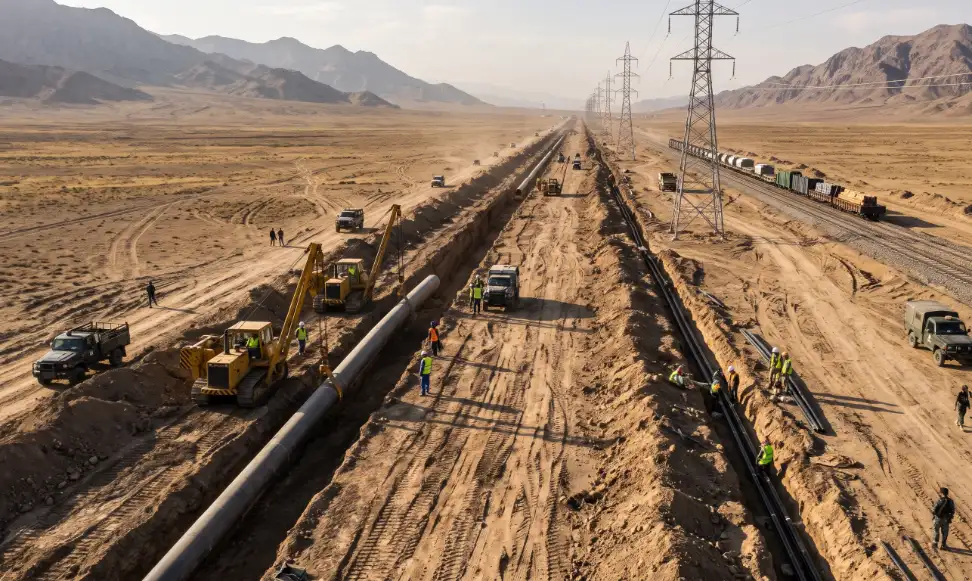
Energy cooperation remains the cornerstone of the relationship. The Turkmenistan-Afghanistan-Pakistan-India (TAPI) gas pipeline is designed to transport natural gas from Turkmenistan's Galkynysh field—with reserves estimated at approximately 27 trillion cubic meters—to markets in South Asia. In late October 2026, the TAPI Pipeline Company announced that the pipeline had reached the outskirts of Herat in Afghanistan, with approximately 124 kilometers of pipe welded and laid, accounting for roughly 80 percent of the Serhetabat-Herat section. Commissioning of this first Afghan section is targeted for the end of 2026.
The regional context has injected new urgency into the project. The disruption of the Strait of Hormuz amid the Iran war has revived Pakistan's interest in alternative energy supply routes. Pakistan's Ambassador to Turkmenistan, Faryal Leghari, stated at an energy forum in Ashgabat that Islamabad is now "committed" to advancing the pipeline. Turkmenistan's Ambassador to Pakistan, Atajan Movlamov, has expressed expectations that conditions will be created to begin natural gas supplies to Pakistan through TAPI in 2027.
Beyond gas, the corridor encompasses broader logistics and connectivity infrastructure. A 1,635-kilometer fiber-optic communication line is planned along the pipeline route through Afghanistan and Pakistan, intended to provide high-capacity telecommunications connectivity with transmission capacity of up to 100 Gbps. The Turkmenistan-Afghanistan-Pakistan (TAP) electricity transmission project is designed to supply power to the pipeline and associated facilities while creating opportunities to export up to 3,000 megawatts of electricity through Afghanistan to Pakistan.
For Pakistan, the strategic calculus extends beyond energy security. Federal Minister for Commerce Jam Kamal Khan has emphasized Pakistan's geographic position as a natural gateway connecting Central Asia with regional and international markets through its seaports. Discussions between the two sides have focused on expanding trade routes, facilitating smoother movement of goods, and enhancing direct engagement between business communities. The joint commission is expected to advance these objectives by providing a structured mechanism for resolving trade and transit issues.
Rail connectivity forms another component of the corridor strategy. Construction began in September 2024 on the Turgundi-Sanabar section of the first phase of the Turgundi-Herat railway, which would link into the broader Turkmenistan-Afghanistan-Pakistan transport network. The TAPI Pipeline Company has emphasized that coordinating plans for energy and railway infrastructure development will help reduce costs, enhance corridor security, and accelerate overall infrastructure development.
However, significant challenges persist. The TAPI project's estimated cost of up to $10 billion raises questions about financing, with analysts suggesting that Chinese financial support may be necessary given Turkmenistan's limited capacity to fund the entire pipeline alone. Construction through Afghan territory faces practical difficulties, including unexploded ordnance along the route, and work is being carried out exclusively by Turkmen engineers and equipment with Afghan involvement limited to security personnel.
For the logistics sector, the joint commission's formalization signals that Turkmenistan and Pakistan are institutionalizing their connectivity agenda rather than pursuing ad hoc projects. If the TAPI corridor materializes alongside the fiber-optic and power transmission components, it would create a multi-utility infrastructure spine running from Central Asia through Afghanistan to Pakistan's ports, potentially reshaping trade flows between landlocked Central Asia and South Asian maritime gateways. The coming months will reveal whether the commission can translate institutional arrangements into tangible progress on financing, construction timelines, and the cross-border regulatory harmonization required for the corridor to function as an integrated logistics route.