
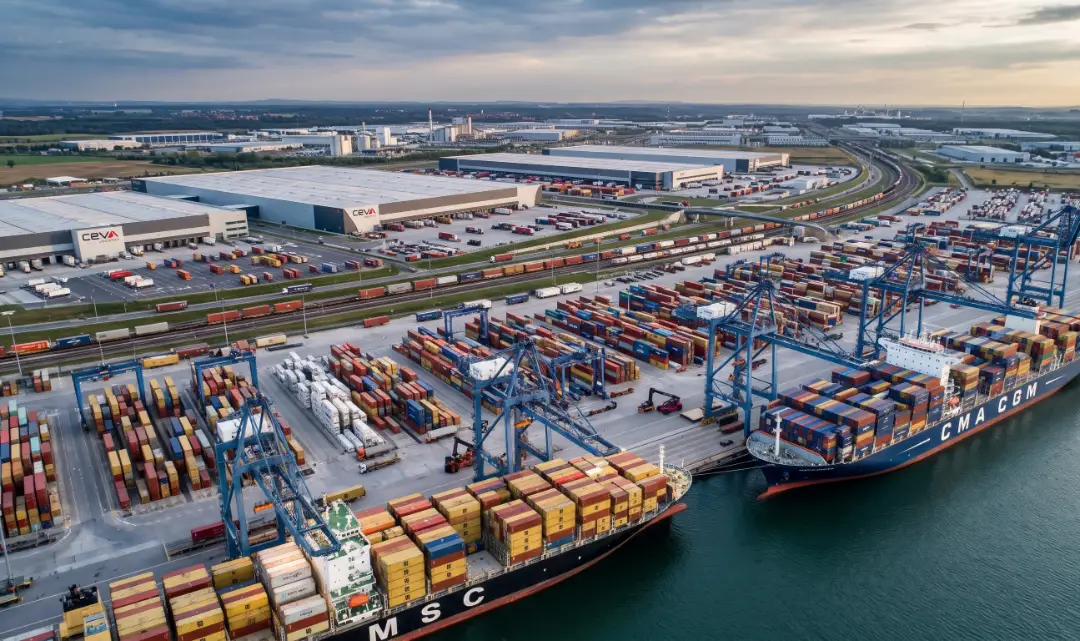
CMA CGM's FedEx Supply Chain acquisition represents the most concrete manifestation of this strategy. The deal, announced on 1 July 2026 and completed on 1 October, added approximately 34 million square feet of warehouse space to CEVA Logistics, expanding its North American presence to more than 240 locations. Beyond the asset transfer, CMA CGM and FedEx entered into multi-year commercial agreements under which CMA CGM becomes FedEx's preferred ocean carrier on a non-exclusive basis, while the two companies collaborate on air cargo capacity on key routes including Asia-Europe. Industry analysis suggests this arrangement could generate nearly $3.5 billion in additional revenue for CMA CGM over ten years.
Maersk has pursued a parallel but distinct path. In April 2026, the Danish group acquired a major digital freight forwarding and logistics platform, integrating its booking, tracking, and customs clearance technologies into Maersk's existing ecosystem. This acquisition aligns with Maersk's long-stated ambition to become a comprehensive end-to-end logistics provider, offering seamless digital experiences across the supply chain. The move also reflects the broader industry trend of consolidation and digitalization, where control over customer interfaces and data flows becomes as strategically important as physical assets.
MSC, the world's largest container line by capacity, has focused its expansion on terminal infrastructure. In May-June 2026, MSC finalized a deal to acquire a 51% stake in Ukraine's TIS container terminal at Pivdennyi Port, marking the first time a global container line has directly entered the capital of a Ukrainian container terminal. MSC operates approximately 1,000 vessels with total capacity of about 7 million TEU, representing roughly 21.4% of global container capacity, and continues to invest in port infrastructure and inland logistics networks across rail and air transport.
The strategic logic behind these acquisitions extends beyond simple revenue diversification. As ocean shipping remains cyclical and vulnerable to geopolitical disruptions—as demonstrated by the ongoing Strait of Hormuz crisis—carriers are seeking more stable, recurring revenue streams from contract logistics, warehousing, and value-added services. Controlling warehouses and distribution networks allows carriers to capture a larger share of the total logistics spend, rather than ceding margin to independent freight forwarders and third-party logistics providers.
Competition for logistics assets has intensified accordingly. CMA CGM's CFO stated in 2026 that the company was "very interested" in participating in the sale of CK Hutchison's port assets, a portfolio valued at approximately $28 billion that includes 43 terminals globally. While MSC was part of the original BlackRock-led consortium bidding for those assets, the exclusivity agreement expired, opening the door for competing bids. CMA CGM currently operates 65 port terminals and sees the CK Hutchison deal as significant for the entire industry.
The implications for shippers are mixed. On one hand, integrated carriers can offer simplified, single-contract solutions covering ocean freight, port handling, warehousing, and final delivery. On the other hand, consolidation reduces the number of independent service providers and may increase carriers' pricing power. The trend also raises questions about neutrality: when a carrier owns the warehouse and controls the data, how much leverage do shippers retain in negotiating rates and service terms?
For the logistics sector, this land grab represents a structural shift in industry boundaries. The traditional division of labor—carriers moving cargo between ports, forwarders arranging documentation and coordination, and warehouses storing goods—is blurring. Carriers are vertically integrating into forwarder and warehousing territory, while logistics companies like FedEx are divesting non-core assets to focus on high-value verticals such as healthcare, automotive, aerospace, and data centers. The result is a more consolidated, capital-intensive competitive landscape in which scale and network density determine who captures the most value from global trade flows.