
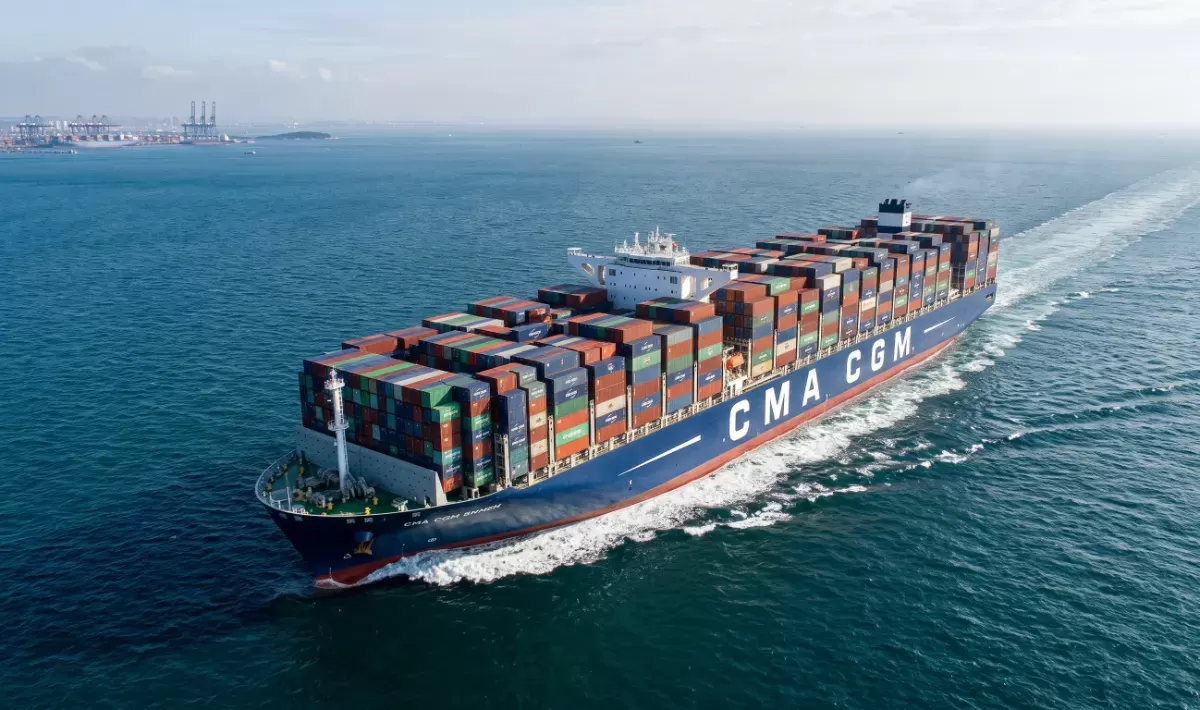
CMA CGM's Q3 performance was primarily driven by the shipping division, which generated revenue of $12.3 billion (up 37.3%) and EBITDA of $4 billion (up from $2.2 billion in the same period last year), with an EBITDA margin expanding 7.5 percentage points to 32.4%. This margin level exceeded Maersk's 29.4% and Hapag-Lloyd's 24.9% for the same period, reflecting CMA CGM's stronger freight rate capture capability amid Middle East route disruptions . The group attributed the volume growth to three factors: corporate inventory replenishment, increased investment in AI-related infrastructure and data centers, and robust demand for clean technology and electric vehicles in China .
In contrast, the logistics division presented a "revenue growth without profit growth" picture. Revenue rose 19.2% to $5.46 billion, supported by organic growth and the consolidation effect of the FedEx Supply Chain acquisition, but EBITDA declined 14.4% to $366 million, with margin narrowing 2.6 percentage points to 6.7%. The group attributed this to intense competition in the freight forwarding market and continued weakness in the automotive industry . This divergence highlights the uneven profitability across different business segments under CMA CGM's integrated logistics strategy.
The ranking goal has concrete fleet data supporting it. As of early November, Maersk's fleet capacity was approximately 4.71 million TEUs, while CMA CGM's was approximately 4.48 million TEUs, with a gap of about 230,000 TEUs. Linerlytica's estimate places the gap at just 150,000 TEUs and predicts CMA CGM could overtake Maersk in 2027. CMA CGM added 235,500 TEUs of capacity in the first half of 2026, the highest growth rate (5.7%) among the top ten liner companies, with an orderbook of approximately 1.5 million TEUs, including twelve 24,000 TEU and over thirty 19,000 TEU LNG-powered vessels .
The strategic divergence between the two companies is noteworthy. Maersk has prioritized vertical integration as a "global logistics integrator" in recent years and was relatively restrained in fleet expansion, but ordered 26 18,600 TEU dual-fuel vessels in September 2026, with deliveries scheduled for 2029-2030, too late to affect the 2027 ranking change. Analysts at Linerlytica noted that "Maersk's decline in the rankings is entirely self-inflicted, having failed to pivot away from its logistics integrator strategy despite the significantly superior results of the ocean shipping business that rivals continue to capitalize on" .
For the logistics and shipping industry, CMA CGM's performance and expansion strategy signal that in an environment of sustained geopolitical disruption and elevated freight rates, scale expansion remains an effective path to profitability. The group's investments in terminal infrastructure—including Jeddah Terminal 4 and a 49% stake in Morocco's Nador Container Terminal—and the deployment of its eight-aircraft air cargo fleet, collectively constitute a vertically integrated network extending from maritime to land and air . If the goal of overtaking Maersk is achieved by the end of 2027, the global liner shipping landscape will shift from the long-standing "MSC-Maersk" duopoly to an "MSC-CMA CGM" new dual-leader structure, with profound implications for Asia-Europe route capacity allocation and freight rate dynamics.