
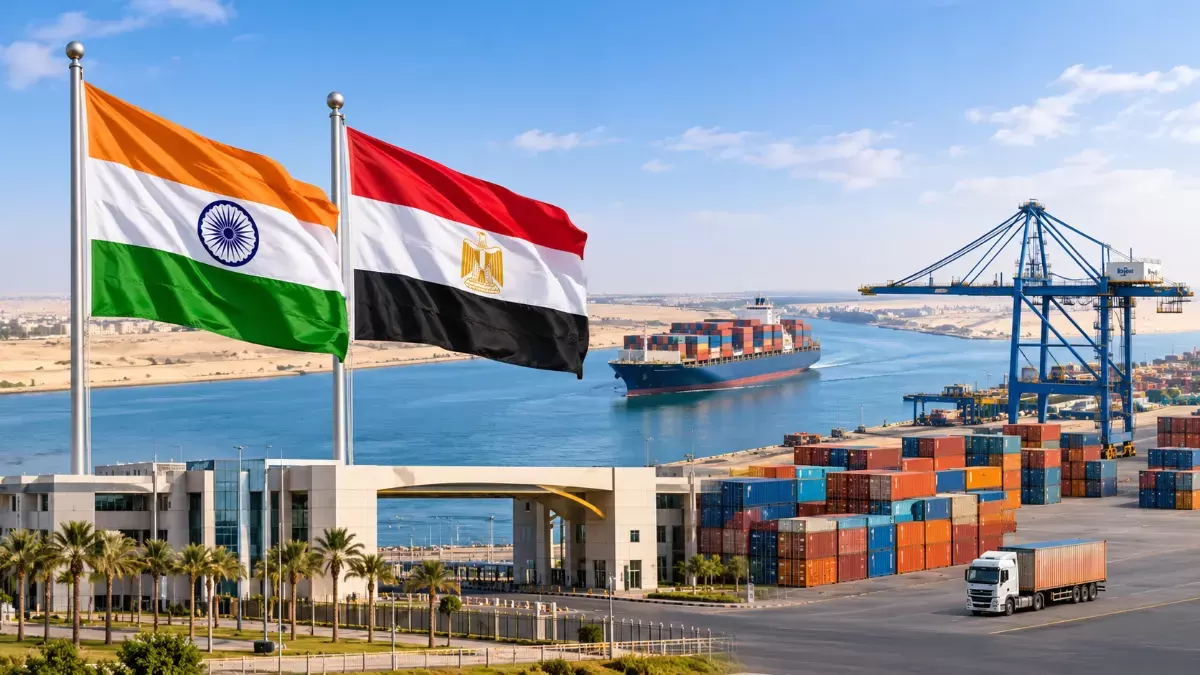
The seventh session of the India-Egypt Joint Trade Committee, co-chaired by Goyal and Egyptian Minister of Investment and Foreign Trade Mohamed Farid Saleh, places the Suez Canal Economic Zone at the center of discussions on industrial development, manufacturing, infrastructure, ports, and logistics. The official agenda explicitly lists "opportunities for cooperation in the Suez Canal Economic Zone" alongside regional value chains, signaling that both governments view the zone as a concrete platform for deeper economic integration rather than a symbolic gesture .
Egypt's pitch rests on a straightforward geographic proposition. President Abdel Fattah El-Sisi, in a September 2026 opinion piece published in The Economic Times, invited Indian companies to use Egypt as "a pivotal hub for global trade and value chains, as well as a regional center for energy transit, logistics, and connectivity." He specifically referenced the Suez Canal and its economic zone as the vehicle for this ambition, citing Egypt's port network and transport links as foundations for expanded trade .
The industrial zone proposal has been under discussion since at least August 2026, when Farid and Goyal met on the sidelines of the BRICS Trade Ministers' Meeting in Jaipur. At that meeting, Farid called for accelerating the implementation procedures for the Indian industrial zone within the SCZone, describing it as a mechanism to attract new Indian investment and increase Egyptian exports. The two sides also discussed cooperation in pharmaceutical manufacturing and fertilizer production .
Indian investment in the SCZone already has a measurable footprint. More than 70 Indian companies operate in Egypt with combined investments exceeding $5.5 billion, and Indian firms have invested over $175 million in the SCZone specifically. Indian companies operating in Egypt contribute more than $1 billion annually to Egyptian exports. The Ain Sokhna industrial area hosts multiple Indian enterprises, while the West Qantara industrial zone has signed its first Indian investment deal .
From a logistics perspective, the SCZone offers Indian exporters and manufacturers an alternative routing option at a time when Red Sea shipping disruptions have exposed the vulnerability of traditional Asia-Europe maritime corridors. The zone combines port access at Ain Sokhna and East Port Said with industrial incentives and proximity to three continents. For Indian companies seeking to build resilient supply chains, a manufacturing presence inside the SCZone could reduce dependence on transshipment through congested or contested chokepoints .
The business delegation accompanying Goyal reflects the breadth of Indian interest. The Joint Business Council meeting and Business Forum are designed to facilitate joint ventures, technology partnerships, and industrial collaboration across sectors including pharmaceuticals, automobiles, textiles, chemicals, engineering goods, renewable energy, and logistics. Goyal is also scheduled to meet with Afreximbank and participate in the Egypt-India Startups Forum, broadening the engagement beyond traditional trade to include export financing and technology ecosystem links .
Egypt's broader economic strategy provides context for the urgency behind the SCZone pitch. Cairo aims to increase trade with India to $12 billion within five years, up from approximately $4.18 billion in 2025. The government is targeting private-sector investment to reach 59% of total investments in fiscal year 2026/2027 and is seeking to raise manufacturing's share of GDP from 14% to 20% by 2030. Indian industrial investment aligns with these objectives by bringing capital, technology, and export-oriented production capacity .
For the logistics sector specifically, the outcome of this week's talks will determine whether the Indian industrial zone moves from proposal to implementation. If realized, it would create a dedicated node in the India-Middle East-Africa trade corridor, giving Indian manufacturers and logistics providers a physical base inside one of the world's most strategically located economic zones. The discussions also cover customs cooperation, transport and logistics, and services, suggesting that the intended cooperation extends beyond manufacturing into the connective infrastructure that moves goods between the zone and its target markets .